

26 July 2026
French Guiana fish gain a near-complete 12S library
A new 12S reference library covers almost 89% of French Guiana’s freshwater fish fauna, strengthening species identification in environmental DNA surveys.
- Sector
- Environment
- Animal groups
- Fish
- Content type
- Scientific news
- Keywords
- Environmental DNAPCRBiosecurity
Environmental DNA (eDNA) surveys do not identify fish from water alone. The recovered DNA fragments must be matched against trustworthy sequences from correctly identified specimens. A new mitochondrial 12S library now represents 369 of the 415 freshwater fish species considered for French Guiana. It closes a major reference gap in one of the world’s most diverse freshwater regions, while showing why marker choice, changing taxonomy and field design still determine what an eDNA inventory can legitimately report.
The reference gap behind an eDNA result
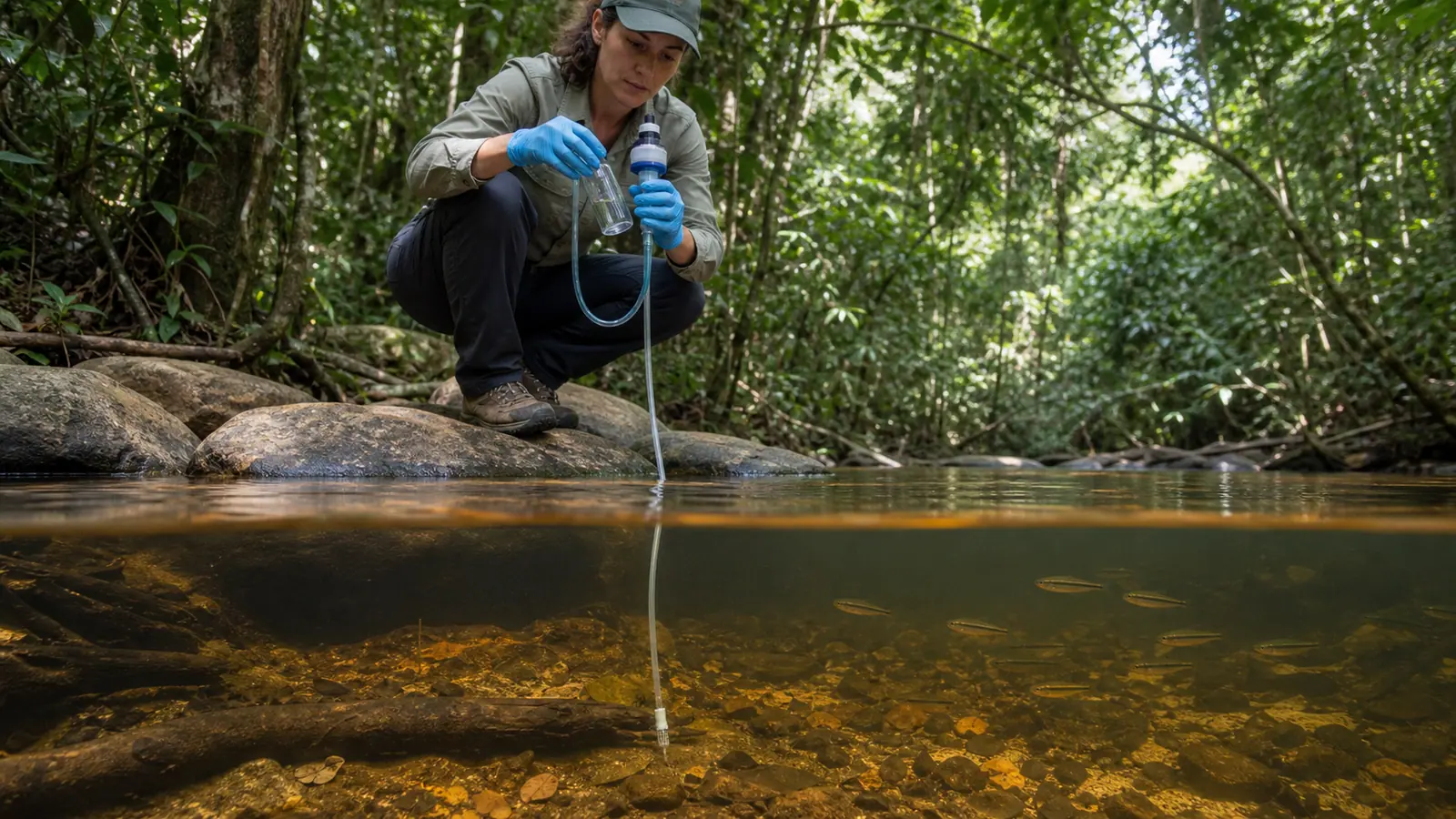
Fish release cells, mucus, faecal material and other biological traces into surrounding water. A survey can filter that water, extract DNA, amplify selected fragments through polymerase chain reaction (PCR), and sequence the resulting mixture. Metabarcoding software then compares those sequences with a reference library.
The final identification cannot be more reliable than that comparison resource. When an appropriate reference is missing, a sequence may remain unidentified or may only be assigned to a genus or family. Closely related species can also share the same short marker. This is particularly restrictive in tropical river systems, where high diversity, difficult access and incomplete taxonomic knowledge coincide.
Many global databases are richest for commercially important or emblematic species. Neotropical freshwater fish are comparatively under-represented despite an estimated regional fauna of roughly 6,300 species. Building a local library is therefore not a secondary laboratory exercise; it is part of the monitoring infrastructure.
Specimens, museum collections and 1,557 sequences
The open Data Descriptor published in Scientific Data contains 1,557 mitochondrial 12S sequences. Together they represent 369 species, 177 genera, 51 families and all 16 freshwater fish orders considered by the authors in French Guiana. The species set includes 295 formally described species and 74 putative species that still await formal binomial names.
Most references came from 1,439 specimens collected across all eight major Guianese river basins between 2008 and 2023. More than 25 field expeditions contributed material. DNA from another 118 specimens held by the Natural History Museum of Geneva added species that field collections had not captured.
Against the study’s working list of 415 species, the library reaches 88.92% coverage. It includes 51 of 52 families, 177 of 185 genera, 295 of 334 described species and 74 of 81 putative species. Multiple individuals were sequenced for nearly two-thirds of the species, helping represent some within-species variation rather than relying on a single specimen in every case.
Each record remains linked to specimen identity, taxonomy, river basin, holding institution and a GenBank accession. Identification was checked against known distribution and genetic distance trees. Sequences that clustered outside the expected species or genus were discarded as possible contamination or misidentification.
The records are publicly available through NCBI GenBank and the European Nucleotide Archive under BioProject PRJNA1399107, with a companion dataset on Figshare. That open structure is important for reproducibility: laboratories can record which reference version supported an assignment and revisit it when names or species boundaries change.
Teleo1 and 12S-V5 do not resolve the same taxa
The authors evaluated two commonly used 12S markers. Teleo1 assigned 1,480 of the 1,557 sequences to species level, a rate of 95.05%. The 12S-V5 fragment assigned 1,289 sequences, or 82.79%, to species level. Twenty-one species were never resolved to species level with Teleo1, compared with 51 for 12S-V5.
These figures do not establish a universally superior primer for every ecosystem or management question. Amplification bias, degraded DNA, the target community and laboratory conditions also matter. They do demonstrate that reports should name the marker used and state its expected taxonomic resolution.
When a sequence only supports genus-level assignment, selecting a species name because it appears likely would create false precision. Conversely, failure to detect a species is not proof of ecological absence. Water volume, replication, flow, season, DNA transport, degradation, inhibition and contamination controls all influence detection.
Earlier work in Guianese tropical streams and rivers has shown that sampling effort must be designed rather than assumed. A strong reference library solves one component of the workflow, but it cannot compensate for poorly distributed sampling or incomplete quality controls.
Broad coverage is not a permanent checklist
The denominator of 415 species includes 81 putative taxa. Fish taxonomy in Amazonian rivers continues to change as species are described, split or reassigned. The library will therefore require curation, and stored sequence data may need to be reinterpreted under future classifications.
For 53 species—14% of the represented fauna—the reference specimens came from neighbouring rivers in Suriname or the Brazilian section of the Oyapock basin because no suitable specimen from French Guiana was available. The occurrence of some of those species within French Guiana remains unconfirmed. Including them can enable future detection, but inclusion itself is not distribution evidence.
The resource also does not turn eDNA reads into direct measures of abundance, animal health, age or viability. DNA can be transported away from its source and may persist after an animal has moved. Read counts are shaped by biological shedding and technical amplification. Conventional observations, taxonomic expertise and habitat information remain valuable counterparts.
Practical implications for environmental monitoring
For environmental managers and consultancies, the library removes a substantial obstacle to fish metabarcoding in French Guiana. It can support biodiversity inventories, surveillance of elusive taxa and comparisons among catchments, especially where conventional capture is difficult or intrusive.
The strongest programmes start with the management question. They select a marker that fits the target taxa, use field and laboratory negative controls, incorporate replication, document hydrological conditions, and preserve the database version and assignment thresholds. Where a result could affect conservation decisions or impact assessment, an independent method may be needed to confirm a critical presence or absence.
The operational benefit is not simply a longer species list. It is a clearer boundary between what the molecular evidence supports, what remains probable, and what requires confirmation. That distinction matters in catchments facing deforestation, small-scale gold mining and other pressures, where monitoring outcomes may influence priorities and resources.
How Vetofish can support your programme
Vetofish can help aquatic-animal monitoring teams translate a management objective into a proportionate sampling plan, review biosafety and contamination controls, and interpret molecular detections alongside field observations and biological indicators. The aim is to make results useful without overstating taxonomic resolution, abundance or health implications that the method does not directly measure.
References
- Brosse, S., Cuenot, Y., Condachou, C. et al. (2026). “Near complete 12S DNA reference library for the freshwater fish of French Guiana, northern Amazonian region.” Scientific Data, 13, 408. https://doi.org/10.1038/s41597-026-06811-5
- National Center for Biotechnology Information. BioProject PRJNA1399107, “Near complete 12S DNA reference library for the freshwater fish of French Guiana.” https://www.ncbi.nlm.nih.gov/bioproject/PRJNA1399107
- Cantera, I., Cilleros, K., Valentini, A. et al. (2019). “Optimizing environmental DNA sampling effort for fish inventories in tropical streams and rivers.” Scientific Reports, 9, 3085. https://doi.org/10.1038/s41598-019-39399-5