

Health, disease and diagnosis
Recognise clinical signs, organise a diagnostic approach and select appropriate samples.
Bacterial, parasitic, viral, fungal and environment-related conditions.
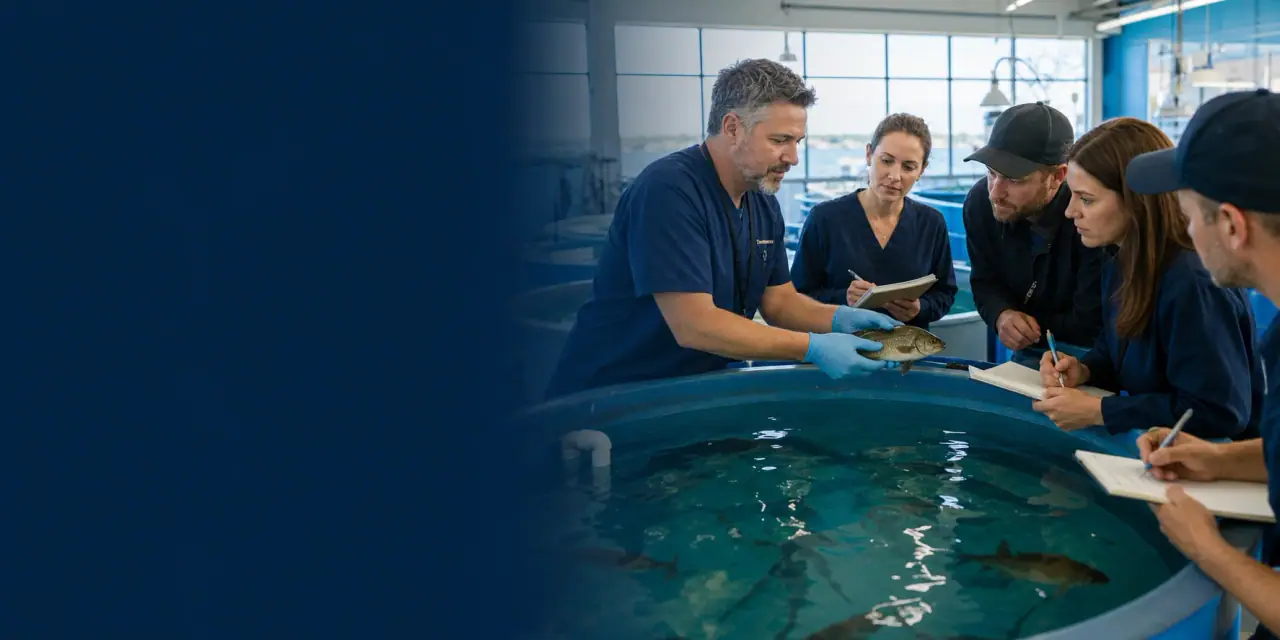
Practical and theoretical training in aquatic animal health, biosecurity and welfare, tailored to participants’ roles, species and facilities.
Each programme is designed around your context, species, facilities, participants’ experience and operational objectives.
Training may be delivered on site or remotely, as a full day, targeted module, technical session or longer programme.
Modules covering the key issues in aquatic-animal health.
Recognise clinical signs, organise a diagnostic approach and select appropriate samples.
Bacterial, parasitic, viral, fungal and environment-related conditions.
Limit the introduction and spread of pathogens through quarantine, flows, cleaning and disinfection.
Particularly relevant to multi-species and recirculating facilities.
Understand how physical and chemical parameters affect aquatic-animal health.
Connect clinical observations with housing conditions and risk factors.
Develop good practice in handling, restraint, anaesthesia, analgesia, euthanasia and sampling.
Content is adapted to farmed, laboratory and display species.
Improve housing, handling, monitoring and intervention practices.
Stress signs, welfare indicators, critical points and internal procedures.
Structure health monitoring, internal procedures, records and surveillance plans.
Aquaculture, research establishments, zoological facilities and public display.
Every aquatic facility has its own species, systems, health history, team organisation and regulatory constraints.
Identify participant roles, prior knowledge and expectations.
Review the facility context and the health or technical issues encountered.
Define the practical skills to acquire and the expected outcomes.
Adapt the programme, duration and delivery method to the facility’s constraints.
Vetofish provides specialist aquatic-animal-health training for professionals working in farming, public aquariums and research facilities.
Vetofish designs and delivers training for aquatic-animal professionals. Courses draw on our field experience in animal health, welfare, disease prevention, biosecurity, diagnosis and the management of issues encountered in aquaculture, public aquariums and research establishments.
Content can be tailored to your team’s needs, the species concerned and your facility’s constraints, through theoretical sessions, practical workshops or on-site training.
Some courses are organised in partnership with Animal Welfare Consulting , a training provider certified under Qualiopi for the “Training actions” category. In this framework, an application for funding may be submitted to your OPCO or another funding body, subject to your eligibility and its prior approval.

Training is intended for technical teams, animal-care staff, veterinarians, biologists, laboratory personnel, fish farmers and health or quality managers.
Content is adjusted from introductory level to advanced specialist training.
Yes. Programmes are adapted to species, facilities, participant roles, initial knowledge and the practical skills required.
Yes. On-site delivery can use the facility and its procedures as teaching material. Some theoretical modules can also be delivered remotely.
Yes, where facilities, regulations and animal-welfare considerations allow. Exercises may cover observation, sampling, water quality, biosecurity or case analysis.
This depends on the subject and practical content. Small groups are preferred for technical workshops, while theoretical modules may accommodate more participants.
Some courses can be organised within a framework compatible with French Qualiopi requirements. Eligibility for skills funding depends on the organisation and funder rules.
Let’s define the audience, objectives and most suitable format.
Explore the sectors where Vetofish adapts its veterinary expertise to each organisation.
Veterinary support for aquaculture facilities, combining prevention, diagnostics, biosecurity and health monitoring to control risks and protect stocks.
Veterinary support for public aquariums covering prevention, collection welfare, clinical care, biosecurity and practical guidance for animal-care teams.
Veterinary expertise for wild aquatic animals, supporting health surveillance, conservation, sampling programmes and environmental research.
Veterinary support for research facilities using aquatic animals, covering health monitoring, welfare, protocols and biosecurity within scientific programmes.


