

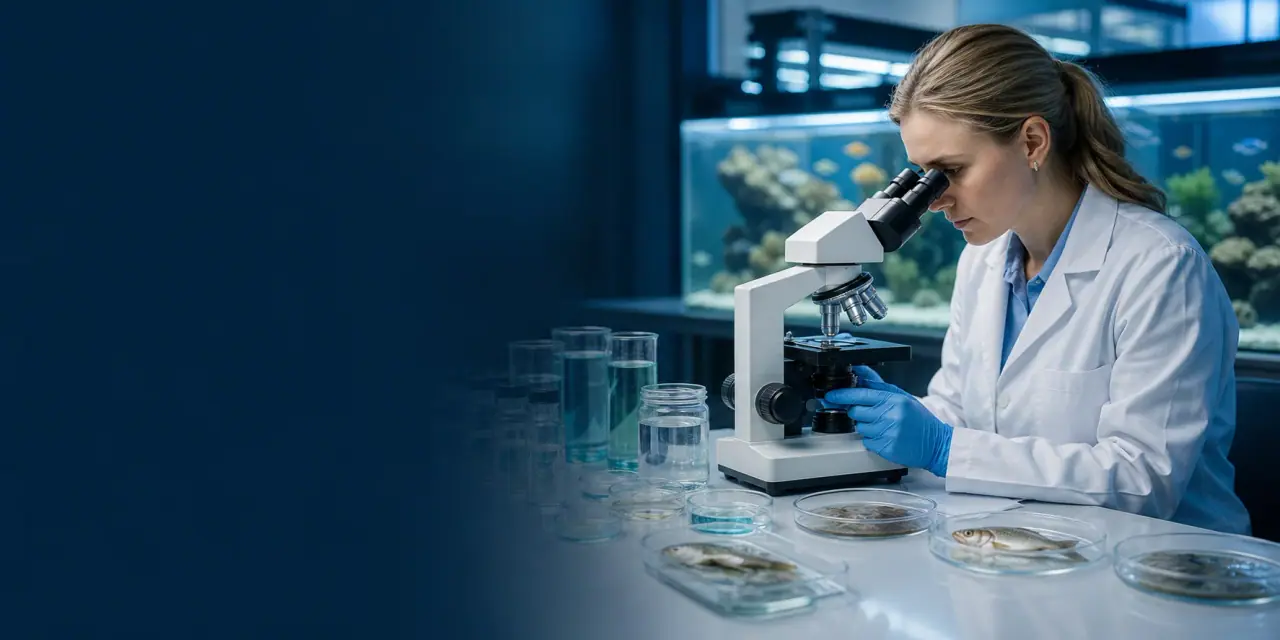
Relevant sampling
Select suitable animals, tissues, volumes and transport conditions for the diagnostic hypotheses.
Vetofish supports aquaculture, aquariums and laboratories with aquatic animal diagnosis through targeted sampling, testing and veterinary interpretation.
Expertise tailored to your situation, animals and facilities.
Select suitable animals, tissues, volumes and transport conditions for the diagnostic hypotheses.
Choose useful investigations while avoiding isolated results that are difficult to interpret.
Relate results to health history, clinical signs, species and environmental parameters.
A clear process from needs assessment to practical recommendations.
History, clinical signs and husbandry conditions.
Prioritisation of possible causes and urgent issues.
Sampling and testing suited to the situation.
Results summary and further recommendations.
Not every investigation is performed in the same place. Vetofish selects the method and laboratory according to the question, species, transport constraints, turnaround time and any accreditation requirements.
A structured examination of the animal to identify lesions, guide sampling and prioritise possible causes.
Best performed as soon as possible after death.Culture, isolation and identification of bacteria. Antimicrobial susceptibility testing may support treatment decisions when appropriate.
Skin, gills, kidney, spleen or other tissues depending on the case.Microscopic tissue examination to characterise lesions, assess severity and investigate infectious, inflammatory, degenerative or neoplastic causes.
Fixative selection and sample freshness are critical.Targeted detection of pathogens or confirmation of an identification through genetic material.
A highly sensitive technique that must be interpreted in context.Investigation of viral agents using methods suited to the species, suspected disease and sample type.
PCR, cell culture or another method depending on the agent.Observation, identification and, where relevant, quantification of external or internal parasites.
Direct examination, microscopy and targeted sampling.Assessment of blood cells and complementary tests to document general condition or systemic disease.
Particularly useful when sampling conditions are carefully controlled.Investigation of metals, pesticides, hydrocarbons, PCBs, PFAS or other contaminants in water, sediment or tissues.
Targeted testing based on suspected substances and required packaging.Physical, chemical and microbiological measurements interpreted in relation to animal health, husbandry systems and filtration.
Water is an integral part of the diagnostic process. Diagnosis becomes meaningful when results are interpreted in light of the clinical and environmental context.
Specimen selection, time since death, fixative, temperature, packaging and transport may alter a result or make a sample unusable.
Prompt examination, preservation status and organ selection determine diagnostic quality.
Whole fish, organ or fresh tissue placed without delay in the recommended fixative.
Separate samples, clean equipment and the agreed temperature conditions.
Containers and storage conditions vary with the parameters or substances investigated.
Depending on the species and context, ultrasonography, radiography, blood sampling or other investigations can document an abnormality without limiting the approach to dead animals.
Internal organs, reproduction, masses and monitoring of selected lesions.
Skeletal structures, foreign bodies and selected abnormalities of the general body cavity.
A useful test answers a clinical question and helps determine what to do next.
Sampling depends on the clinical signs, species, mortality pattern and diagnostic hypotheses. Vetofish can specify suitable animals, tissues, volumes, containers and shipping conditions before samples are sent.
Yes. Results must be considered alongside clinical findings, health history, water parameters and husbandry. We can review an existing case and identify genuinely useful further investigations.
Not always, although it often provides decisive information in mortality events or non-specific disease. Its value depends on specimen condition, time since death and the tests being considered.
Yes, subject to availability and location. An initial discussion helps secure immediate measures, preserve useful samples and determine whether an on-site visit is required.
Yes. Laboratories are selected according to the tests, species, accreditation requirements, turnaround times and shipping constraints. Vetofish remains independent when selecting and interpreting investigations.
Let’s identify the samples and tests suited to your situation.
Explore the sectors where Vetofish adapts its veterinary expertise to each organisation.
Veterinary support for aquaculture facilities, combining prevention, diagnostics, biosecurity and health monitoring to control risks and protect stocks.
Veterinary support for public aquariums covering prevention, collection welfare, clinical care, biosecurity and practical guidance for animal-care teams.
Veterinary expertise for wild aquatic animals, supporting health surveillance, conservation, sampling programmes and environmental research.
Veterinary support for research facilities using aquatic animals, covering health monitoring, welfare, protocols and biosecurity within scientific programmes.


