

18 July 2026
Chytrid surveillance in Catalonia: looking beyond visible amphibian outbreaks
A survey of 3,253 wild amphibians links Batrachochytrium dendrobatidis detection with temperature and human disturbance, without establishing causation.
- Sector
- Environment
- Animal groups
- Amphibians
- Content type
- Scientific news
A wildlife pathogen does not need to produce a conspicuous mortality event to remain ecologically important. Five years of sampling in Catalonia have documented geographically widespread but largely cryptic circulation of Batrachochytrium dendrobatidis (Bd), the chytrid fungus that causes amphibian chytridiomycosis. Published in April 2026, the study associates detection probability with higher maximum summer temperatures and a composite measure of human disturbance. It does not establish that either factor causes infection, but it offers a practical case for combining sentinel hosts, landscape context, seasonality and field biosecurity in surveillance design.
A five-year, multi-species survey
Researchers sampled 3,253 amphibians at 41 Catalan sites between 2019 and 2023. The locations extended from sea level to 2,360 metres and the 14 sampled species represented all seven amphibian families occurring in the region. Surveys took place in spring and summer, during reproductive activity, under moderate field temperatures that never exceeded 25 °C.
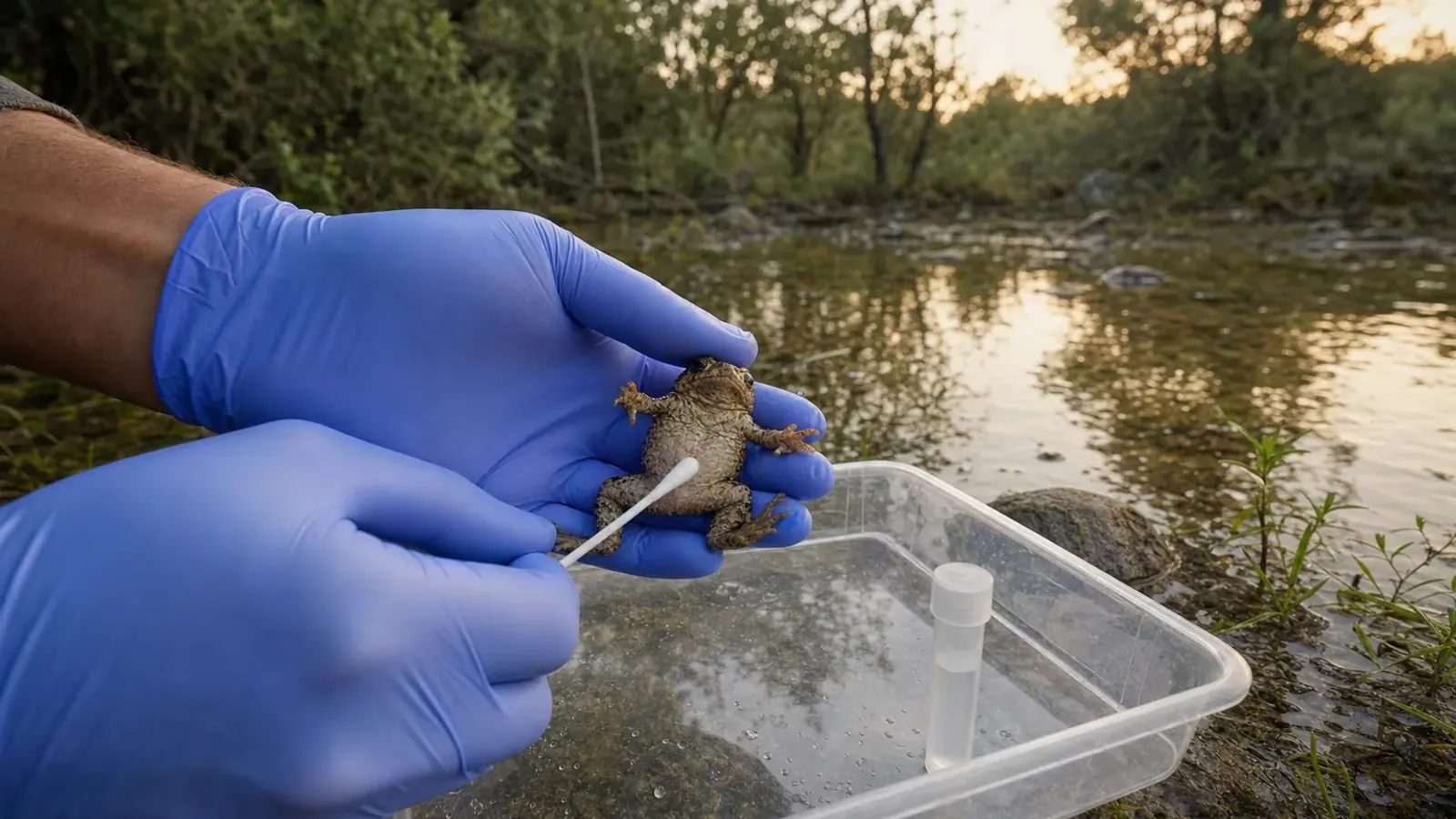
Each post-metamorphic animal was kept in a clean bag and handled with a fresh pair of nitrile gloves. A swab was drawn 30 times across standardised ventral and foot surfaces. For common midwife toad (Alytes obstetricans) tadpoles, researchers sampled the keratinised mouthparts instead. Swabs were stored at −20 °C within 24 hours and tested with a duplex quantitative PCR assay targeting both Bd and Batrachochytrium salamandrivorans (Bsal).
Consistent methods make results comparable, but a negative swab still describes one specimen at one point in time. It cannot prove that a pathogen is absent throughout a landscape. Sampling intensity also differed among sites and species, and winter and other seasonal windows were not represented.
Bd was present; Bsal was not detected
Bd was detected in 141 animals, giving an overall prevalence of 4.33%, with a 95% confidence interval of 3.69–5.09%. Twelve of 41 sites produced at least one positive result. Crude annual prevalence ranged from 1.2% to 6.2%, with no consistent upward or downward trend across the five years.
No sample tested positive for Bsal. That is reassuring, but it is not evidence of eradication. The location of a Bsal outbreak reported in 2018 could not be sampled, and a rare pathogen can be missed by incomplete spatial and seasonal coverage. Continued targeted surveillance therefore remains appropriate.
Positive Bd loads ranged from 1 to 70,383 genomic equivalents per reaction, with a median of 52. Most positive post-metamorphic animals looked clinically healthy. Visual inspection alone would consequently have missed much of the distribution described by molecular testing.
Midwife toad tadpoles emerge as a priority
Common midwife toad larvae had the highest observed prevalence, at 26.57%. Bd can persist on their keratinised mouthparts while their prolonged aquatic development continues. Seventeen of 51 positive larvae showed mouthpart depigmentation, although they otherwise appeared healthy. The authors identify the larvae as potential contributors to environmental persistence, but a functional reservoir role still requires further confirmation.
Metamorphosis may be a particularly vulnerable transition. Only three post-metamorphic midwife toads tested positive; two were found dead and carried high loads. This pattern could reflect clearance by some animals and mortality among heavily infected individuals, but the field observations cannot quantify those two processes separately.
The Mediterranean tree frog (Hyla meridionalis) had a prevalence of 14.34%, despite its largely arboreal ecology and the lack of observed clinical signs. It may therefore be another informative surveillance host. A high proportion of positive tests does not, however, prove that a species transmits more infection or suffers the greatest population impact.
Temperature and human pressure are associations, not causal findings
For landscape modelling, the researchers excluded opportunistically sampled midwife toad larvae and site–species combinations represented by fewer than five animals. The resulting analysis covered 2,731 individuals in 156 observations and considered eight climatic, geographic, ecological and anthropogenic predictors.
The highest-ranked model positively associated Bd occurrence with maximum summer temperature and a human-disturbance index. The index combined urban land cover, road density, distance to human populations and nitrogen from livestock production. After standardisation, a one-unit increase in disturbance was associated with 3.68 times the odds of Bd detection, but the 95% confidence interval was wide at 1.14–11.89. The model-averaged temperature estimate gave an odds ratio of 2.93, whose 0.66–12.97 interval included no effect.
These odds ratios are not simple forecasts for an individual pond. Four candidate models were within two corrected Akaike information-criterion units of the best model, positive detections clustered in a limited number of places, and landscape variables can track unmeasured conditions. “Warmer” is not universally equivalent to “better for Bd”, either: fungal performance depends on thermal ranges, microclimate, host behaviour and variation over time.
Translating evidence into field surveillance
The study supports stratified rather than uniform monitoring. Sites under stronger human pressure, thermally suitable areas and communities containing frequently positive hosts or life stages may merit additional attention. A defensible design should still retain reference sites and repeat sampling across seasons, so that pathogen risk is not confused with seasonal animal activity or capture probability.
Biosecurity is part of measurement quality. In this study, gloves, bags and swabs were single-use, while clothing and equipment were disinfected between sites with 1% Virkon S. That concentration reports the published protocol; it is not a universal prescription. Product approval, contact time, material compatibility and local requirements must be validated for each programme. Field routes should minimise movement of water and sediment, separate clean and exposed equipment, and document which kit entered each site.
Surveillance planning also needs predefined escalation rules. Repeated molecular detections, rising loads, abnormal behaviour, skin changes, mouthpart depigmentation or unexplained deaths should trigger an agreed response. This may include repeat sampling, carcass recovery under permit, veterinary examination, histopathology and notification of the relevant wildlife authority.
A positive swab is not a population diagnosis
PCR detects targeted DNA in the collected material. On its own, it does not establish clinical disease, viable fungus, active transmission or population decline. Conversely, the absence of visible lesions does not exclude infection. Interpretation should integrate pathogen load, life stage, clinical observations, mortality, population trajectories and repeated measurements.
Scientific names matter here. Bd and Bsal are separate pathogens with different host profiles and thermal preferences. Testing for both in one assay is efficient, but a result for one cannot be used to infer the status of the other. Suspected mortality events require investigation beyond a screening swab.
The Catalan survey is most consistent with endemic Bd persistence rather than a steadily expanding epidemic during the study period. Its multi-year, multi-host coverage is a major strength; heterogeneous sampling, limited seasonal coverage and clustered detections constrain causal interpretation. The study therefore supports risk-informed surveillance, not simplistic intervention based on temperature or land use alone.
From laboratory result to conservation decision
Waiting for a mass-mortality event discards valuable early information. A stronger programme links molecular results to host ecology, landscape change and population monitoring, while maintaining biosecurity rigorous enough that the survey itself does not move pathogens between wetlands.
Vetofish can assist conservation teams with sampling design, field biosecurity procedures, staff training, alert thresholds and joint interpretation of health and ecological datasets. The central lesson is measured but actionable: monitor systems and susceptible transitions, not only visibly sick animals, and retain enough temporal replication to distinguish persistent risk from a short-lived field fluctuation.
References
- Puig Ribas M., Fernández Aguilar X., Espunyes J., Carrera-Faja L., Pailler-García L., Marco I. et al. (2026). “Human disturbance and higher temperatures are linked to amphibian chytrid fungus in Catalonia, Northeastern Spain.” Scientific Reports, 16, 19694. Published 25 April 2026. https://doi.org/10.1038/s41598-026-45967-3