

18 July 2026
Marine ich and hydroxychloroquine: an intriguing case, not yet a treatment protocol
A 2025 case report describes rapid clinical improvement in nine marine fish after hydroxychloroquine exposure. Its uncontrolled design makes it a prompt for stronger diagnostics, quarantine and drug monitoring—not a dose to copy.
- Sector
- Public aquariums
- Themes
- DiseasesBiosecurity
- Animal groups
- Fish
- Content type
- Scientific news
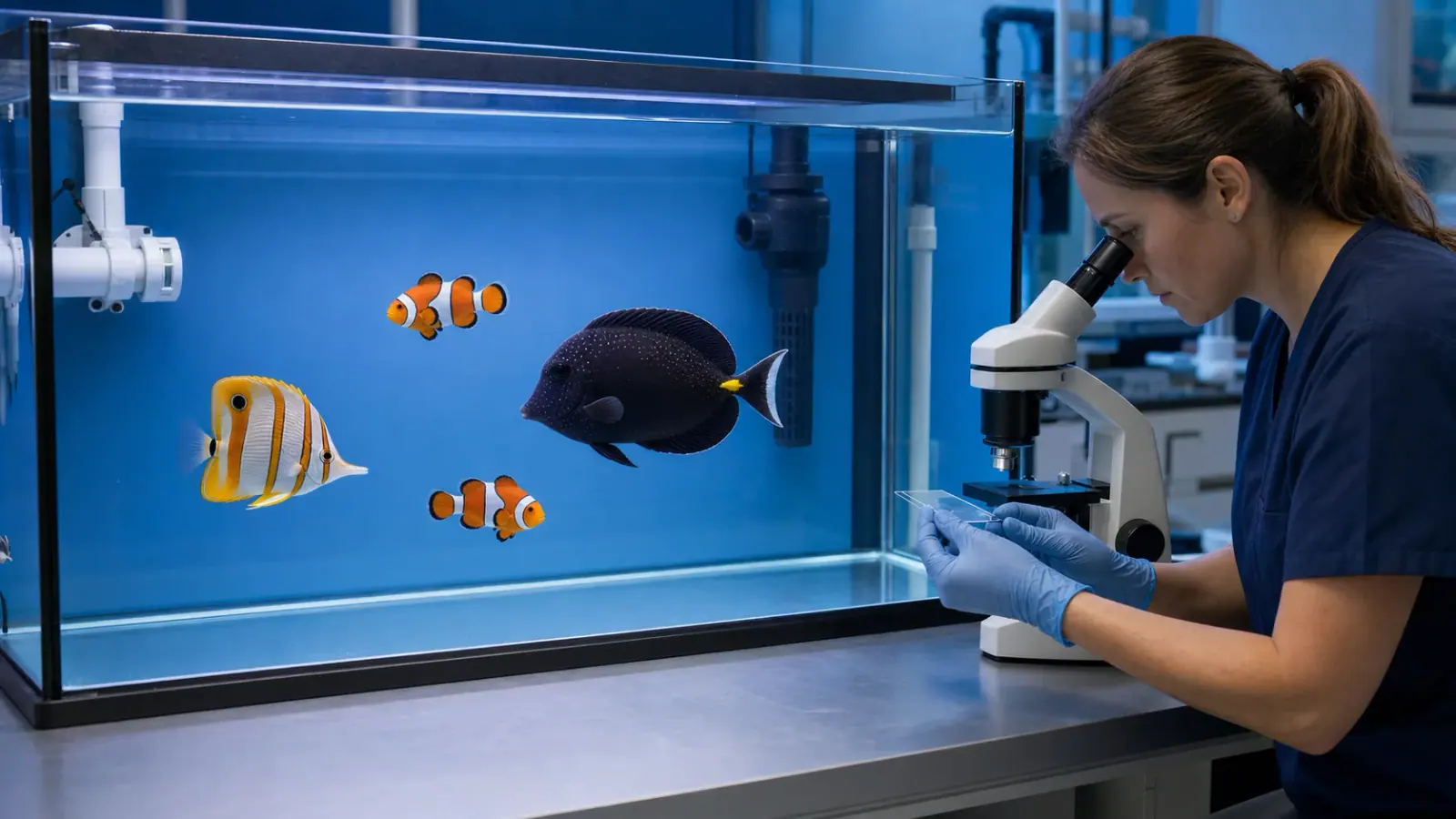
Nine marine fish, eight species and one 300-litre reef aquarium: that is the narrow setting of a short communication published in Aquatic Sciences and Engineering in 2025. Three days after an apparently healthy Copperband Butterflyfish (Chelmon rostratus) entered the established community, every fish began flashing and several developed white spots. Skin scrapes confirmed the ciliate Cryptocaryon irritans. Following hydroxychloroquine sulphate administration to the water, behaviour reportedly improved within 24 hours and no parasite was detected in a scrape taken at 72 hours.
The report deserves attention because published evidence for this drug against C. irritans remains scarce. It is not, however, a therapeutic validation. One aquarium was treated without a control, random allocation, analytical exposure measurements or follow-up beyond the 15-day course. The useful conclusion is therefore not a new marine-ich recipe. The case instead shows what a clinical signal can contribute—and what a controlled study must still establish before public aquariums can rely on it.
Diagnosis must go beyond visible white spots
C. irritans infects the epithelia of marine fishes. Trophonts occur in the skin, fins and gills; other stages leave the host, encyst in the environment and eventually release infective theronts. This alternation matters operationally. A visibly clear fish does not prove that transmission has stopped, because the organisms on its surface represent only one part of the parasite population.
The Brazilian case involved Acanthurus achilles, A. nigricans, Amphiprion ocellaris (two fish), Chelmon rostratus, Pygoplites diacanthus, Siganus vulpinus, Zanclus cornutus and Zebrasoma desjardinii. Four fish with conspicuous spots were sampled. Their trophonts measured approximately 150–250 µm and were ciliated, pear-shaped to rounded and characteristically rolling on the wet mount.
Sampling the most affected fish limited handling of the others, but it also restricts the inference. The five animals without an individual positive result were regarded as infected because they shared the system. At 72 hours, the paper reports no parasite on “a skin scraping sample”, without specifying how many fish were resampled or examining gills and environmental cyst stages. A collection record should distinguish confirmed cases, probable cases and exposed animals instead of merging those categories.
What the observed treatment actually showed
The recirculating aquarium was maintained at 26°C, salinity 33 g/L, pH 8.3 and dissolved oxygen 5 mg/L. The authors made one addition of hydroxychloroquine sulphate at 20 mg/L and continued the course for 15 days without water changes. Staff vacuumed the substrate twice daily and kept an external filter operating. At the end, they placed 100 g of activated carbon in the filter to remove residual drug.
Fish behaviour improved after 24 hours, while trophonts collected at that point moved more slowly. At 48 hours, observed organisms were immobile and vacuolated. By 72 hours, no fish had visible white spots and the follow-up scrape was negative. All nine fish remained alive through day 15, with no apparent adverse effects or relapse during that observation window.
This sequence is compatible with a treatment effect, but it cannot establish causation. Without an untreated comparator, the drug cannot be separated from the normal departure of mature trophonts, repeated substrate cleaning or other system changes. Without a standardised count before and after treatment, “complete elimination” is stronger than the sampling supports. Nine individuals also cannot characterise tolerance across the taxonomic breadth of a major aquarium collection.
Actual exposure is the critical blind spot
The amount added is not necessarily the concentration maintained. A primary study published in Science of the Total Environment in 2022 examined microbial degradation of chloroquine phosphate—a related but distinct compound—in large marine systems. It attributed falling concentrations to microbial communities associated with pipework. The finding flags the potential importance of system-specific biofilms, but it does not demonstrate that hydroxychloroquine has the same degradation kinetics.
The 2025 case did not measure hydroxychloroquine after dosing. Its authors explicitly note that aquarium teams lack a convenient water test for the compound comparable with routine copper assays. Exposure may therefore fall unnoticed; conversely, empirical redosing could increase risks to animals or receiving waters. Invertebrates, algae, biological filters and installation materials introduce further compartments that this single fish-only case did not evaluate.
The reported 20 mg/L should not be transferred as an instruction. Any proposed use requires a veterinary decision under the applicable jurisdiction, ideally in a separate treatment unit where risks to the collection and environment can be controlled. The plan must address the fate of medicated water and consumables, prevent uncontrolled discharge and define stopping criteria before exposure begins.
Turning an encouraging case into a quarantine strategy
The strongest lesson concerns prevention. Signs followed shortly after a new animal entered an established community. A physically and hydraulically separate quarantine provides time to document appetite and respiration, observe across relevant parasite cycles and collect diagnostic samples before a display system is exposed. Nets, siphons, transfer water, hands and other equipment need clearly separated workflows.
When marine ich is suspected, examination should include the gills rather than relying on skin spots. A fresh wet mount, interpreted promptly by trained personnel, can confirm a motile ciliate while leaving room for differential diagnoses. Useful outbreak data include species, numbers at risk, arrival dates, temperature, salinity, sequence of signs, sampled sites and repeat findings. Surveillance should continue after visible resolution and beyond a single expected cycle to detect recrudescence.
A robust hydroxychloroquine trial would require untreated controls, replicated independent systems, quantified parasite burdens on skin and gills, water concentration measurements, metabolite and water-quality monitoring and observation after drug removal. Safety assessment should be species-specific and include non-target organisms. Only that level of evidence could convert a nine-fish signal into a defensible option for collection medicine.
Useful evidence depends on retaining uncertainty
The report documents a real clinical observation: signs subsided rapidly in this aquarium and all nine fish survived for 15 days. It does not demonstrate system-wide eradication or a universally effective and safe dose. For public aquariums, its lasting value lies in highlighting three priorities: confirm the diagnosis, measure exposure rather than assuming it, and protect the collection through independent quarantine.
Vetofish can support institutions in designing quarantine pathways, interpreting parasitology findings, defining clinical and environmental monitoring and critically evaluating treatment options with the veterinarian responsible for the collection.
References
- Cardoso, P. H. M., Balian, S. C., Soares, H. S., Kahwage, B. S. N., Lauri, L. S. & Martins, M. L. (2025). Efficacy of Hydroxychloroquine Sulphate for Treating Disease Caused by Cryptocaryon irritans Brown, 1951 in Marine Ornamental Fish. Aquatic Sciences and Engineering, 40(1), 37–41. https://doi.org/10.26650/ASE20241594074
- Hua, J., Hellgeth, N., Cabay, C., Clark, J., Oliaro, F. J., Van Bonn, W. & Hartmann, E. M. (2022). Towards understanding microbial degradation of chloroquine in large saltwater systems. Science of the Total Environment, 807, 150532. https://doi.org/10.1016/j.scitotenv.2021.150532
- Yanong, R. P. E. (2009). Cryptocaryon irritans infections (marine white spot disease) in fish. UF/IFAS Extension. https://doi.org/10.32473/edis-fa164-2009