

18 July 2026
Danionella cerebrum links thyroid signalling to schooling behaviour
Whole-brain RNA sequencing, CRISPR perturbations and T3 exposure identify a thyroid–klf9–ATPase pathway associated with aggregation and alignment in Danionella cerebrum.
- Sector
- Research facilities
- Animal groups
- Cyprinids
- Content type
- Scientific news
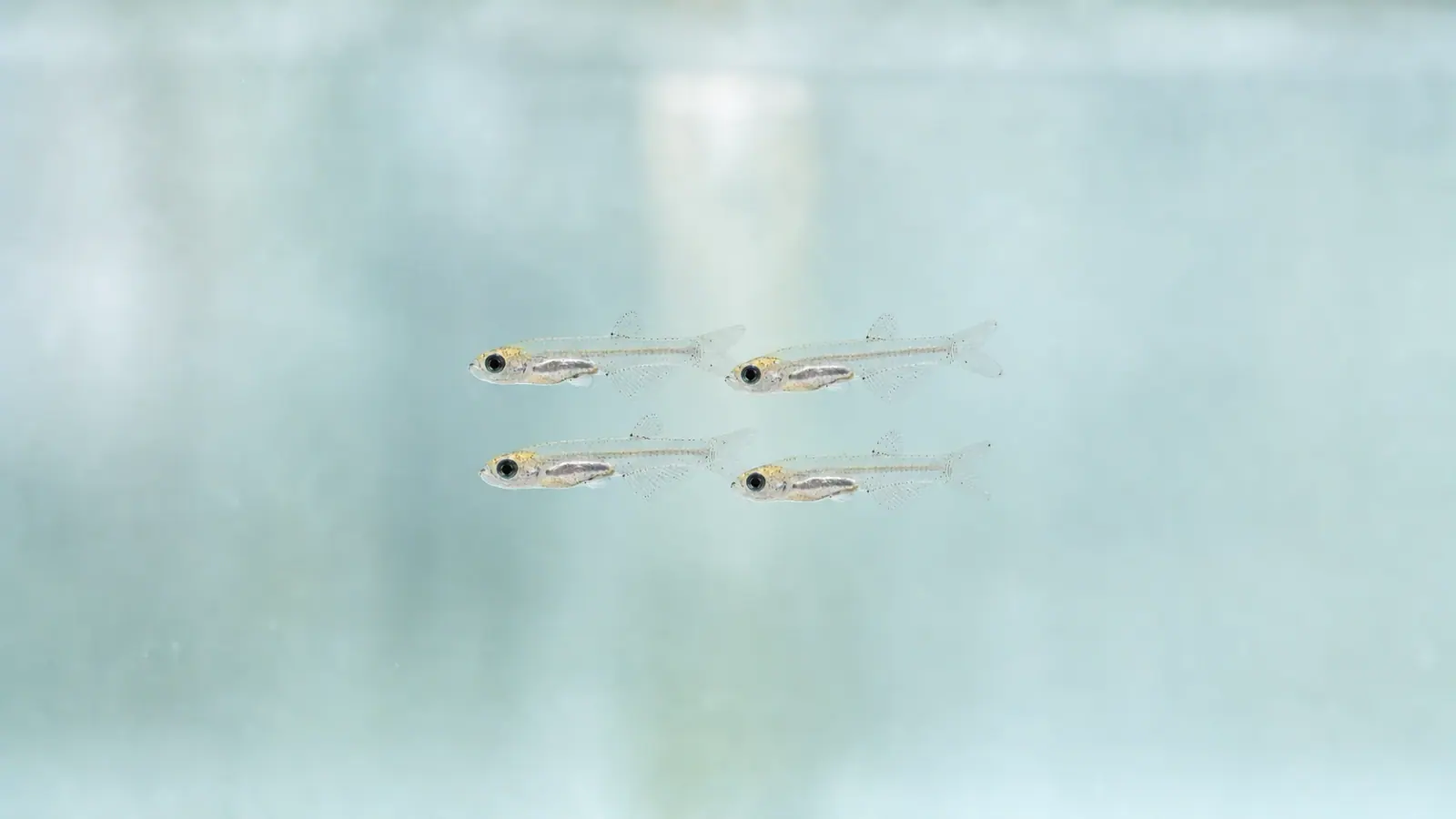
Schooling is an organised behaviour, not simply several fish occupying the same tank. Individuals must remain close enough to form a group while continually adjusting their headings to their neighbours. In Danionella cerebrum, these two components emerge during development and depend on social experience. A Cell Reports study in the January 2026 issue now uses this miniature transparent fish to ask whether different disruptions of schooling converge on shared molecular pathways. Whole-brain RNA sequencing, CRISPR perturbations and experimental thyroid-hormone exposure point to an interaction between triiodothyronine (T3), the transcription factor klf9 and the sodium–potassium pump subunit atp1a1a.4. The work provides a mechanistic entry point, not a complete account of social behaviour or a husbandry treatment.
Why Danionella is more than a small zebrafish
Danionella cerebrum is a translucent cyprinid that matures at approximately 10–15 mm. Developmental truncation leaves the adult with several larval skeletal characteristics, including a largely absent bony skull roof. Researchers can therefore image neural activity through the skin of an adult vertebrate, while transgenesis and genome editing support experiments that connect circuits with mature behaviour.
Accurate species identity matters. Early neuroscience publications described their laboratory fish as Danionella translucida. Combined anatomical and molecular work published in 2021 showed that the most widely studied stock was a distinct species, formally named D. cerebrum. The two look very similar externally and can occur together in Myanmar streams, but differ substantially in internal anatomy and genetics. Colony provenance and taxonomic documentation are consequently part of experimental reproducibility.
Previous work established the behavioural framework used in the new study. At about two weeks, fish avoid social partners; by six weeks, socially reared animals aggregate and align into schools. Developmental isolation impairs both adult schooling and neural responses to social motion. This made age and social history useful, non-equivalent routes to a shared behavioural endpoint.
Starting with several disruptions, not one preferred hypothesis
The investigators compared socially reared fish at two and six weeks with six-week-old animals isolated from shortly after hatching. They also targeted disc1, shank2b or syn1 with CRISPR–Cas9 in one-cell embryos. These genes contribute to synaptic structure or function and are associated with human neurodevelopmental conditions. In this experiment they provide genetic perturbations known to affect social behaviour in other models; the fish should not be described as having a human psychiatric disorder.
RNA sequencing used three biological replicates per condition, each pooling four whole brains, with approximately 25 million paired-end reads per sample. Juvenile and socially isolated fish shared more than half of their differentially expressed genes relative to social adults: 3,289 were upregulated and 5,041 downregulated in common. The three crispant models had very different transcriptomic profiles, yet still shared 108 upregulated and 50 downregulated genes. Circadian regulation and thyroid signalling repeatedly appeared among the convergent processes.
Schooling was quantified in groups of four mixed-sex adults. After acclimation, fish were recorded for five minutes in a 300-mm circular arena containing one litre of system water. Automated pose tracking measured swimming speed, the convex-hull area occupied by the group and correlation between headings. All three synaptic-gene crispant groups moved more slowly, spread across a larger area and aligned less closely than Cas9-only controls. The design could therefore compare molecular changes across several routes to reduced schooling without assuming that those routes were biologically identical.
Testing the thyroid–klf9–atp1a1a.4 chain
Only five genes were downregulated in common across socially isolated adults and all three crispant models. The strongest candidate was atp1a1a.4, which encodes an alpha subunit of Na⁺/K⁺-ATPase. This membrane pump maintains ionic gradients central to cellular excitability and homeostasis. Meanwhile, klf9, a thyroid-responsive transcription factor, was upregulated.
The authors then moved from correlation towards intervention. Inducible klf9 overexpression in larvae increased klf9 messenger RNA by 101% and reduced atp1a1a.4 expression by 78%. Exposing larvae to 10 nM T3 for three days increased klf9 by 44% and reduced atp1a1a.4 by 22%. These results support a regulatory sequence from thyroid hormone through klf9 to the ATPase subunit, although the relevant cell types, binding partners and neural circuits remain unknown.
Adult exposure provided a behavioural test. After three days at 50 nM T3, mean swimming speed remained similar, but group area increased by 236.8% and heading correlation fell by 97.3%. The fish were still active, yet their schools were substantially less compact and aligned. A 100 nM condition caused a swollen swim bladder and abnormal baseline swimming and was excluded from behavioural testing. These are experimental concentrations in one model; they are not environmental limits, therapeutic doses or husbandry recommendations.
Targeting atp1a1a.4 independently produced a related phenotype. Crispant groups occupied 128.35% more area and showed a 47.19% reduction in heading correlation than controls. Unlike the three synaptic-gene groups, however, they swam 10.92% faster. Reduced schooling was therefore not merely a mathematical consequence of slower locomotion.
A pathway with important boundaries
The experiments show that altering thyroid signalling or atp1a1a.4 can change aggregation and alignment under the tested conditions. They also reveal partial molecular convergence across development, social isolation and several genetic perturbations. They do not establish a single master pathway for collective behaviour, nor do they justify extrapolation to other fish species or human social conditions.
Bulk RNA sequencing of whole brains cannot assign expression changes to a particular cell type or circuit. F0 crispants are mosaic, so the proportion and identity of edited cells vary among individuals; individually sequenced targets do not entirely eliminate potential off-target effects. The direct regulatory steps between Klf9 and atp1a1a.4, and the neural dynamics through which the pump affects schooling, still require spatial transcriptomics and circuit-specific tools.
The study also exposes an interpretive challenge. Thyroid signalling influences development and many aspects of physiology. A schooling change after T3 cannot be assumed to be socially specific unless locomotion, morphology, vision, stress and circadian activity are assessed alongside it. The exclusion of the abnormal 100 nM group is therefore scientifically important, not a minor methodological detail.
Social history belongs in the experimental record
For aquatic research facilities, age, group history and time of day are potential experimental variables. The colony was maintained at 28 ± 0.5°C on a 14-hour light and 10-hour dark cycle, and behavioural recordings occurred within a defined zeitgeber window before feeding. Group composition, density, duration of isolation, arena acclimation and recording time should be standardised whenever schooling is an outcome.
No single metric should carry the interpretation. A larger group area may reflect social spacing, but it can also accompany freezing, altered swimming, visual impairment or poor buoyancy. Combining aggregation, alignment, speed and clinical observation makes the phenotype more defensible. Hormonal exposure and genome editing also require prospective welfare endpoints, ethical approval and explicit criteria for excluding animals with systemic abnormalities.
Vetofish can help research facilities characterise emerging aquatic models, standardise husbandry metadata, develop ethograms and distinguish behavioural readouts from clinical confounders. Danionella cerebrum offers unusual access to the living adult vertebrate brain; reliable inference still begins with careful control of the fish’s social and physical environment.
References
- Zada D., Kadobianskyi M., Judkewitz B., Lovett-Barron M. (2026). “Convergent thyroid-ATPase interactions regulate collective behavior in Danionella.” Cell Reports, 45(1), 116730. https://doi.org/10.1016/j.celrep.2025.116730
- Zada D., Schulze L., Yu J.-H. et al. (2024). “Development of neural circuits for social motion perception in schooling fish.” Current Biology, 34(15), 3380–3391.e5. https://doi.org/10.1016/j.cub.2024.06.049
- Britz R., Conway K. W., Rüber L. (2021). “The emerging vertebrate model species for neurophysiological studies is Danionella cerebrum, new species (Teleostei: Cyprinidae).” Scientific Reports, 11, 18942. https://doi.org/10.1038/s41598-021-97600-0