

19 July 2026
Salmonid eggs: where surface disinfection stops
Iodophor treatment reduces viral contamination on salmonid egg surfaces, but it must remain part of a documented, multi-barrier hatchery biosecurity plan.
- Sector
- Aquaculture
- Content type
- Practical guide
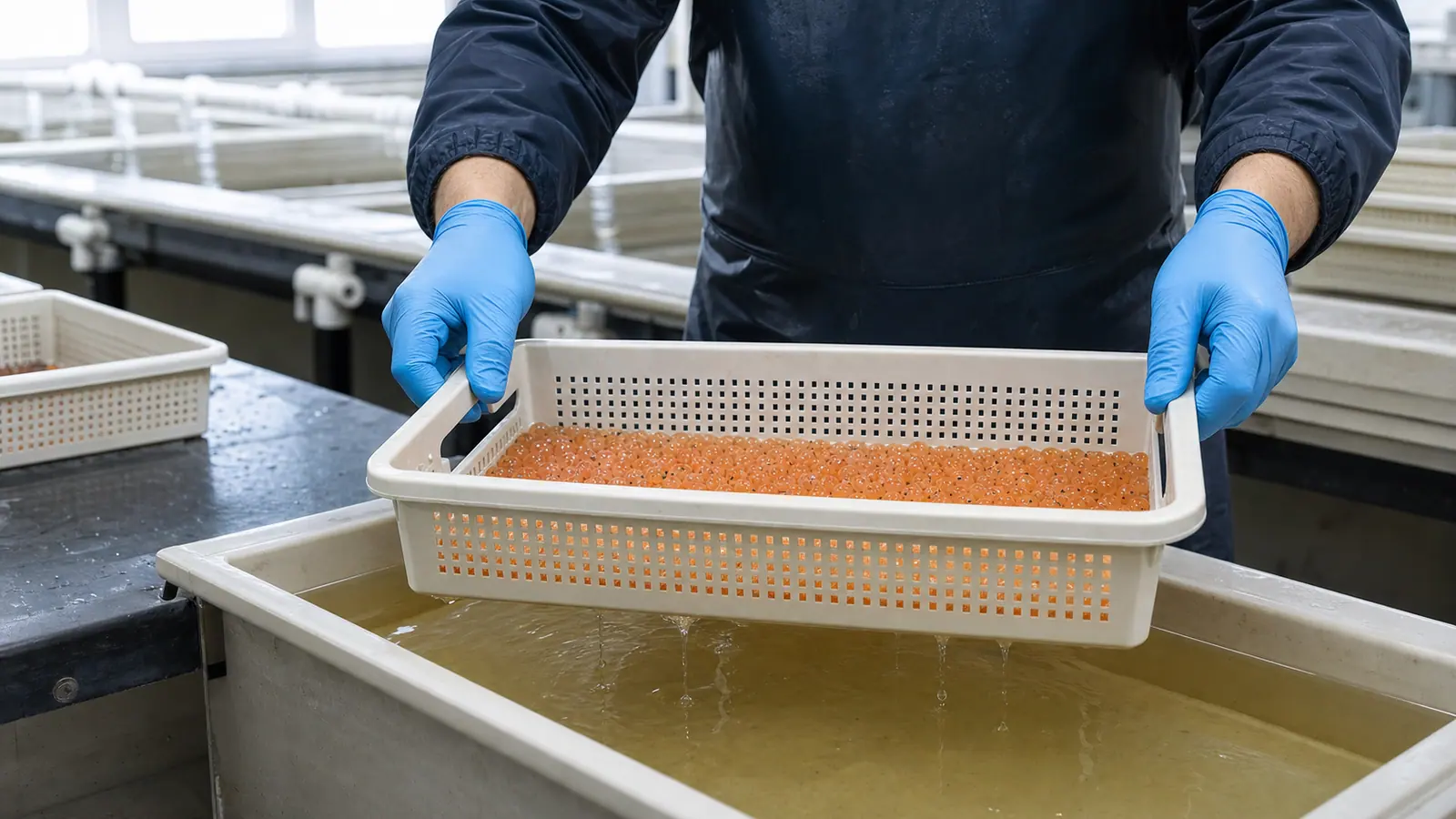
Disinfecting salmonid eggs is a well-established health barrier, but it cannot turn a high-risk batch into a guaranteed pathogen-free one. A scientific opinion published by the European Food Safety Authority (EFSA) in December 2025 distinguishes true internal transmission from contamination on egg surfaces. For the three viruses assessed, the evidence does not substantiate true vertical transmission, yet eggs, reproductive fluids and their environment can still carry infectious particles. Treatment must therefore remain connected to broodstock health, controlled water, traceability and protection against recontamination.
What disinfection can — and cannot — achieve
EFSA assessed viral haemorrhagic septicaemia virus (VHSV), infectious haematopoietic necrosis virus (IHNV) and highly polymorphic region-deleted infectious salmon anaemia virus (HPR-deleted ISAV). Its systematic review found no evidence substantiating true vertical transmission: passage of infectious virus inside the egg that would escape properly applied surface disinfection. The panel expressed 99–100% certainty in this conclusion.
This does not make egg movements risk-free. All three viruses can contaminate egg surfaces or reproductive fluids. Iodophor acts on contamination it can reach; it cannot correct a poorly executed protocol or protect eggs from a new exposure after treatment. Studies reviewed by EFSA associated detections in progeny despite disinfection with inadequate contact time or concentration, unsuitable pH or temperature, organic matter and mucus, or transfer back into contaminated water. Virions may also be shielded in irregularities of the egg surface.
EFSA’s quantitative estimates describe tightly defined worst-case import scenarios and rely partly on expert elicitation. They should not be presented as a universal “failure rate” for every hatchery. The more defensible conclusion is that disinfection lowers the risk of external contamination without eliminating it, and performs best alongside independent safeguards.
The reference protocol for salmonid eggs
Chapter 4.5 of the World Organisation for Animal Health (WOAH) Aquatic Animal Health Code describes iodophor surface disinfection for newly fertilised or eyed salmonid eggs. Newly fertilised eggs should first begin water hardening. The protocol is not recommended for unfertilised ova or during fertilisation because these stages are more vulnerable and disinfectant exposure may damage gametes.
The reference sequence includes:
- rinsing for 30–60 seconds in 0.9–1.1% saline prepared with pathogen-free water to remove organic material;
- immersion in an iodophor solution containing 100 parts per million available iodine for at least 10 minutes;
- maintaining solution pH between 6 and 8 and monitoring the active concentration;
- a second 30–60 second saline rinse, followed by incubation in pathogen-free water.
These parameters belong to the international protocol for salmonid eggs. They should not be extrapolated to other fish species, embryonic stages or disinfectant formulations without validation. Commercial formulation, water chemistry and manufacturer instructions remain important. “100 ppm” refers to available iodine, not to an uncalculated volume of commercial product.
Five controls before treating a batch
The first control is batch identity: species, origin, fertilisation date and time, hardening stage, and the associated broodfish or epidemiological group. Without traceability, a laboratory result or process deviation cannot be linked reliably to the eggs concerned.
The second is solution control. Active concentration, pH, temperature, volume, preparation time and use should be recorded. Organic material consumes available iodine, so a bath that looks clean is not necessarily effective. Measurements must follow the establishment’s validated procedure and the product instructions.
Third comes actual contact time. Timing begins when the entire batch is exposed to a compliant solution, not when pouring starts. The fourth control is the microbiological quality of rinses and incubation water. Returning treated eggs to a contaminated basket, pipe or water supply can undo part of the benefit.
The fifth is flow separation. Clean equipment should not cross paths with containers, effluent or staff that handled broodfish and reproductive fluids before disinfection. One-way workflows, zone-specific tools and a response plan for spills help prevent cross-contamination.
Biosecurity starts with the broodstock
EFSA places broodstock controls first among risk-mitigation measures. Depending on the production system, these may include clinical surveillance, individual testing at stripping or sampling of the epidemiological group under the applicable health framework. Origin and health status cannot be replaced by an iodophor bath at the end of the process.
Water quality, separation of production units, controlled access, cleaning and disinfection of equipment, and competent diagnostic laboratories are parts of the same system. In the European Union, VHS, IHN and HPR-deleted ISAV infection are subject to specific requirements for disease-free status and surveillance. Movements may also require animal health certification. Before shipment, operators should confirm with the competent authority which requirements apply to the species, origin, destination and health status of the relevant zones.
This layered approach matters because each measure addresses a different failure route. Broodstock surveillance reduces the probability that contaminated gametes enter the process. Surface disinfection reduces accessible contamination. Pathogen-free water and separated equipment protect the treated batch. Documentation allows an investigation to reconstruct where control was lost.
Turning a protocol into verifiable evidence
A useful procedure is more than a sheet posted beside the treatment tank. It states who prepares the bath, which measurement device is used, what the acceptance criteria are, and what happens when a result falls outside the defined range. It includes instrument checks or calibration, staff training and records tied to each batch.
Deviations should be handled as health events: insufficient concentration, out-of-range pH, incomplete exposure, broken one-way flow or uncertainty about water quality. Automatically repeating the treatment may not be harmless to embryos. The response should be agreed with the veterinarian or aquatic animal health lead, taking account of developmental stage, prior exposure and epidemiological risk.
Trend review adds another layer of control. Repeated borderline concentrations, unexplained embryo losses or frequent workflow deviations may signal a design problem rather than isolated operator error. Recording without reviewing produces an archive, not a biosecurity system.
Conclusion: a measurable barrier, not a shortcut
Iodophor surface disinfection remains a central tool in salmonid hatchery biosecurity. Its performance depends on measured process parameters and a coherent health chain from broodstock to incubation water. Treating it as a stand-alone guarantee hides the recontamination routes highlighted by current evidence.
Vetofish can help hatcheries map workflows, draft and qualify procedures, train teams, select meaningful records and define responses to deviations. The aim is to make every barrier observable, traceable and open to review, rather than placing the safety of an egg batch on a single bath.
References
- EFSA Panel on Animal Health and Welfare (AHAW) et al. (2025). “Viral haemorrhagic septicaemia virus, infectious haematopoietic necrosis virus and HPR-deleted infectious salmon anaemia virus — Risk of introduction in free areas through fertilised eggs and gametes.” EFSA Journal, 23(12), e9800. https://doi.org/10.2903/j.efsa.2025.9800
- World Organisation for Animal Health (WOAH) (2024). Aquatic Animal Health Code, Chapter 4.5, “Recommendations for surface disinfection of salmonid eggs.” https://www.woah.org/fileadmin/Home/eng/Health_standards/aahc/current/chapitre_disinfection_eggs.pdf
- European Commission (2020, consolidated version 22 April 2026). Commission Delegated Regulation (EU) 2020/689, surveillance, eradication and disease-free status requirements for certain listed diseases. https://eur-lex.europa.eu/eli/reg_del/2020/689/2026-04-22/eng
- European Commission (2020). Commission Implementing Regulation (EU) 2020/2236 on model animal health certificates for certain movements of aquatic animals. https://eur-lex.europa.eu/eli/reg_impl/2020/2236/oj/eng