

23 July 2026
Gilthead seabream: assessing tactile enrichment with care
A 21-day trial linked voluntary passage through soft strands with fewer aggressive displays and a reduced acute stress response in gilthead seabream.
- Sector
- Aquaculture
- Animal groups
- Fish
- Content type
- Scientific news
- Keywords
- StressEnrichmentEthogram
Could a structure that fish voluntarily swim through provide useful tactile enrichment in aquaculture? A study in juvenile gilthead seabream (Sparus aurata) offers an encouraging first signal. After 21 days, groups given access to soft strands showed fewer aggressive displays and a lower cortisol response to acute stress. This remains an experimental finding: it is not yet evidence for routine commercial deployment.
A simple device with a structural control
Marta Soares and colleagues studied seabream measuring approximately 10.2 cm and weighing 34.2 g. After at least twenty days of acclimation, fish were housed in groups of four across twelve tanks of about 80 litres within a recirculating seawater system. Temperature was maintained at 21 °C, salinity at 30.2‰ and the photoperiod at twelve hours light and twelve hours dark.
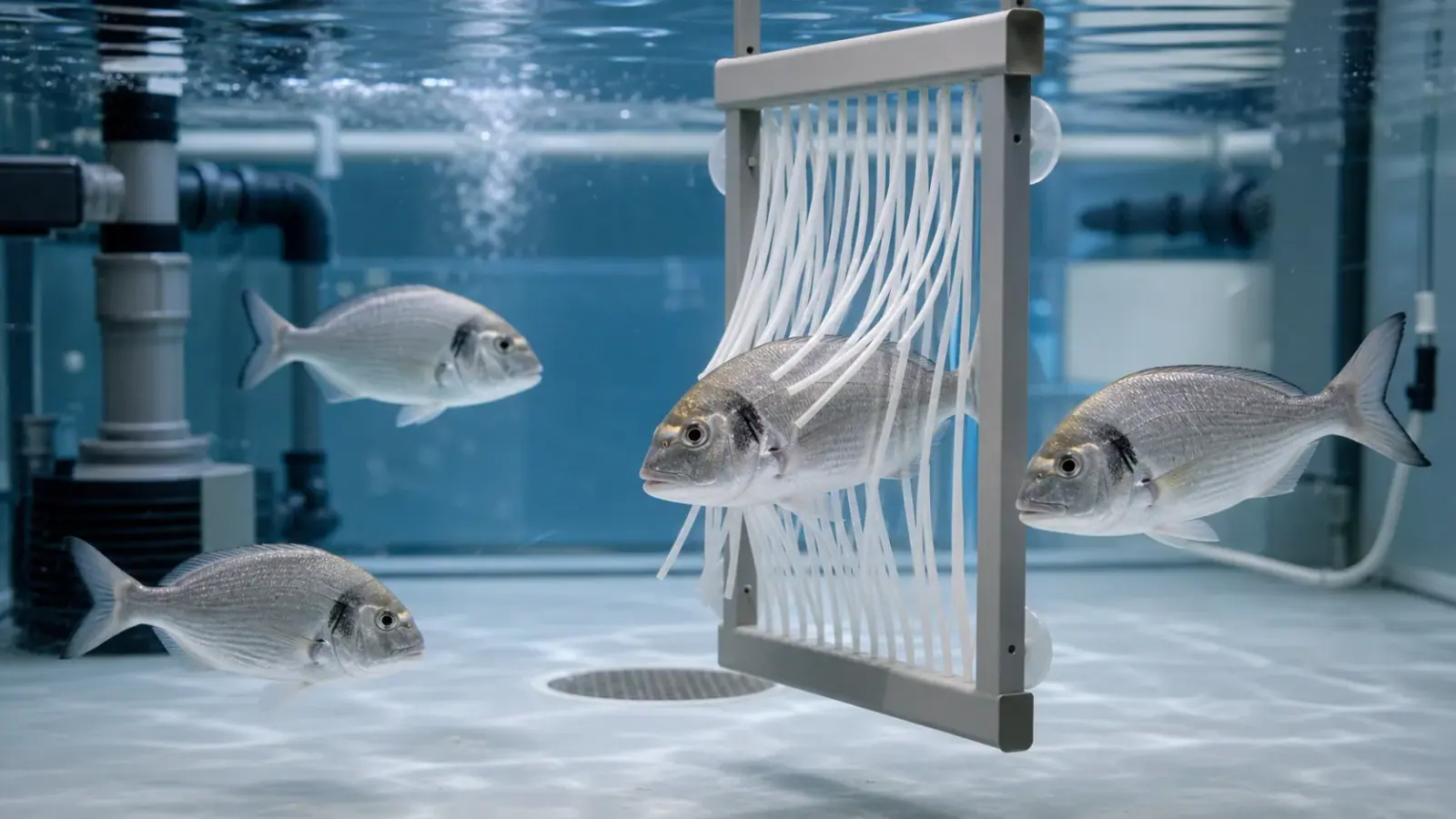
Enriched tanks contained a polyvinyl chloride frame fitted with flexible silicone strands. Fish could swim through and make contact with them. Control tanks received a comparable frame without strands. This design matters because it helps separate tactile contact from the effect of introducing a novel structure.
Researchers recorded thirty minutes of video daily over eighteen days. They counted passages through the apparatus, aggressive displays and attacks. On day 22, two fish from each group underwent an acute confinement test. Cortisol and several monoamines were then measured in different brain regions.
Fewer displays, but not every measure of aggression changed
Seabream continued to use the strand device throughout the trial. Aggressive displays were less frequent in enriched groups. Overt attacks, however, did not differ significantly between treatments. That distinction prevents an overstatement such as “enrichment eliminated aggression”: one behavioural endpoint changed while another did not.
The social unit also needs attention. Four fish shared each tank, and dominance, body size and familiarity can shape their interactions. Analyses focused mainly on groups, and the authors recommend individual tracking in future work. An arrangement that benefits some fish could be used differently by dominant and subordinate individuals.
Contact was voluntary in this experiment. Choice is part of the interpretation. A stimulus that a fish can seek or avoid is not equivalent to forced rubbing caused by a compulsory passage, water flow or high stocking density.
A lower response to confinement
Confinement strongly increased cortisol in both treatments. The mean post-stress value was nevertheless lower in fish previously exposed to tactile enrichment than in controls. The appropriate interpretation is attenuation of the acute stress response, not absence of stress.
Monoaminergic signalling also differed, particularly in the midbrain and hindbrain. Dopamine, noradrenaline and serotonin contribute to many processes; their metabolites and turnover ratios are not stand-alone welfare scores. Here, their value comes from convergence with behaviour and cortisol.
Samples were collected at the end of the experiment. They therefore do not describe the full physiological trajectory over three weeks or show how long any effect would persist after the structure was removed.
What must be validated before farm use
Translation from laboratory tanks first requires testing across stocking densities, group sizes and life stages. The device must remain accessible without creating a competition hotspot, obstructing circulation or concentrating fish. Shape, flexibility and spacing need to prevent trapping, skin abrasion and fin damage.
Hygiene is equally important. Added surfaces can retain organic material and support biofilms. Teams must verify compatibility with cleaning and disinfection, material stability in seawater and the absence of leaching. A behavioural benefit would not offset a mechanical or biosecurity hazard.
Evaluation should combine several indicator families: voluntary use, spatial distribution, interactions, lesions, growth, feed intake, mortality, water quality and physiological responses. A single measure can mislead. Reduced movement near a device, for example, might indicate calm, avoidance or access monopolised by a few fish.
The control condition also matters. Comparing an equipped tank with a completely barren tank would combine tactile, structural and novelty effects. The strand-free frame used in this study provides a useful methodological starting point for professional pilots.
Enrichment cannot be copied blindly between species
Gilthead seabream have a distinct behavioural repertoire and response to captivity. A device accepted by juveniles at 21 °C cannot be transferred unchanged to salmonids, flatfish or broodstock. Preferences may also shift with body size, season, water velocity and stocking density.
The trial lasted three weeks under controlled conditions and involved a limited number of tanks. It did not assess long-term production performance, chronic contact lesions or operation at commercial scale. Its contribution is to show that voluntary tactile stimulation produces measurable responses and deserves larger, appropriately controlled trials.
Commercial evaluation should also define failure criteria before installation. Rising injuries, deteriorating water flow, uneven access or persistent avoidance should trigger modification or removal. Enrichment is not beneficial merely because it increases environmental complexity.
Conclusion: test a tool, not a promise
The findings support a possible enrichment route for gilthead seabream: fewer aggressive displays and a reduced cortisol response after confinement, accompanied by neurochemical differences. They do not yet establish a durable whole-animal benefit or a ready-to-use farm solution.
Vetofish can support pilot design, welfare indicator selection, biosecurity risk analysis and stopping criteria. A husbandry innovation becomes useful when it remains voluntary, safe, cleanable and demonstrably suitable for the species and production conditions in which it will operate.
References
- Soares, M. C., Gauy, A. C. dos S., Macieira, J., Cambiaghi e Silva, B., Banha, F., Gesto, M., Gonçalves-de-Freitas, E. & Saavedra, M. (2026). “Tactile stimulation enrichment affects behavioural and physiological responses of a marine commercial fish species, the gilthead seabream Sparus aurata.” Aquaculture, 625, 744343. https://doi.org/10.1016/j.aquaculture.2026.744343