

17 July 2026
In-tank electrical euthanasia for zebrafish still needs further validation
A study tested electrical euthanasia of adult zebrafish groups in their housing tanks, finding that performance depended on tank volume and stocking level.
- Sector
- Research facilities
- Content type
- Regulatory analysis
- Keywords
- AnaesthesiaAnalgesiaStress
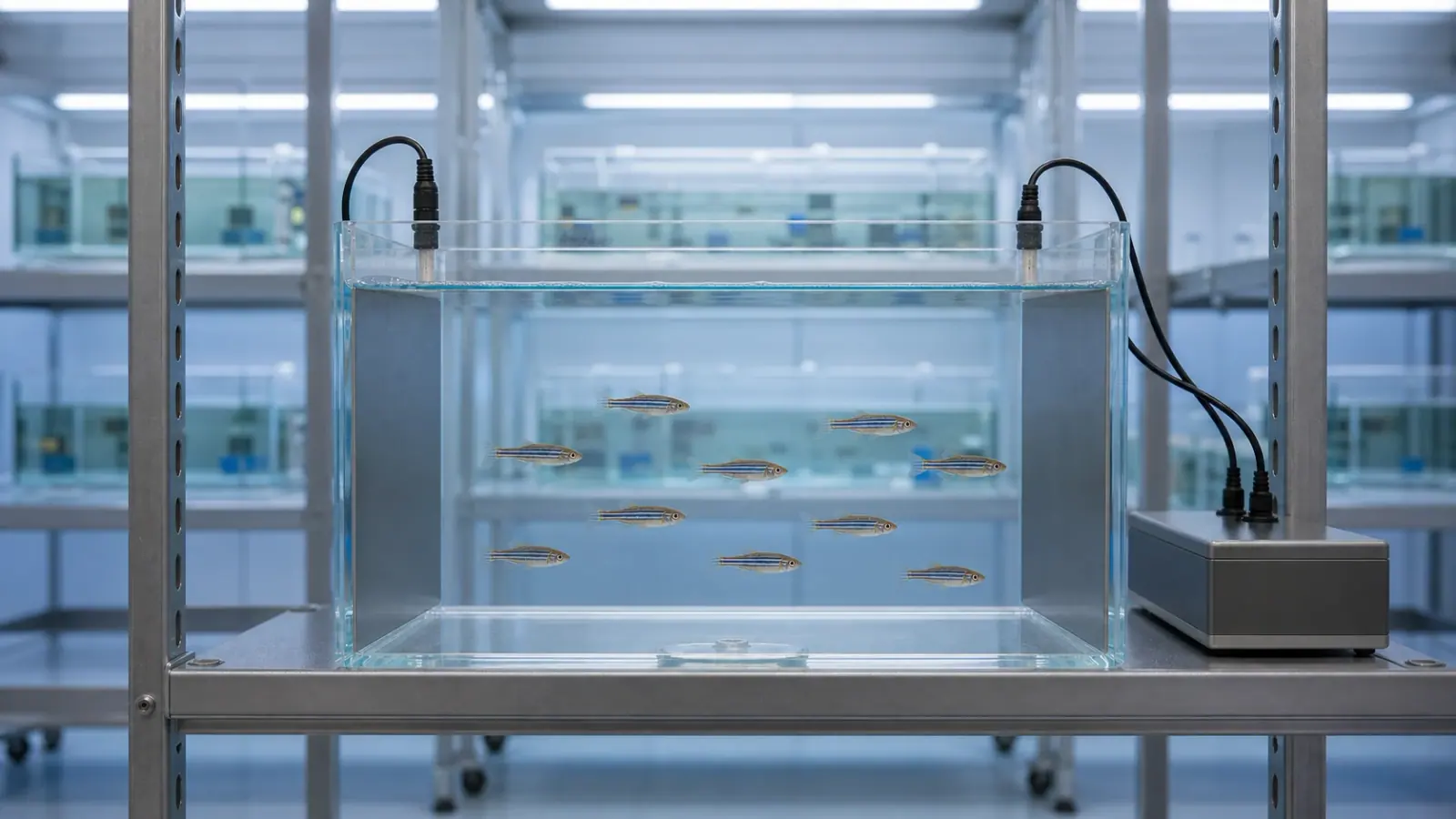
Netting a zebrafish (Danio rerio), moving it to another container and administering a killing agent add several handling events at the end of the animal’s life. A 2025 study in Scientific Reports explored a different approach: applying alternating current in a standard aquarium to stun and kill a group of adult fish without removing them from the water. The prototype prevented recovery in several tested configurations. However, the results are neither a universal validation nor direct evidence of immediate loss of consciousness. Research facilities therefore need to consider the method’s biological, engineering and occupational-safety limits alongside its potential to reduce handling.
Testing electrical treatment in housing aquaria
The researchers studied 650 adult AB and C strain zebrafish aged 14–18 months. Fish were housed at approximately five animals per litre. During the experiments, water temperature was 28 ± 0.9 °C and conductivity was 800 ± 14 µS/cm. Two parallel stainless-steel plates positioned against opposite sides of the aquarium generated a 50 Hz sinusoidal alternating electric field.
In an initial 7.2-litre experimental tank, a one-second exposure to at least 5 ± 0.02 V RMS/cm and 0.5 ± 0.003 A RMS/dm² immediately immobilised all ten fish. Every fish nevertheless recovered within 30 minutes. When the same field and current density were applied for 30 seconds, none of a further ten fish recovered during the observation period.
The team then built electrodes for 3.5- and 8-litre standard aquaria used in the facility. Operational success meant that no gill, body or fin movement, stimulus response, or return of equilibrium was seen during treatment or during the following 30 minutes. Any fish that recovered was promptly euthanised with 250 mg/L MS-222.
Tank volume and group size changed performance
In 3.5-litre aquaria holding ten fish, treatment at 5 V/cm and 0.5 A/dm² for 30 seconds produced no recovery in 110 animals across 11 trials. The same settings reached only 93% with 15 fish: one of 15 recovered after 1.3 minutes. Increasing the field to 6 ± 0.1 V/cm and current density to 0.7 ± 0.009 A/dm² then resulted in no recovery among 75 fish tested over five trials.
Configuration also mattered in 8-litre tanks. With ten fish, 5 V/cm and 0.5 A/dm² achieved 90% operational success: four of 40 fish recovered between 0.9 and 13 minutes. A field of 6 V/cm at 0.7 A/dm² prevented recovery in the next configuration. Yet when 40 fish occupied the same volume, those settings achieved 98%, with two of 80 fish recovering at 0.4 and 6.4 minutes. Raising the field to 7 ± 0.02 V/cm and current density to 0.8 ± 0.01 A/dm² produced no recovery in 240 fish across six trials.
These results make one practical point especially clear: voltage cannot be selected independently of tank geometry, water conductivity and the biomass between the electrodes. Three fish also hid in the narrow space between an electrode and a tank wall and were omitted from the dataset. Any production device would need to eliminate that refuge and demonstrate that every animal remains within the intended field.
Behavioural success is not yet proof of unconsciousness
In this study, “100%” means that no behavioural sign of recovery was detected over 30 minutes. The investigators did not record brain activity in adult fish. Immobility alone cannot establish exactly when consciousness is lost or rule out perception before death. The authors acknowledge that behavioural indicators may underestimate time to unconsciousness or, conversely, overestimate recovery.
A related Lab Animal study provides mechanistic evidence at a different life stage. In four-day-old larvae, 50 V/cm alternating current applied for 32 seconds stopped behavioural responses within one second. Calcium imaging also showed loss of coordinated brain activity. That larval protocol used a field ten times stronger than some adult conditions and cannot be transferred directly. Instead, it demonstrates the value of combining behavioural and neurophysiological endpoints in future adult validation.
The FELASA Working Group on humane killing of laboratory fish recommends evaluating any method against the species and developmental stage, reliability, welfare impact, staff and environmental safety, and the intended scientific use of the carcass. In-tank electrical treatment may address some concerns by avoiding netting and transfer. It still needs stronger evidence about when unconsciousness occurs.
Why the published settings are not a ready-made protocol
The trials were conducted at approximately 800 µS/cm. The authors note that zebrafish facilities may operate from around 200 to 3,000 µS/cm, and conductivity directly affects the current produced at a given field strength. Temperature, tank shape, electrode surface area and spacing, fish age and stocking density may also change the outcome. Copying a volts-per-centimetre value therefore cannot guarantee efficacy or welfare in another system.
Human safety is an equally important boundary. No incidents or near misses were reported during the study, but the prototype still allowed potential contact with the electric field. Translation into routine facility use cannot rely on a makeshift electrical assembly. It requires a site-specific risk assessment, guarded live parts, an interlocked lid, automatic isolation before access, fish-free commissioning tests and documented staff training. A validated back-up killing method must be immediately available whenever recovery is possible.
Nor does a 30-minute absence of recovery remove the obligation to confirm death under an approved procedure. Facilities should prospectively define the signs to observe, monitoring frequency, minimum delay before removal, and action to take if any sign is uncertain. Ethical approval, veterinary input and compatibility with downstream tissue collection all belong before a pilot study begins.
A refinement opportunity that requires local qualification
Killing a group in its home tank could reduce chasing, capture, air exposure and environmental change before conventional methods. It may also allow all fish in a group to be treated at the same time. Those potential advantages have to be balanced against uneven fields, animals shielded by equipment geometry and settings that may be unsuitable for local water conditions.
A cautious pathway starts by characterising the actual tanks, conductivities and stocking levels in use, followed by equipment review with electrical-safety, animal-welfare and veterinary personnel. Early trials need predefined stopping criteria, individual monitoring and a back-up method. They should document behavioural outcomes and, where feasible, include neurophysiological measures rather than assuming immobility equals unconsciousness.
Vetofish can help research facilities review end-of-procedure practices, develop veterinary death-confirmation criteria, draft operating procedures and build validation plans suited to their fish and systems. The study offers a credible direction for refinement, but it does not yet make electrical euthanasia a standard method that can be adopted without local qualification.
References
- Saarinen U., Sundell E., Sneddon L., Gräns A. (2025). “Novel euthanasia technique for zebrafish using electric shock in standard group housing aquaria.” Scientific Reports, 15, 3011. https://doi.org/10.1038/s41598-025-87540-4
- Burkhardt D.-S., Leyden C., Thomas C. et al. (2025). “Behavioral and neurophysiological effects of electrical stunning on zebrafish larvae.” Lab Animal, 54, 50–58. https://doi.org/10.1038/s41684-024-01505-0
- Mocho J.-P., Ramos Blasco J., Rengtved Lundegaard P. et al. (2025). “Methods of humane killing of laboratory fish: FELASA Working Group recommendations.” Laboratory Animals, 59(5), 599–613. https://doi.org/10.1177/00236772251351095