

29 July 2026
Zebrafish gephyrin helps myelin choose its axons
In larval zebrafish, oligodendrocytes use a protein best known from inhibitory synapses to influence axon-class targeting and restrain myelin sheath length.
- Sector
- Research facilities
- Content type
- Scientific news
- Keywords
- HistopathologyPCRStress
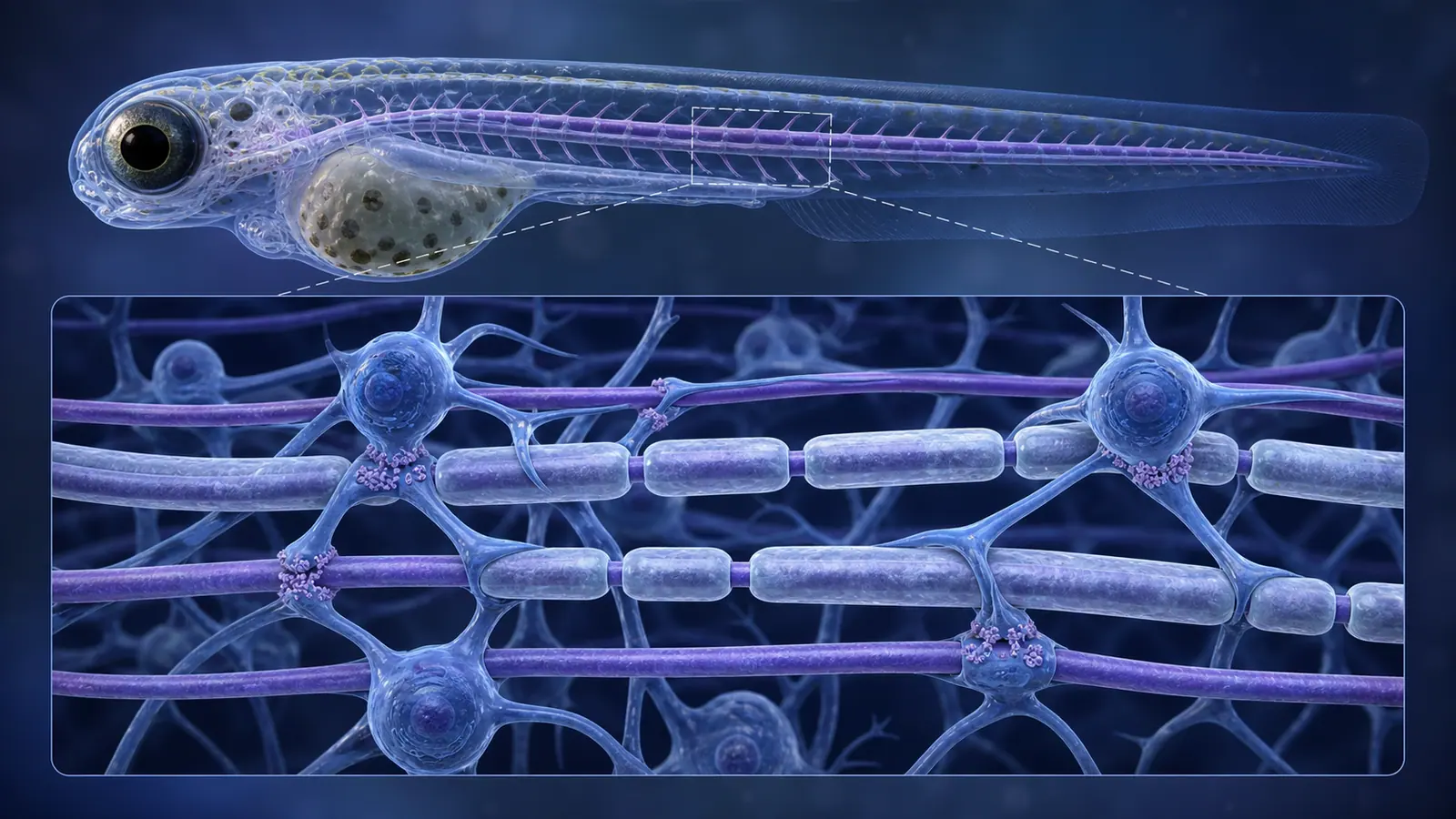
Myelin does not wrap axons at random. A study in Nature Communications shows that zebrafish oligodendrocyte-lineage cells use gephyrin—a protein best known for organising inhibitory synapses—to favour myelination of particular axon classes and constrain sheath length. The work links neuronal identity recognition to myelin architecture, although it does not yet establish that the same mechanism operates identically in mammals.
A synaptic scaffold inside a myelin-forming cell
In the central nervous system, oligodendrocytes extend processes that wrap axons in myelin. This insulation accelerates and organises signal propagation, but its distribution varies among circuits and neuronal classes. The signals that allow an oligodendrocyte to recognise axon identity remain only partly understood.
Gephyrin classically acts as a postsynaptic scaffold at synapses that use gamma-aminobutyric acid (GABA) or glycine, both inhibitory neurotransmitters. Earlier work detected postsynaptic proteins in oligodendrocyte precursor cells and suggested that neuronal contacts influence sheath formation. Carey, Doll and Appel asked whether gephyrin retains an axon-class recognition role beyond conventional neuron-to-neuron synapses.
The researchers used transgenic Danio rerio larvae in which oligodendrocytes, myelin or selected axon populations carried fluorescent labels. In vivo and confocal imaging enabled them to trace individual cells in the spinal cord and assign sheaths to GABAergic, glycinergic or glutamatergic axons. CRISPR-Cas9 mutant lines were used to study loss of gphnb, the zebrafish paralogue expressed predominantly in the nervous system.
Selective localisation and a later effect on sheath length
Gephyrin was enriched in myelin surrounding GABAergic and glycinergic axons. This distribution fits its known synaptic role but does not by itself establish function. The team therefore compared sheath architecture in wild-type larvae and larvae deficient in gphnb.
At three and four days post-fertilisation, dorsal oligodendrocytes showed no difference in sheath length or number. At seven days, sheaths were significantly longer in mutants. A complementation test using alleles from independent founders reproduced the phenotype, reducing the likelihood that an off-target mutation explained the result. Gephyrin therefore appears unnecessary for initiating every sheath but helps restrict growth as the observed myelin matures.
Loss of gphnb did not affect every axon association equally. In mutants, long sheaths more often occupied GABAergic axons, while the overall frequency of myelin placement on those axons was reduced. Put another way, fewer contacts were made with this class, but the contacts that remained could extend farther. The authors conclude that gephyrin contributes both to selecting GABAergic axons and to controlling the length of their myelin.
An experiment using tetrodotoxin to reduce neuronal activity added another piece. In wild-type larvae, treatment reduced sheath number and increased individual sheath length without changing cumulative length. Those parameters no longer responded in the same way in gphnb mutants. The long-sheath phenotype was therefore not simply explained by general mutant hyperactivity; gephyrin seems to affect how an oligodendrocyte translates activity into myelin architecture.
A powerful model with an incomplete mechanism
Zebrafish make it possible to observe myelination live at a resolution that is difficult to achieve in an opaque vertebrate. Larval transparency, axon-class reporters and genetic editing allow researchers to analyse a single cell and its sheaths within an intact circuit. This is particularly valuable for separating sheath number, length and target—three outcomes that a bulk measure of myelin could merge.
The model also sets clear limits. The observations focus mainly on larval spinal cord over a short developmental window. Gephyrin has multiple roles, including an enzymatic function in molybdenum cofactor biosynthesis. Targeting gphnb prioritised its nervous-system function, but whole-gene loss does not necessarily mimic a cell-specific intervention in an adult oligodendrocyte. The journal version available at the time of writing is also an accepted manuscript released before final copy-editing.
The study does not investigate remyelination after injury, improve an animal model of demyelinating disease or test a therapy. It identifies a developmental cell mechanism. Direct claims about multiple sclerosis or therapeutic targeting would therefore be premature.
Additional questions remain open. Gephyrin could organise a molecular contact at the axon–myelin interface, change signalling inside the oligodendrocyte or interact with activity-dependent pathways in more than one way. The experiments support a role in class-selective placement and growth control, but do not yet resolve the complete molecular sequence.
Implications for research facilities
For experimental design, the study is a reminder that total myelin quantity is an incomplete endpoint. Protocols should specify age, anatomical region, axon class, sheath number, length and spatial distribution. Genetic background, rearing temperature, density and imaging conditions should remain comparable because myelination changes rapidly during larval development.
Tetrodotoxin is a highly toxic laboratory reagent, not a husbandry or enrichment tool. Its use requires risk assessment, institutional procedures and interpretation restricted to the tested mechanism. Mutant lines likewise need allele-level genotyping and reporting rather than a generic “gephyrin loss” label.
Vetofish can support zebrafish protocol design, standardisation of rearing conditions and integration of imaging observations with health and behavioural indicators. Robust interpretation starts by distinguishing whether an intervention changes sheath length, number or targeting.
References
- Carey, N. J., Doll, C. A. & Appel, B. (2026). “Zebrafish oligodendrocyte lineage cells use the postsynaptic protein Gephyrin to myelinate GABAergic axons and limit myelin sheath growth.” Nature Communications. https://doi.org/10.1038/s41467-026-74902-3
- Carey, N. J., Doll, C. A. & Appel, B. (2024). “Oligodendrocytes use postsynaptic proteins to coordinate myelin formation on axons of distinct neurotransmitter classes.” Archived preprint in PubMed Central. https://pmc.ncbi.nlm.nih.gov/articles/PMC11580840/