

28 July 2026
Sand tiger shark trade tests aquarium traceability
A review documents rising sand tiger shark collections in Delaware Bay and calls for population assessment, lifelong traceability and demonstrable conservation returns for every permit.
- Sector
- Public aquariums
- Animal groups
- Fish
- Content type
- Scientific news
- Keywords
- TransportBiosecurityReproduction
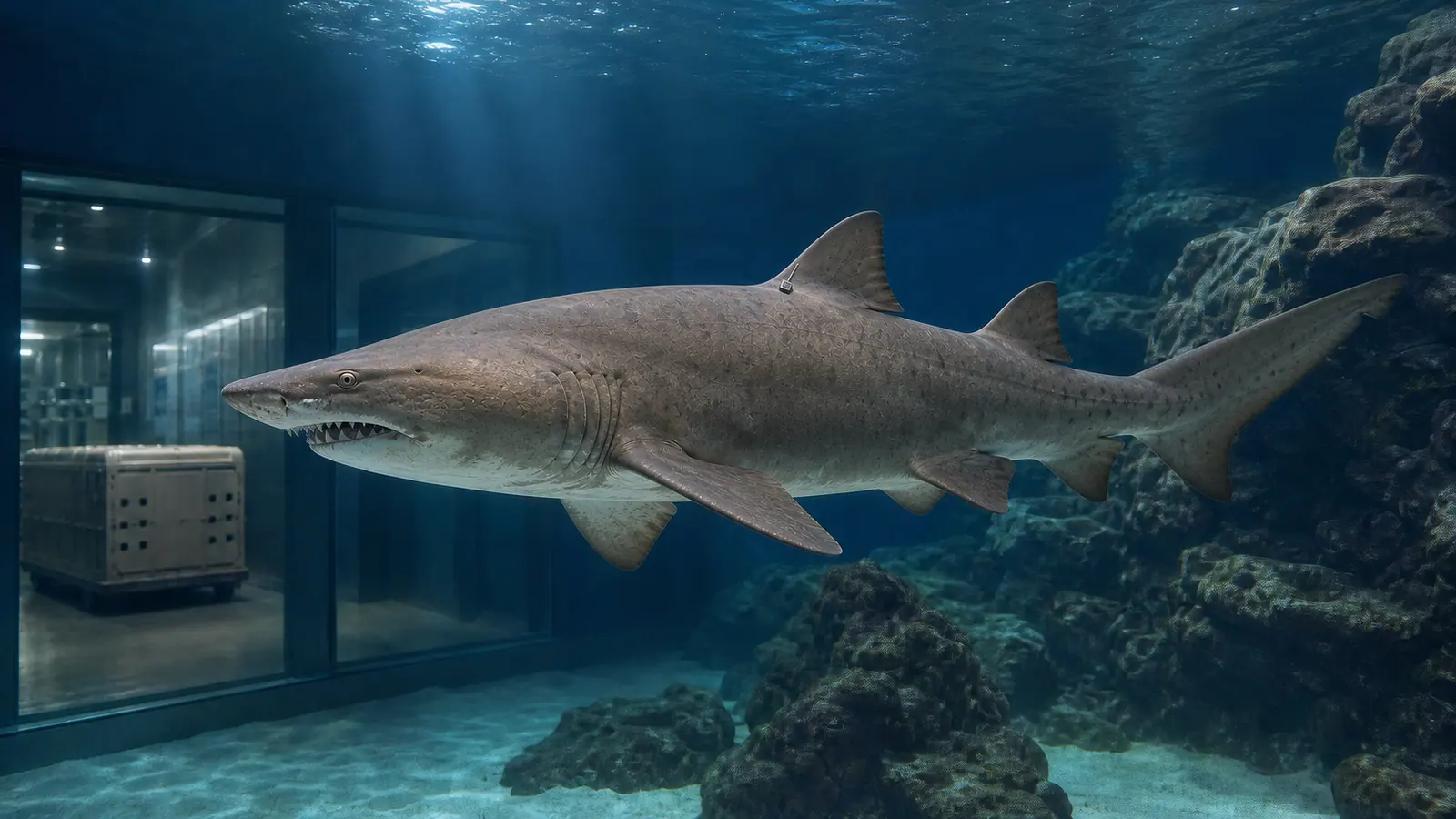
The sand tiger shark, Carcharias taurus, is a familiar flagship in large public aquariums yet is classified as Critically Endangered globally. A review in Frontiers in Conservation Science examines a practical contradiction: protected sharks are legally collected in Delaware Bay for an international display market even though the size and structure of the Northwest Atlantic population have not been formally assessed. The authors call for population-based decisions, lifelong traceability and measurable conservation returns.
Legal collection from an important habitat
The species is prohibited from routine landing in United States fisheries. An organisation seeking sharks for public display must obtain a federal Exempted Fishing Permit and then a state scientific collection permit when capture occurs in state waters. The removals discussed in the paper were therefore authorised. The question is whether the evidence required by that process is adequate and consistent with recovery objectives.
Delaware Bay is designated a Habitat Area of Particular Concern, identifying a particularly important or vulnerable part of essential fish habitat. Sand tiger sharks return seasonally and may aggregate there, making collection comparatively efficient. Such site fidelity also means that local removals could draw disproportionately from a particular population segment whose demographic importance is unknown.
Using Delaware Division of Fish and Wildlife records, the authors report that 80 sharks were collected from state waters between 2018 and 2024. Annual collection rose from two animals in 2018 to 40 in 2023 before falling in 2024. Those 80 sharks represented 27% of the 301 sand tiger sharks then reported in aquariums worldwide. For 2021–2024, when destination data were complete, approximately 90% were exported outside the United States, with China, the United Arab Emirates, South Korea and Thailand among the leading destinations.
Why large juveniles deserve particular attention
Collected sharks had a mean total length of 178.3 cm, with a standard deviation of 16.5 cm. Based on maturity sizes cited in the review, most were large juveniles and some were adults. Animals in this stage have survived the earliest and most vulnerable years and are approaching or beginning their reproductive contribution. For a late-maturing species with low fecundity and a long reproductive cycle, removing this cohort can matter more than taking the same number from a rapidly replenishing population.
The central evidence gap is equally clear. No formal stock assessment has been completed for the Northwest Atlantic population, and recent population trends and cumulative mortality have not been fully evaluated. The precise demographic impact of the 80 removals cannot therefore be calculated. The authors do not claim that aquarium collection is the leading threat; post-release mortality in recreational and commercial fisheries may be greater. Directed capture nevertheless adds to all other mortality sources.
A global Critically Endangered classification does not mean that every regional population has an identical status. The Northwest Atlantic population is considered one of the less threatened because of US fisheries management. “Less threatened”, however, is not synonymous with abundant and does not establish that any particular removal level is sustainable.
Traceability must continue after arrival
Delaware rules require annual status reports for collected sharks throughout their lives. According to the review, reporting and enforcement have not always been sufficient, partly because of limited administrative resources. For groups sent to the same destination in successive years, available information did not consistently reveal whether new sharks expanded the collection or replaced animals that had died.
That gap prevents reliable assessment of transport and long-term survival and weakens the evidence available for later permits. Useful traceability would link each shark’s identity to capture location and date, sex, size, destination, subsequent transfers, health status, any reproduction and date of death. These are not merely administrative details: they measure the true cost of removal and create feedback for improving care.
Aquarium breeding could eventually reduce reliance on wild collection. A sand tiger shark birth was achieved at a US aquarium in 2022 after sustained research. Yet late maturity, very low offspring production, long cycles and demanding spatial requirements make a self-sustaining managed population difficult. The authors therefore frame ex situ breeding as a complement to wild conservation, not an immediate licence for continued removals.
A more transparent decision framework
The review first recommends a stock assessment, population viability analysis, genetic work and tagging to determine how Delaware Bay sharks fit within the wider Northwest Atlantic population. It then proposes a public framework defining permissible numbers, individual follow-up and evidence that collection does not contribute to decline. In the authors’ view, organisations that remove and derive value from imperilled wildlife should help finance the assessment and species-specific conservation actions with demonstrable outcomes.
This is an evidence-based review and policy argument, not an experimental estimate of the causal effect of collection. Several numbers come from state administrative data, while some economic information and examples of illicit collection are anecdotal. Those limitations support the case for verifiable reporting but do not establish a precise sustainable threshold.
For public aquariums, responsible practice therefore extends beyond possessing a valid permit. It documents the origin of every animal, prioritises coordinated transfers and breeding, maintains lifelong records and states the expected conservation benefit in auditable terms. Welfare must be considered through capture, transport, acclimation and long-term care; survival alone is not a complete welfare outcome.
Vetofish can support health documentation, transport planning, individual records and monitoring indicators that make traceability operationally useful. Displaying a threatened species should be defensible with evidence, not only through a general educational intention.
Reference
- Carlisle, A. B., Fox, D. A., Hale, E. & Wetherbee, B. M. (2026). “Reconciling conservation and management objectives with the international aquarium trade of the globally critically endangered Sand Tiger Shark.” Frontiers in Conservation Science, 7. https://doi.org/10.3389/fcosc.2026.1797608