

21 July 2026
Zebrafish assays: the solvent can alter behaviour
A seven-solvent study shows that the vehicle can alter zebrafish larval locomotion and confound behavioural results unless controls are carefully designed.
- Sector
- Research facilities
- Content type
- Scientific news
In a zebrafish larval assay, the test compound may not be the only biologically active component. The solvent used to deliver it can increase or suppress swimming and distort a behavioural endpoint. A study published in Scientific Reports on 23 June 2026 compared seven common solvents at four concentrations. Its findings offer useful design benchmarks, but they are not universal safety thresholds for every strain, life stage or protocol.
Seven vehicles tested within one experimental framework
The researchers examined dimethyl sulfoxide (DMSO), ethanol, methanol, acetone, acetonitrile, isopropanol and ethyl acetate. Each was prepared in E3 medium at nominal concentrations of 0.05%, 0.1%, 0.5% and 1% by volume, alongside a solvent-free E3 control. Exposure was static and continued until 120 hours post fertilisation (hpf).
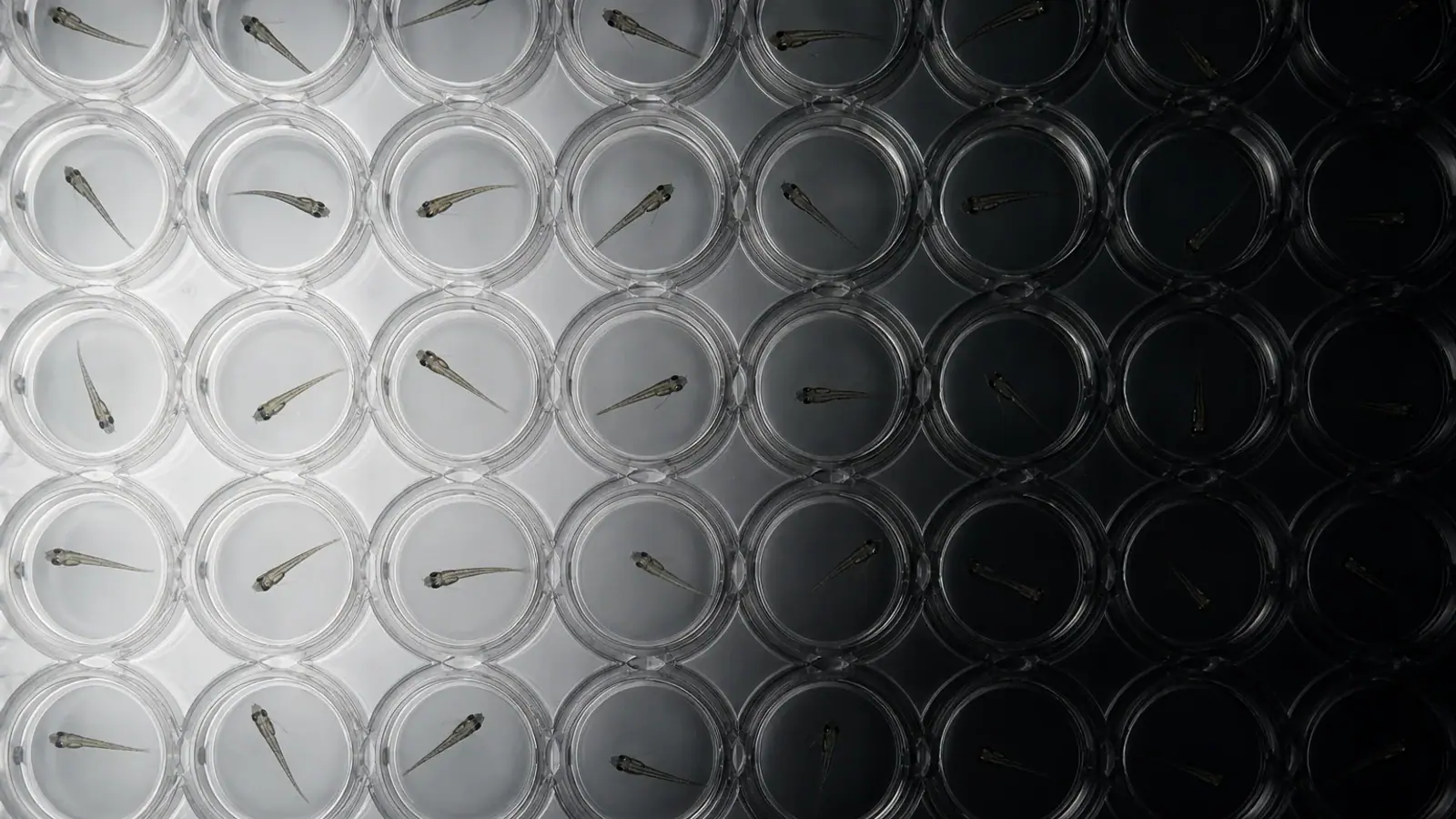
Three independent replicates were performed by three operators. Each replicate assigned 40 embryos to every solvent concentration and the control, giving 120 planned individuals per condition. Treatments were interspersed within and across several 96-well plates to reduce systematic position effects. Plates were maintained at 27.5 ± 0.5 °C.
At 120 hpf, larvae underwent ten minutes of dark acclimation followed by twenty minutes of automated tracking in a DanioVision chamber. The programme alternated five-minute light and dark periods. Recorded endpoints included distance, velocity, acceleration, mobility states and turning. These measurements describe integrated locomotor responses; they do not independently establish a specific neurotoxic mechanism.
Solvent identity and concentration changed the response
Ethanol, methanol, acetone and isopropanol induced hyperactivity at concentrations of 0.5% or above under the study conditions. DMSO produced a biphasic pattern. At 0.5%, distance increased by 23.7% in light and 17.6% in darkness. At 1%, dark-phase movement fell by 13.1%, while time classified as highly mobile decreased by 19.2%.
Acetonitrile stood out for significant inhibition at 0.5%. Ethyl acetate could only be assessed behaviourally at 0.05% and 0.1% because higher concentrations compromised viability before testing. Neither low concentration produced a significant change in the measured behavioural endpoints.
No significant locomotor alteration was detected for acetone and ethyl acetate up to 0.1%, or for DMSO, ethanol, methanol, acetonitrile and isopropanol at 0.05%. This is not evidence of general biological harmlessness. It means that the study did not detect an effect on its selected locomotor endpoints in 120-hpf WIK larvae after this exposure, in this medium and with this statistical power.
Illumination outweighed the solvent label
In the multivariate analysis, the first two principal components explained more than 80% of total variance. Light and dark phases produced the strongest separation, exceeding the influence of solvent identity or concentration. A different light schedule, phase duration or acclimation procedure can therefore hide a chemical effect or make two datasets appear incompatible.
A vehicle control only resolves this problem if it follows exactly the same timeline as the treated group: same plate, temperature, clock time, acclimation, illumination sequence and recording duration. A solvent-free E3 control is also required to quantify the vehicle’s own effect. Comparing a dissolved compound only with its vehicle control cannot reveal whether the vehicle has shifted the behavioural baseline.
Turning the evidence into a design rule
Before selecting a vehicle, teams should document compound solubility, the minimum final solvent concentration and stability in the exposure medium. The relevant concentration is the value in the exposure well after every dilution, not the stock solution. Calculations, lots, time between preparation and exposure, container materials and mixing steps should be traceable.
A pilot study can then compare realistic vehicle concentrations with a solvent-free control. Acceptance criteria should be prespecified: survival and development, but also the primary behavioural variable, dispersion, exclusions and the largest effect considered compatible with the study objective. An absence of mortality or malformation does not rule out a sublethal locomotor bias.
Where test compounds require different solvent concentrations, every final vehicle level needs its corresponding control. Otherwise, an apparent compound dose-response may partly reflect the rising vehicle concentration. If one vehicle concentration is applied across all treatments, it should be identical and at least match the highest final level in the series, provided that level has been validated for the endpoint.
Reporting should make the control structure reconstructable. ARRIVE-aligned methods can specify randomisation, experimental unit, plate layout, operator, time window, light programme and criteria for missing tracks or non-viable larvae. Raw trajectories and analysis settings are especially valuable because reprocessing may reveal whether a finding depends on one threshold used to classify mobility.
Limits: benchmarks rather than a safety table
The study used the WIK strain, a single 120-hpf stage, static exposure and a light-dark locomotor assay. It did not test other strains, adult fish, chronic exposure beyond that stage or the pharmacokinetics of the dissolved compound. Concentrations were nominal: solvent density was not incorporated into the percentage calculations, and analytical measurements of well concentrations were not reported.
The results therefore do not replace OECD Test Guideline 236 when conducting a regulatory fish embryo acute toxicity test. Where a solvent is required, that guideline calls for a dedicated solvent control and sets a maximum liquid-solvent concentration of 0.01% by volume. Vujović and colleagues addressed a different question: when does a vehicle begin to change a defined behavioural endpoint? The two forms of guidance are complementary, not interchangeable.
The European regulatory context also requires careful wording around life stage. Directive 2010/63/EU covers independently feeding larval vertebrates and earlier forms if they are allowed to live beyond that stage. The authors report that procedures up to 120 hpf were treated as non-protected embryonic stages under their applicable framework. Facilities must still follow their national transposition, institutional authorisations and local animal-welfare oversight rather than extrapolating a single paper’s ethics statement.
Conclusion: treat the vehicle as an experimental factor
The operational lesson is straightforward: a solvent belongs in the experimental model as a potentially active factor, not merely in a preparation note. Its selection, final concentration, matched control and illumination timeline should be justified and reported. That discipline protects biological interpretation and cross-laboratory comparability.
Vetofish can support research facilities with aquatic protocol review, control design, confounder analysis and standardised husbandry and assay metadata. The goal is not to prescribe one universal solvent, but to demonstrate that the selected vehicle is compatible with the endpoint being measured.
References
- Vujović, T., Begić Biškup, K., Bojanić, K., Čož-Rakovac, R. & Babić Brčić, S. (2026). “Comparative assessment of behavioural alterations induced by common laboratory solvents in zebrafish (Danio rerio) larvae.” Scientific Reports. Published online 23 June 2026. https://doi.org/10.1038/s41598-026-59476-w
- Organisation for Economic Co-operation and Development (OECD) (2025). Test No. 236: Fish Embryo Acute Toxicity (FET) Test, OECD Guidelines for the Testing of Chemicals, Section 2. https://doi.org/10.1787/9789264203709-en
- European Parliament and Council of the European Union (2010). Directive 2010/63/EU of 22 September 2010 on the protection of animals used for scientific purposes. https://eur-lex.europa.eu/eli/dir/2010/63/oj/eng