

23 July 2026
Hydrokinetic turbines: how do juvenile trout respond?
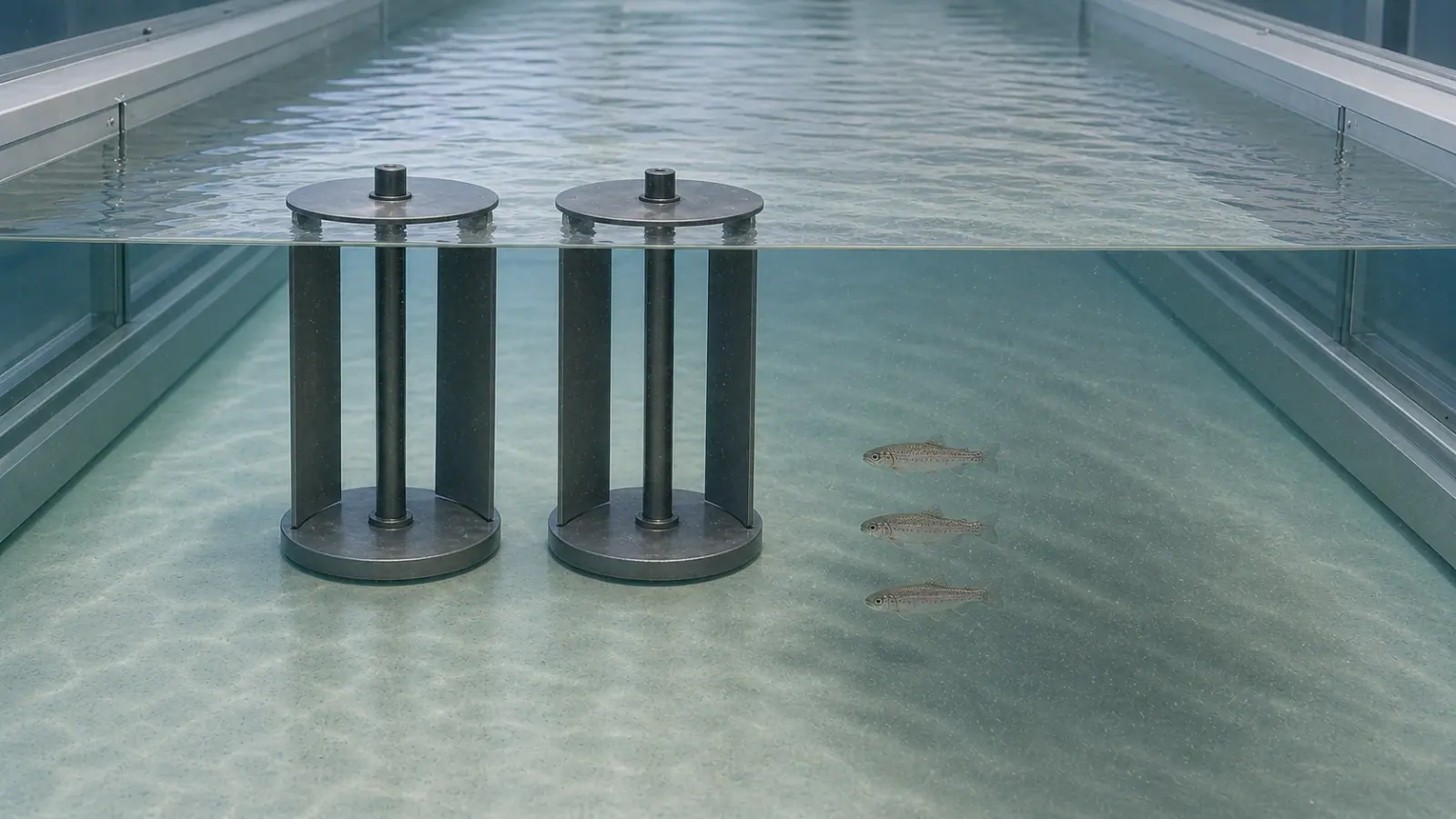
In a laboratory flume, juvenile trout passed small hydrokinetic turbines while adjusting their swimming behaviour to the wake and social setting.
- Sector
- Environment
- Content type
- Scientific news
- Keywords
- EthogramStressTemperature
Hydrokinetic turbines generate electricity from moving water without necessarily requiring a large impoundment. Their use in rivers and channels nevertheless raises a practical question: how does a fish respond when it encounters moving blades and a turbine wake? A study published in Scientific Reports provides experimental evidence from juvenile rainbow trout. In a laboratory flume, the fish continued to pass through the turbine area and no visible injuries were found. Their behaviour did, however, vary with turbine configuration and with whether they swam alone or in a shoal.
The findings can inform more realistic environmental testing. They do not demonstrate that a full-scale turbine is harmless: the experiment used small models, one species, one life stage and tightly controlled conditions.
Five configurations in a recirculating flume
The researchers used 80 female, triploid juvenile rainbow trout (Oncorhynchus mykiss). Mean total length was 67.5 ± 10.7 mm. The analysis covered 19 shoals of three fish and 16 fish tested individually.
Trials took place in a 10 m-long, 1.2 m-wide and 0.3 m-high recirculating open-channel flume. The filmed working area measured 1.2 × 1.2 m under a water depth of 0.23 m. Water temperature was maintained at 14 ± 1 °C. At a discharge of 53 L/s, bulk flow velocity was 0.19 m/s.
The laboratory vertical-axis turbines were 0.12 m in both diameter and height and had three straight blades. Together, the devices blocked 25% of the flume cross-section, leaving open corridors beside them. The team compared a control without a turbine, a stationary turbine, a rotating turbine and two twin-turbine arrangements with the rotors turning either in the same or opposite directions. Operating turbines turned at 59 rpm, with a tip-speed ratio of 1.9.
After acclimation, each trial lasted ten minutes. An overhead camera recorded at 55 frames per second. Video tracking mapped position, swimming speed, resting periods, tailbeat frequency and passages between the upstream and downstream parts of the observation area.
Passage continued, but swimming behaviour shifted
Across configurations, the trout spent approximately 25% of their time upstream of the turbines and 75% downstream. Turbine presence or rotation therefore did not eliminate use of the upstream area. Passage counts did not generally decrease and were higher in one co-rotating twin-turbine configuration.
This lack of complete avoidance does not mean that behaviour was unchanged. With twin turbines, fish spent an average of 123 seconds—or 20.5% of the ten-minute trial—in the near wake. Immediately downstream of the rotors, this region combines reduced velocities with turbine-generated turbulence.
Tailbeat frequency provided another indicator. Its overall value in the control was 14.6% higher than in several operating-turbine configurations. Mean tailbeat frequency in the far wake was 4.9 Hz across rotating treatments. Shoals exposed to twin turbines had a frequency approximately 21% lower than in the control and single-turbine cases. The authors interpret these differences as a possible adjustment to areas where fish can reduce effort, rather than direct proof of a measured energy saving.
Social setting also affected the response. In the single-turbine comparison, individually tested trout rested for 181 seconds longer than shoaling fish. Testing isolated individuals alone would therefore have provided an incomplete picture of the interaction with the equipment.
No visible harm in the trial is not a field guarantee
Survival was 100%, and no fish had visible injuries after the trials. Encounters with blades were rare, with no significant strikes reported. That is reassuring within the tested conditions, but its meaning must remain strictly bounded.
The turbine models were only 12 cm across. Their wakes, blade-tip velocities and associated pressure fields cannot reproduce every feature of a full-scale installation. The flume was straight, shallow and free of the obstacles, discharge variation, thermal gradients and refuges found in a river. Fish had lateral routes around the devices and were not forced through a rotor.
The study also examined juvenile triploid females from a species with relatively strong swimming performance. Larvae, large adults, benthic fish or weaker-swimming species may respond differently. Ten-minute observations describe an immediate encounter, not long-term attraction, avoidance, fatigue or the cumulative effects of repeated exposure. Finally, tailbeat frequency and resting are behavioural measures; they cannot substitute for metabolic measurements or physiological stress markers.
Implications for environmental assessment
The experiment first shows why collision counts alone are insufficient. An assessment should combine passage with detailed maps of trajectories, residence time in each hydrodynamic zone, swimming speeds and resting behaviour. Comparing a stationary turbine with an operating one is critical for separating the effect of a physical obstacle from that of blade motion and the wake.
It also demonstrates that the experimental unit matters. Individual trials simplify tracking, but isolation can substantially alter rest and exploration. Where a species forms groups, shoaling trials are needed, supported by an analysis that accounts for dependence among fish. Body size, life stage, water temperature, current speed, water depth and rotor dimensions should all be reported so that results can be compared.
For a field project, the findings support retaining bypass routes and characterising the low-velocity zones created downstream. They also favour a staged approach: hydrodynamic testing, behavioural observations across several species and size classes, followed by in situ monitoring at representative flows. A favourable laboratory result in juvenile trout does not replace a site-specific environmental assessment or post-installation surveillance.
Vetofish can help design protocols that connect fish behaviour, hydrodynamics and health observations. The objective is not merely to confirm survival after an encounter, but to determine whether fish can move without excessive effort, disorientation, injury or a lasting change in habitat use.
References
- Sonnino Sorisio, G., Müller, S., Wilson, C. A. M. E., Cable, J., Ouro, P. et al. (2026). “Impact of hydrokinetic turbines on rainbow trout behaviour.” Scientific Reports, 16, 13652. https://doi.org/10.1038/s41598-026-43568-8
- Sonnino Sorisio, G. et al. (2026). Source data associated with the study, Mendeley Data, version 1. https://doi.org/10.17632/xmrptb6mjw.1