

18 July 2026
An edible bacterial carrier advances oral vaccination against fish nodavirus
Virus-like nodavirus particles carried inside Lactococcus lactis reduced brain viral load in orally vaccinated Asian seabass, offering a promising but still experimental platform.
- Sector
- Aquaculture
- Animal groups
- Fish
- Content type
- Scientific news
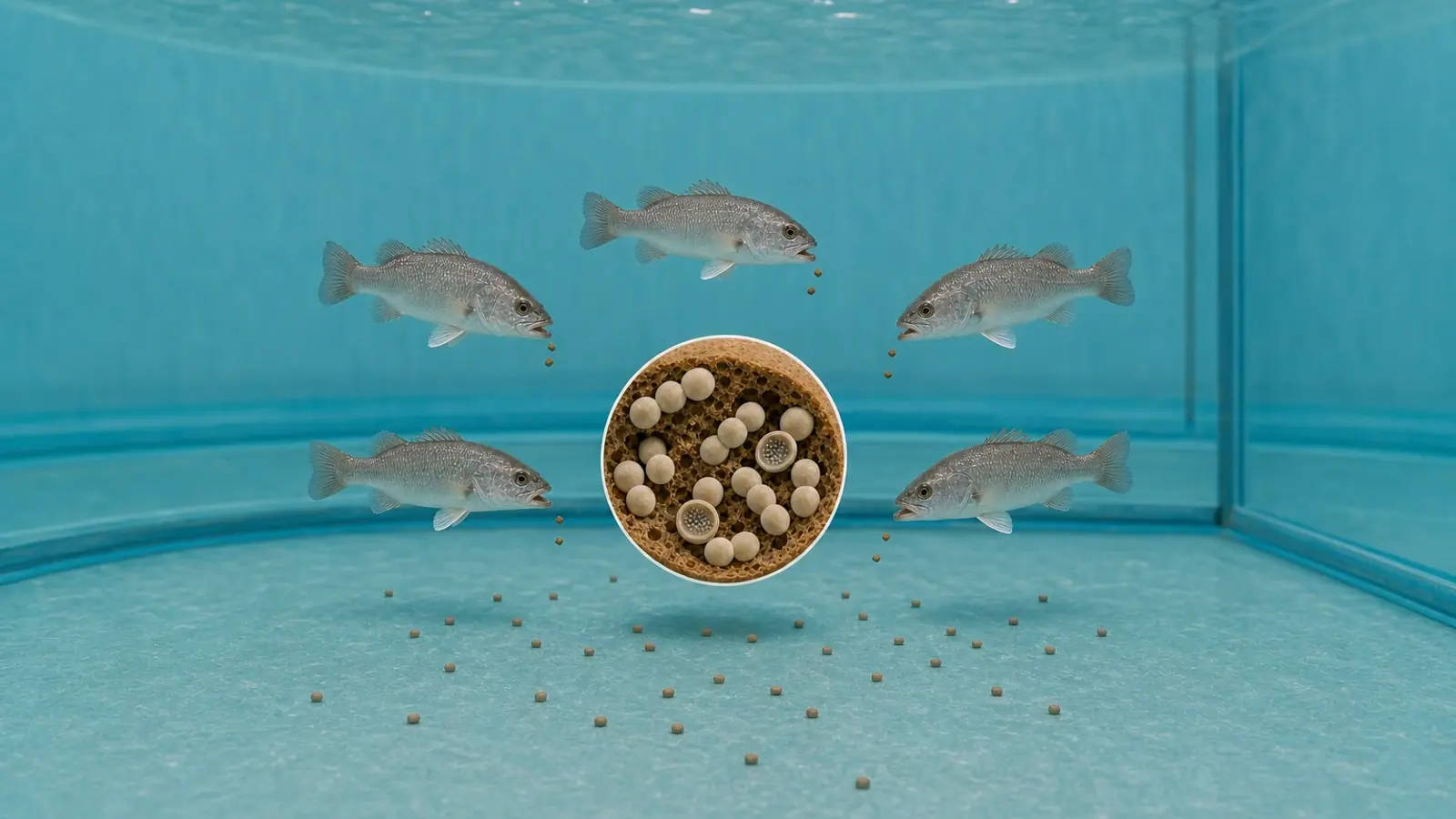
Vaccination through feed could reach fish that are too small or too numerous for individual injection. Delivering antigen by mouth, however, is not simply a matter of adding a vaccine to pellets. The material must survive manufacturing, storage, contact with water and digestion before reaching immune tissues in a recognisable form. A February 2026 study in Fish & Shellfish Immunology reports a new approach to this problem for nervous necrosis virus (NNV) in Asian seabass (Lates calcarifer).
The researchers engineered the food-grade bacterium Lactococcus lactis to produce the NNV capsid protein. Inside the bacterial cells, that protein assembled into virus-like particles (VLPs): repetitive antigenic structures that resemble the viral surface but do not constitute a complete infectious virus. Crucially, performance depended on how the carrier cells were inactivated. Live and heat-treated cells did not provide the intended oral response, whereas hypochlorite-inactivated cells preserved the particles, improved the measured antibody response and reduced brain viral burden after experimental challenge.
A neurological disease of marine fish
Viral nervous necrosis is also known as viral encephalopathy and retinopathy. The World Organisation for Animal Health diagnostic chapter describes a serious disease of several marine fish species, characterised by vacuolating lesions in the central nervous system and retina. Betanodavirus infections can cause substantial losses, with larvae and juveniles often the most vulnerable production stages.
Affected fish may show abnormal or circular swimming, loss of balance, altered buoyancy and reduced feeding, depending on species, age and farming conditions. None of these observations is diagnostic on its own. A proper investigation connects clinical signs and mortality with water temperature, batch history, animal movements and recent husbandry events. Histopathology can identify characteristic vacuolation, while RT-PCR detects viral RNA in target tissues such as brain and eye.
Vaccination research therefore sits within, rather than outside, a broader health programme. Even an effective future feed vaccine would not replace broodstock and juvenile surveillance, batch separation, prompt investigation or laboratory confirmation.
Building a non-infectious mimic inside a food bacterium
The study used the capsid protein of a grouper NNV representative of the RGNNV genotype. When expressed in L. lactis, capsid molecules self-assembled into large particles displaying repeated copies of the viral antigen. Because a VLP does not contain the viral genome needed for replication, it can reproduce important structural signals without delivering an infectious betanodavirus.
Previous work produced NNV VLPs in Escherichia coli and demonstrated experimental protection in orange-spotted grouper larvae. The 2026 study asked whether a food-grade organism could act as both production unit and delivery capsule. In principle, this could reduce purification requirements and shield antigen during oral administration. In practice, enclosing antigen inside a bacterium creates another challenge: the particle still has to be released in an immunologically useful state.
The team compared purified VLPs delivered by injection or orally with VLPs enclosed in live, heat-inactivated or sodium-hypochlorite-inactivated L. lactis. Asian seabass fingerlings were vaccinated and subsequently exposed to NNV under controlled challenge conditions.
Processing the carrier changed the immune outcome
Intraperitoneal injection of purified VLPs produced NNV-specific IgM titres approximately four times higher than oral delivery, despite using one-tenth of the antigen dose. The comparison illustrates a central limitation of feed vaccination: the amount offered is not the same as the amount that remains intact and reaches the relevant immune surfaces.
Live recombinant bacteria and heat-inactivated cells failed to induce protective neutralising antibodies through oral delivery. The authors attribute this result to poor antigen release. Heating did not solve the accessibility problem, even though the cells contained the target protein.
Hypochlorite inactivation produced a different result. It maintained VLP encapsulation, solubility and structural integrity while apparently making the antigen more available. At equivalent antigen doses, orally delivered hypochlorite-inactivated cells generated antibody and neutralising titres about twice those achieved with orally delivered purified VLPs.
Seven days after viral challenge, NNV load in the brain was reduced by approximately 2.5 log in the selected formulation. On a base-ten scale, that represents a difference of several hundred-fold. It is a meaningful biological endpoint, but it must remain attached to the sampled tissue, time point and experimental comparator.
Promising efficacy is not yet field authorisation
The study should not be reported as a commercial protection rate. Its published abstract does not provide a survival percentage that could support claims about preventing farm mortality. The work covers one host species, a juvenile stage, a defined viral challenge and a specific schedule. Lower brain viral load at day seven does not by itself establish duration of immunity, reduction of transmission, lifetime performance or cross-protection against all NNV genotypes.
The platform is also a recombinant prototype. Development will require reproducible VLP manufacture, complete and consistent carrier inactivation, stability through feed processing and storage, uniform intake, environmental safety and regulatory assessment. Feed delivery introduces biological variation: subordinate, stressed, anorexic or already diseased fish may eat less and receive a smaller dose than the population mean suggests.
The phrase “hypochlorite-inactivated” refers to a controlled manufacturing step. It is not an instruction to add disinfectant to vaccine feed or culture water. Residual chemistry, complete bacterial inactivation, antigen integrity and final-product safety all require validation before any application outside an authorised experimental protocol.
Why this result matters for vaccine design
The main advance is the demonstration that carrier processing can determine whether an enclosed antigen remains immunologically useful. Heat treatment and chemical inactivation were not interchangeable. Any scale-up will need to monitor the relationship between process conditions, particle structure, release and biological response rather than assuming that a positive laboratory formulation will tolerate manufacturing changes.
Further trials should compare the candidate with unvaccinated controls, purified VLPs and an appropriate reference vaccine where available. Predetermined endpoints should include survival, viral load, neurological signs, shedding, growth and adverse effects. Farm-scale studies will also need to account for appetite, social competition, pellet stability, water quality and batch-to-batch variation.
For now, suspected NNV events still demand rapid diagnosis, biosecurity and disciplined movement control. Vetofish can support sampling plans, interpretation of virology and histopathology, risk-factor analysis and the design of appropriately governed vaccine trials. The 2026 study moves oral immunisation a credible step forward, particularly for young marine fish, but its value lies in defining the next validation questions—not in bypassing them.
References
- Hong HY, Carmen LCP, Chee PX, Ying LX, Wong ZW, Chan J, Prabakaran M, Yang D. “Oral vaccination via virus-like particles encapsulated in Lactococcus lactis.” Fish & Shellfish Immunology. 2026;169:111013. doi:10.1016/j.fsi.2025.111013.
- Chien MH, Wu SY, Lin CH. “Oral immunization with cell-free self-assembly virus-like particles against orange-spotted grouper nervous necrosis virus in grouper larvae, Epinephelus coioides.” Veterinary Immunology and Immunopathology. 2018;197:69–75. doi:10.1016/j.vetimm.2018.01.012.
- World Organisation for Animal Health. “Viral encephalopathy and retinopathy.” Manual of Diagnostic Tests for Aquatic Animals, Chapter 2.3.12. Open the chapter.