

18 July 2026
Breeding Xenopus without hormone injections: can simulated rain refine embryo production?
A study involving twelve Xenopus laevis obtained embryos by simulating spring and rainfall rather than injecting hCG. The feasibility signal is encouraging, but refinement and reduction still require comparative measurement.
- Sector
- Research facilities
- Animal groups
- AmphibiansXenopus
- Content type
- Scientific news
- Keywords
- ReproductionStressTemperature
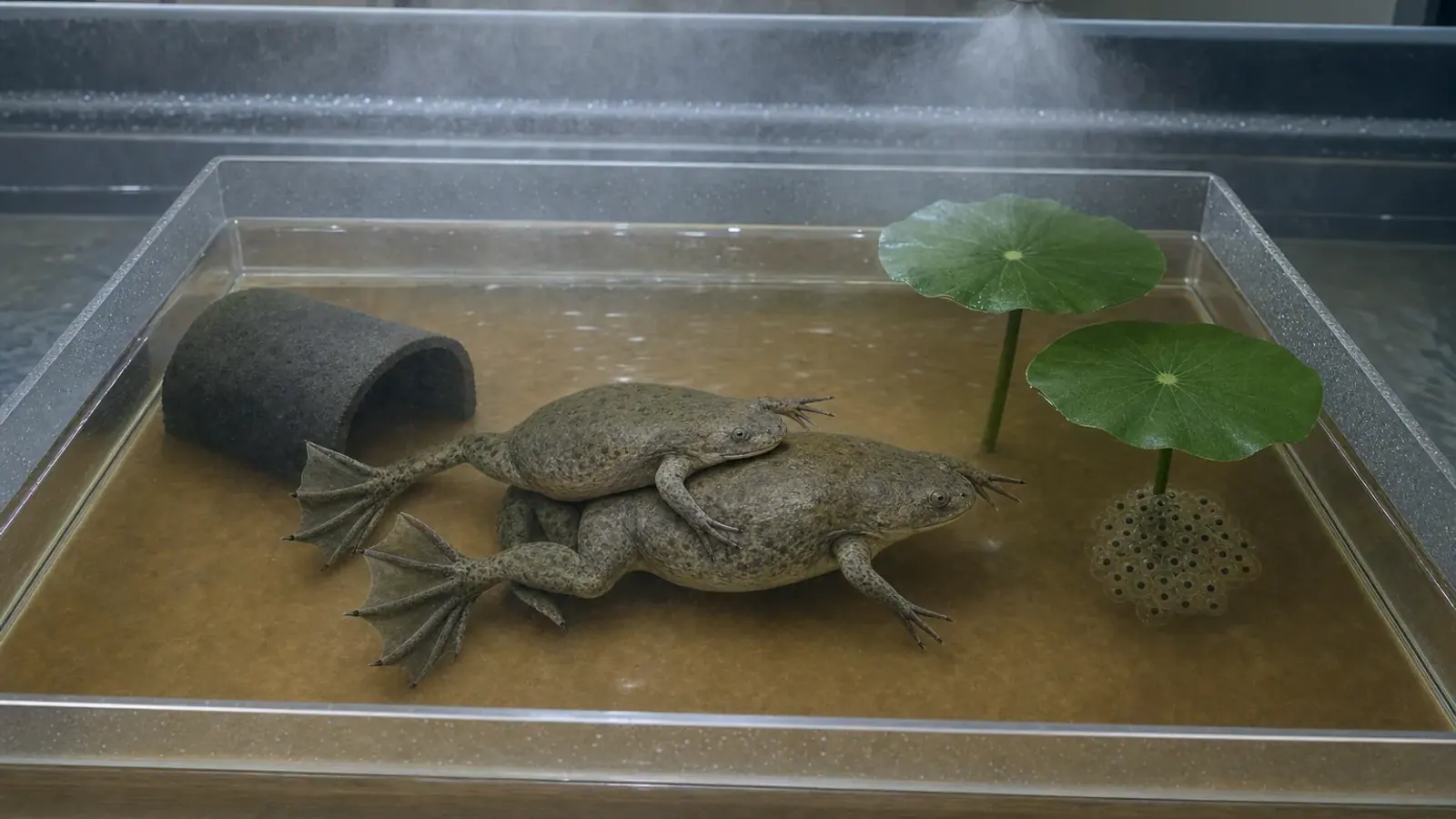
Producing Xenopus embryos without injecting hormones into adult frogs is the aim of a new report from the University of Milan in Laboratory Animals. The team adjusted housing conditions for twelve adult Xenopus laevis, then simulated rainfall and gradual water warming before pairing one male and one female overnight. Ten of the twelve animals responded to the conditions, and successful pairs produced live embryos that developed into healthy tadpoles.
The demonstration is relevant to facilities using Xenopus in developmental biology and toxicology. Human chorionic gonadotropin (hCG) makes year-round spawning possible but requires restraint and skin penetration. Environmentally induced amplexus could remove that intervention and, if adults can breed again sooner, reduce the size of the breeding colony. Yet the study did not measure distress, reproductive output or embryo quality against a hormone-treated control. It establishes feasibility in one facility; it does not establish a universal standard.
An aquatic amphibian supporting diverse research
The African clawed frog, Xenopus laevis, is a fully aquatic amphibian native to southern Africa. Its large embryos develop outside the female and are readily observed and manipulated. Those characteristics have made the species important in embryology, cell biology, genetics, physiology and toxicology. The Frog Embryo Teratogenesis Assay–Xenopus (FETAX), for example, exposes embryos during organogenesis to investigate the effects of chemicals and complex mixtures.
Facilities commonly obtain fertilised eggs by administering hCG. The paper notes a recommended resting interval of two to three months before adults are used again. Captive breeding was historically encouraged by temperature changes that mimicked spring rains, but this approach was considered seasonal and less predictable.
In natural spawning, a male grasps the female in dorsal pelvic amplexus during the night and fertilisation occurs externally. Reproductively ready males develop dark nuptial pads on the underside of their forearms, while females have swollen cloacal lips. The Milan group used these visible features to identify readiness instead of beginning with pharmacological stimulation.
Twelve adults under spring-like conditions
The colony comprised six males and six females. Sexes were housed separately while stable social groups of three to six animals were retained. Brown 27-litre tanks provided 13 cm of water, shelters and artificial water lilies. The recirculating system maintained water at 20.5 ± 1°C, pH 7.5 ± 1, conductivity 1,150 ± 250 µS/cm and flow of 30 mL/min. Air temperature was 20 ± 2°C, with routine relative humidity of 40–60%.
Water variables were monitored continuously, and qualified technicians examined the animals daily. Adults were fed twice weekly. Veterinary inspection occurred weekly, with pathogen screening twice a year or when requested. These details define the tested system; they are not evidence that identical values will be optimal for every strain, age or facility design.
All twelve adults developed the morphological features interpreted as reproductive readiness. That observation suggests the husbandry environment supported sexual preparation, but there was no comparator group under a different regime to identify which variables were decisive.
Simulated rain followed by overnight pairing
On the morning before pairing, ultrasonic foggers directed above the tanks raised air humidity to 100%. The reported operating output was 200 mL/h. Late in the afternoon, one male and one female entered a mating tank containing water at 18°C. This tank sat within a thermostatically controlled aquarium at 22°C, allowing the mating water to warm gradually.
Pairs remained together overnight, matching the species’ normal timing of amplexus. The next morning, adults returned to their housing system, and eggs were examined with a dissecting microscope for fertilisation and developmental stage. If mating did not occur, “rain” stimulation could be repeated twice weekly until success or for a maximum of seven cycles.
Two males—one wild type and one albino—did not respond. The remaining animals paired and produced what the authors described as large numbers of live embryos capable of becoming healthy tadpoles. The first fertilised clutch required one to five rain cycles. A resting period of approximately three weeks was sufficient for another successful mating.
Plausible refinement, unproven reduction
Avoiding intralymphatic hCG injection removes the restraint and needle penetration associated with that procedure. Natural amplexus therefore has a credible refinement rationale under the 3Rs. A three-week interval, shorter than the two to three months cited after hormonal stimulation, might also enable a facility to meet a defined embryo demand with fewer breeders.
However, the report does not give clutch sizes, fertilisation percentages, abnormalities, larval survival or variation among breeding events. It does not compare behaviour, lesions or physiological stress markers with an hCG-treated group. The claim that the protocol minimises distress is therefore a reasonable hypothesis, not a measured effect. Reduction will depend on actual embryo demand, failure rates, scheduling and the need to maintain adequate genetic diversity.
Environmental stimulation must also be assessed rather than assumed benign. Saturated air, temperature change, repeated pairings and as many as seven cycles could affect animals differently. Monitoring should cover escape attempts or aggression, skin condition, feeding, recovery and humane stopping criteria. The two non-responsive males demonstrate why repeated stimulation should trigger individual reassessment rather than continue automatically.
Building a local validation study
A facility interested in this approach should design a comparison with its veterinarian, animal-welfare body and scientific users. Endpoints could include amplexus success, time to spawning, clutch size, fertilisation, normal development, adult reuse and animal-based welfare indicators. Water, air, photoperiod, enrichment and health data should be recorded for each attempt.
Reproducibility remains to be tested across wild-type, albino and genetically modified lines, as well as across ages, reproductive histories and seasons. A stopping plan should limit repeat cycles after failure and identify an alternative when scientific embryo requirements cannot be met. The goal is not to exchange one rigid routine for another, but to select the least burdensome method that supplies embryos of documented quality.
Husbandry as an experimental and welfare variable
This study makes a broader point: housing conditions are not merely background. They can shape reproductive physiology and become an active refinement tool. In this group of twelve frogs, spring-like husbandry, simulated rain and gradual warming supported hormone-free breeding in most animals. The result warrants controlled, multicentre evaluation rather than immediate acceptance of the authors’ proposed “gold standard” label.
Vetofish can help research facilities review breeding practices, define animal-based welfare measures, plan local comparisons and incorporate the findings into standard operating procedures and colony health surveillance.
References
- Menegola, E., Di Renzo, F., Bacchetta, R. & Battistoni, M. (2025). Advancing animal welfare: A natural mating protocol for Xenopus laevis. Laboratory Animals, 59(6), 722–726. https://doi.org/10.1177/00236772251351091