

17 July 2026
Wild fish anaesthesia: recovery continues long after release
Whole-lake telemetry shows that tagged fish may need several days to resume behaviour comparable with controls, long after equilibrium has returned.
- Sector
- Environment
- Animal groups
- Fish
- Content type
- Protocol / technique
Is a fish fully recovered simply because it swims upright after release? For field teams that capture, sedate or immobilise and then tag wild fish, the answer matters to animal welfare and to the validity of the resulting data. A Canadian whole-lake study tracked northern pike and largemouth bass after acoustic transmitter implantation. Its results show that a return to behaviour comparable with control fish can take days rather than minutes. They also suggest that choosing between MS-222 and electro-immobilisation explains only part of the disturbance caused by the full tagging event.
Watching post-release behaviour across an entire lake
The study ran from May 2023 to May 2024 in Lindsay Lake, Ontario, a waterbody of approximately 16 hectares with a maximum depth of about 10 metres. Thirty-three acoustic receivers, plus one in the channel to neighbouring Poole Lake, reconstructed fish movements with no more than roughly 100 metres between adjacent receivers. Positions with an excessive estimated error were removed from the analysis.
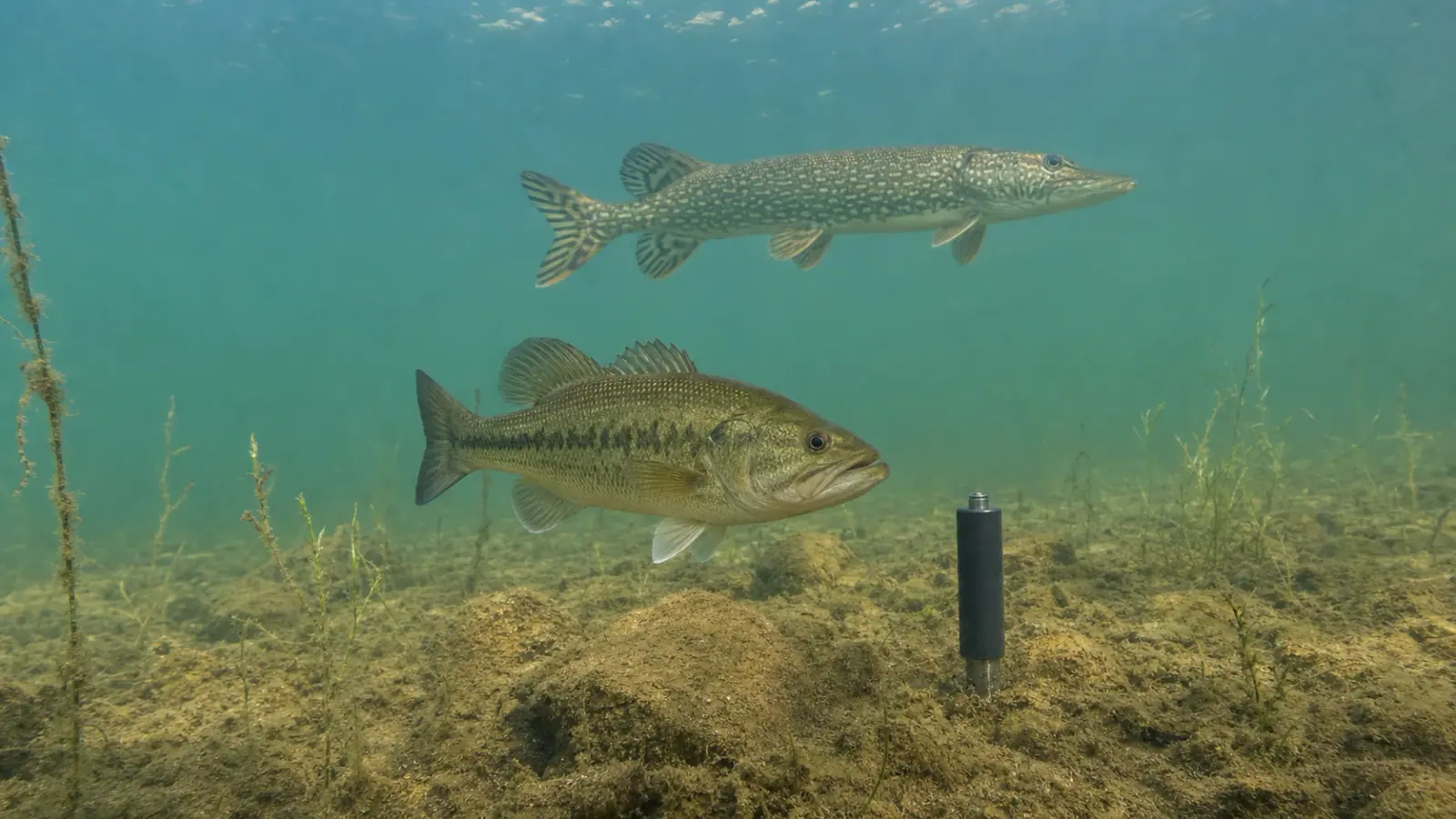
Researchers angled 48 northern pike (Esox lucius) and 54 largemouth bass (Micropterus nigricans), landing each fish in under 60 seconds. Newly tagged fish received a small acoustic transmitter in the peritoneal cavity through a 5–10 mm incision closed with one suture. Throughout the procedure, the fish lay supine in a wet sling while their gills were continuously irrigated with aerated lake water.
Two immobilisation approaches were compared. One group entered a buffered 100 mg/L MS-222 bath until it showed complete loss of equilibrium, slower ventilation and no response. The other received transcutaneous electrical nerve stimulation, or TENS, at 150 Hz and a 300-microsecond pulse width, with intensity increased gradually until the fish became immobile and unresponsive. Control animals had already carried transmitters for at least six months. They offered a behavioural reference, but were not captured and handled alongside the newly tagged fish.
Species differed during the first 72 hours
The dataset was unusually rich for a field study. During the first 72 hours, the array recorded 309,256 positions from pike and 212,264 from bass. The researchers classified movement into burst, stationary and sustained or cruising states, providing more context than mean swimming speed alone.
Electro-immobilised pike moved slightly more slowly than controls over this window: 0.053 ± 0.108 m/s compared with 0.064 ± 0.116 m/s. Their speed became comparable with controls after about 30 hours. MS-222 pike averaged 0.061 ± 0.137 m/s, which was not statistically different from controls. Their allocation among the three movement states also changed little.
Largemouth bass showed a stronger response. Controls averaged 0.086 ± 0.142 m/s, compared with 0.081 ± 0.144 after electro-immobilisation and 0.061 ± 0.105 after MS-222. The TENS group approached control-like speeds after approximately 40 hours, whereas the MS-222 group remained slower throughout the 72-hour period. Recently operated bass also spent more time stationary and less time in burst or sustained movement.
These contrasts cannot be assigned solely to the immobilising method. Capture, restraint, incision, transmitter implantation and release occurred together in both newly tagged groups. Because the controls had recovered from tagging months earlier, the design could not isolate each component of the procedure.
A control-like pattern emerged after four to eight days
Across two weeks, the team analysed more than 2.5 million positions and nearly 198,000 movement segments from both species. Once season was included in the models, mean speed no longer differed significantly between treatment and control groups. Some movement-state effects persisted. MS-222 bass remained more stationary, while sustained swimming was less frequent in both newly tagged bass groups.
Overall, behaviour converged towards control patterns between approximately 100 and 200 hours, or four to eight days after the procedure. The authors therefore support censoring at least the first week when telemetry analyses are intended to represent normal behaviour. A shorter exclusion period could misclassify a response to capture and tagging as habitat preference, low intrinsic activity or a difference among individuals.
Two pike, one from each newly tagged treatment, became stationary after approximately 54 and 120 hours. The study could not distinguish death from transmitter loss, so these observations should not be reported as two treatment-related mortalities.
Immobilisation is not automatically anaesthesia
Electro-immobilisation produced a broadly similar recovery trajectory to MS-222 and allowed movement to resume immediately when current stopped. It may avoid the induction and recovery time associated with a chemical bath. However, immobility under TENS does not demonstrate analgesia or loss of sensory perception. The investigators explicitly identify this as an unresolved question. TENS should not be described as complete anaesthesia unless its effects have been validated for the species and procedure concerned.
A second 2025 study adds a useful physiological comparison. Researchers assigned 50 adult hatchery-origin lake trout (Salvelinus namaycush) to control, 20 mg/L eugenol, constant direct current or TENS groups during a simulated procedure. Mean heart rate rose from 10.0 beats per minute in controls to 32.1 with eugenol, more than a threefold increase. Neither electrical treatment produced a statistically significant increase. Mean motor recovery took 413 seconds after eugenol but 2 seconds after TENS, and all fish survived to the end of the six-day study. These laboratory results from adult cold-water hatchery fish cannot be assumed to apply to wild species after release.
Designing protocols that protect welfare and data
Field teams should define the post-tagging exclusion window in the analysis plan before deployment, ideally using a pilot specific to the species, water temperature and transmitter design. Contemporary controls exposed to some or all of the capture and handling sequence would help separate effects. Fight time, air exposure, procedure duration, gill irrigation, temperature, dissolved oxygen, transmitter burden and release reflexes should all be recorded.
Selecting a chemical anaesthetic also requires attention to local authorisations, staff exposure and any withdrawal constraints for fish that might enter the food chain. Electrical methods require purpose-designed equipment, species-specific validated settings, safeguards against accidental contact and a back-up plan. Veterinary and ethical review should cover immobilisation, analgesia, surgery and recovery criteria rather than focusing only on the return of equilibrium.
The study has a wider message for telemetry projects. Behavioural measurements collected immediately after release are not neutral merely because a fish has regained posture. Excluding the first week costs data, but retaining a period dominated by procedural recovery may cost the study its inference.
Vetofish can support field programmes with risk assessment, recovery indicators, operating procedures and pilot designs that align fish welfare, staff safety and scientific validity. Visible awakening is a milestone; it is not the end of recovery.
References
- Shorgan M. B., Howell B. E., LaRochelle L. et al. (2025). “Behavioural impacts of MS-222 and electro-immobilization on wild fish assessed using a whole lake telemetry system.” Canadian Journal of Fisheries and Aquatic Sciences, 82, 1–12. https://doi.org/10.1139/cjfas-2025-0079
- Funnell T. R., Binder T. R., Vandergoot C. S. (2025). “Cardiac and behavioral responses to chemical and electrical immobilization in Lake Trout.” Transactions of the American Fisheries Society, 154(2), 205–213. https://doi.org/10.1093/tafafs/vnaf012