

27 July 2026
Loire silver eels: low predation, but a dam-related signal
Acoustic tracking of 80 silver eels in the Loire basin found little predation, but all four sensor activations followed passage of the Châtellerault dam.
- Sector
- Environment
- Animal groups
- Fish
- Content type
- Scientific news
- Keywords
- TelemetryCapture–recaptureStress
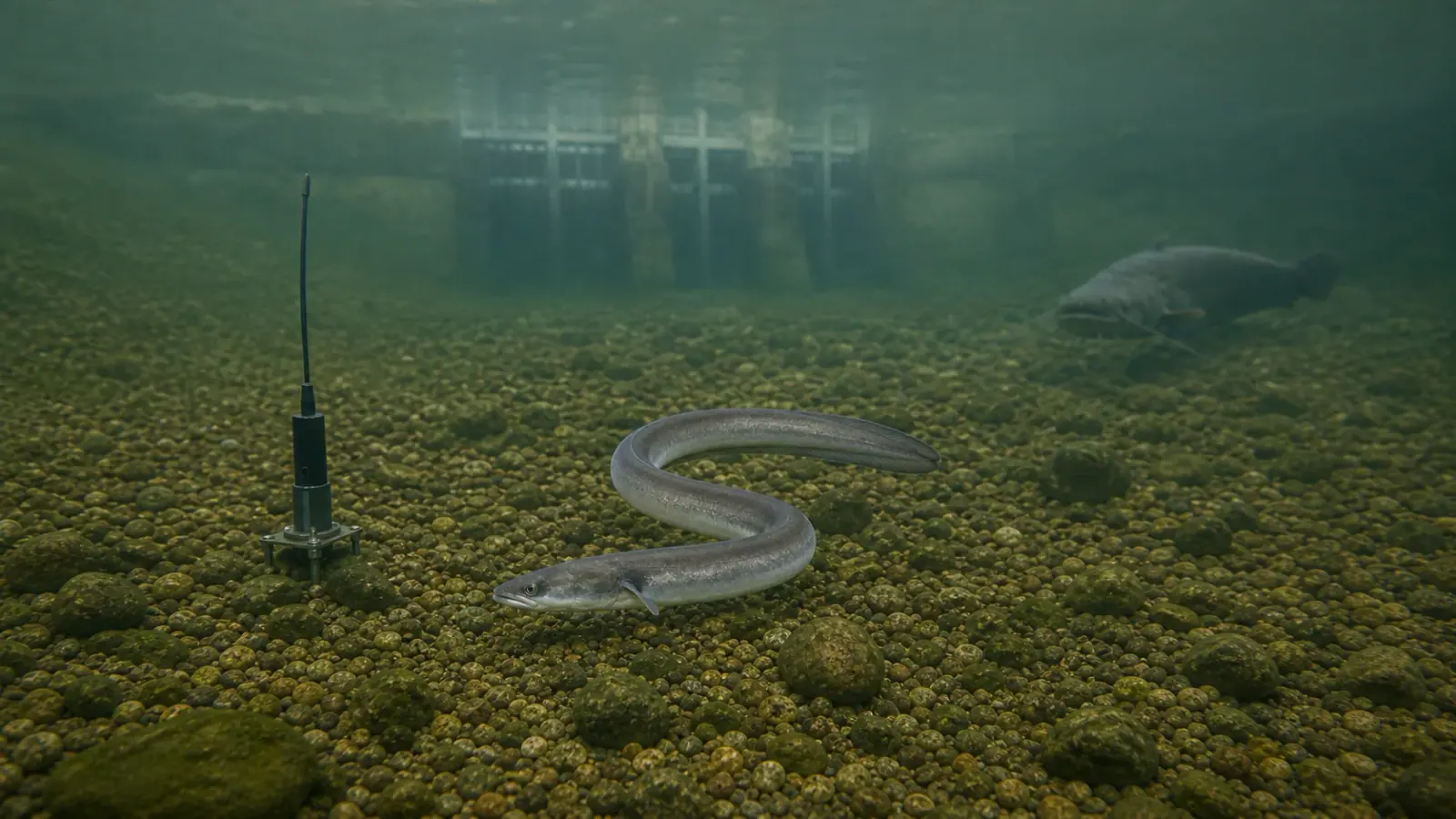
The spread of European catfish in western European rivers has raised a difficult conservation question: can this large predator compromise the seaward migration of the critically endangered European eel? A new study from France’s Loire basin provides a measured answer. Among 80 female silver eels fitted with acoustic predation tags, four signals consistent with ingestion were recorded. Every event occurred in the Vienne River after passage of the Châtellerault hydropower dam; none was detected in the free-flowing Creuse study reach. The pattern does not identify a predator with certainty. It shows why predation, infrastructure and fish condition must be assessed together.
A high-value life stage for eel recovery
European eels, Anguilla anguilla, spend years growing in continental waters before beginning their reproductive migration towards the Sargasso Sea. Silvering prepares them for that journey: the eyes enlarge, body colour changes and stored energy must support a migration of several thousand kilometres without feeding. Losing a silver eel therefore removes an animal approaching reproduction from an already depleted stock.
Predation is only one pressure. Barriers, turbines, fishing, pollution, habitat alteration and climate change all affect the population. The European Union’s Eel Regulation has required national management plans since 2007, using an escapement objective of at least 40% of the silver-eel biomass that would exist without human influence. Correctly assigning mortality matters: predator control would not address a loss caused primarily by unsafe passage through infrastructure.
European catfish, Silurus glanis, is established in the Loire catchment. Previous French studies have reported substantial predation on some migrating sea lamprey, shad and Atlantic salmon under particular seasonal and spatial conditions. Freshwater predation on silver eels, however, had not been quantified directly.
Eighty eels and two contrasting river reaches
The research team collected eels that were already undertaking natural downstream migration in December 2021. Two groups of 40 females were released approximately 270 km from the Loire estuary: one in the Vienne upstream of the Châtellerault dam, the other in an unobstructed section of the Creuse.
Selected eels averaged 814 ± 85 mm in length and 990 ± 344 g in mass, with individual lengths ranging from 635 to 1,003 mm. Under general anaesthesia, each received a 31.5 × 9 mm, 5 g acoustic transmitter in the peritoneal cavity. Tag burden remained at or below 1% of body mass. The incision was closed with absorbable sutures, and fish recovered for at least 60 minutes before release.
Forty-one hydrophones monitored 33 km of the Vienne and 13 km of the Creuse. The tag’s signal changes after exposure to a predator’s digestive environment. This technology can record the timing of an event consistent with ingestion, but it does not film the interaction or identify the consumer. Interpretation still depends on movement history, temperature, digestion delay and the predators that could swallow the tagged animal.
Four activations in the Vienne, none in the Creuse
Seventy-nine of the 80 tagged eels resumed downstream migration. Four predation sensors activated, all in the Vienne. After correcting for the estimated digestion-related activation delay, the events occurred 2.8 to 16.3 days after the eels passed Châtellerault dam. The resulting estimate was 10% predation in the Vienne and 0% in the Creuse within the monitored reaches.
After fish with uncertain fates during high flows were removed from the calculation, escapement from the study array was 68.8% in the Vienne and 96.8% in the Creuse. Eels that left the reaches moved quickly. Mean estimated migration speed was 1.73 ± 0.27 m/s in the Vienne and 1.37 ± 0.15 m/s in the Creuse.
That fast downstream movement may shorten exposure to predators. Timing may also help: silver eels migrate mainly in late autumn and early winter, when European catfish feeding activity is generally lower. These factors offer plausible explanations for the low observed predation compared with the much higher rates previously reported for other diadromous fish in specific French river settings.
The finding is cautiously encouraging for the large female silver eels studied. It does not show that predation is absent across the Loire basin or that the same rate applies to glass eels, resident yellow eels or smaller silver males.
The dam signal does not prove predator identity
The clustering of all four events after dam passage is the most useful operational signal. Turbines can kill or injure eels, potentially making them easier prey. When three of the four subsequently predated eels crossed Châtellerault, only 7–10 m³/s was passing through alternative routes while 70 m³/s passed through the turbines. The researchers could not determine the route taken by each eel.
If the eels were swallowed intact, European catfish is the most plausible consumer because of its gape and because the four eels measured 754–877 mm. If turbine passage fragmented or seriously injured an eel, northern pike (Esox lucius) or pikeperch (Sander lucioperca) could also have consumed the tagged tissue. The evidence therefore supports four predation events, not four certain kills by European catfish.
Dam transit time did not separate subsequently predated fish from the others. After one unusually slow individual was excluded, mean passage was 0.73 ± 0.27 hours for predated eels and 0.80 ± 0.15 hours for non-predated eels, with no statistically significant difference. A rapid passage does not rule out injury or a delayed consequence.
Limits define what the result can mean
The hydrophone array covered 46 km and included only one dam. Predation downstream of that area could not be recorded, so the published figures are minimum estimates for instrumented reaches rather than survival rates to the ocean. Only large females were tagged. Their size and speed may protect them from predators that could take smaller life stages.
High discharge also interfered with acoustic detection. Nine Creuse eels and seven Vienne eels were excluded from parts of the escapement analysis because their fates became uncertain under high-flow conditions. Capture, transport, anaesthesia and surgery can add residual stress even though the researchers used oxygenated transport, limited tag burden and relied on experienced personnel.
The sensors themselves add another layer of uncertainty. Activation is affected by digestion conditions, and a tag must later be detected by a hydrophone for its stored event information to be recovered. One unusual movement path suggested a possible missed predation event, but the sensor did not activate, so the animal was not counted as confirmed predation.
These constraints prevent a causal claim that the dam produced the four events. They do support a testable hypothesis: passage route, injury and subsequent predation should be measured over more structures and longer river sections.
Management should connect passage conditions with fate
For river managers, simply counting detections below a dam is not enough. A strong monitoring design would align flow through each route, turbine operation, fish condition before and after passage, migration speed, sensor activation and final detection outside the study reach. That combined record can help distinguish direct mortality, injury followed by predation, migration interruption and acoustic detection failure.
The study also cautions against ranking pressures by visual impact. Predation recorded in these reaches was low for this life stage. Yet the contrast between an unobstructed river and a dammed river directs attention to cumulative infrastructure effects. A silver eel may have to pass several structures before reaching the estuary; a modest risk repeated across sites can become biologically important.
For international programmes, the central lesson is methodological as much as regional. Predation tags can sharpen evidence, but the result remains a chain of inference. Infrastructure data, animal welfare records and ecological context determine whether an activation becomes a credible management diagnosis.
How Vetofish can support monitoring teams
Vetofish can help river managers, environmental consultancies and research groups design capture, anaesthesia, surgery, recovery and telemetry procedures for migratory fish. Support can integrate welfare criteria, hydraulic traceability and cautious mortality classification so that a sensor signal is not confused with the initiating cause or an unverified predator identity.
References
- Possémé, C., Robin, E., Rault, P., Jugé, P., Teichert, N., Lamoureux, J., Feunteun, E. & Trancart, T. (2026). “Low European catfish predation on silver eels in the Loire River watershed.” Journal for Nature Conservation, 91, 127249. https://doi.org/10.1016/j.jnc.2026.127249
- Council of the European Union (2007). Council Regulation (EC) No 1100/2007 establishing measures for the recovery of the stock of European eel. https://eur-lex.europa.eu/eli/reg/2007/1100/oj
- ICES (2022). “EU request for technical evaluation of the Eel Management Plan progress reports.” ICES Advice. https://doi.org/10.17895/ICES.ADVICE.19902958