

24 July 2026
Guppies: can plant diversity improve welfare?
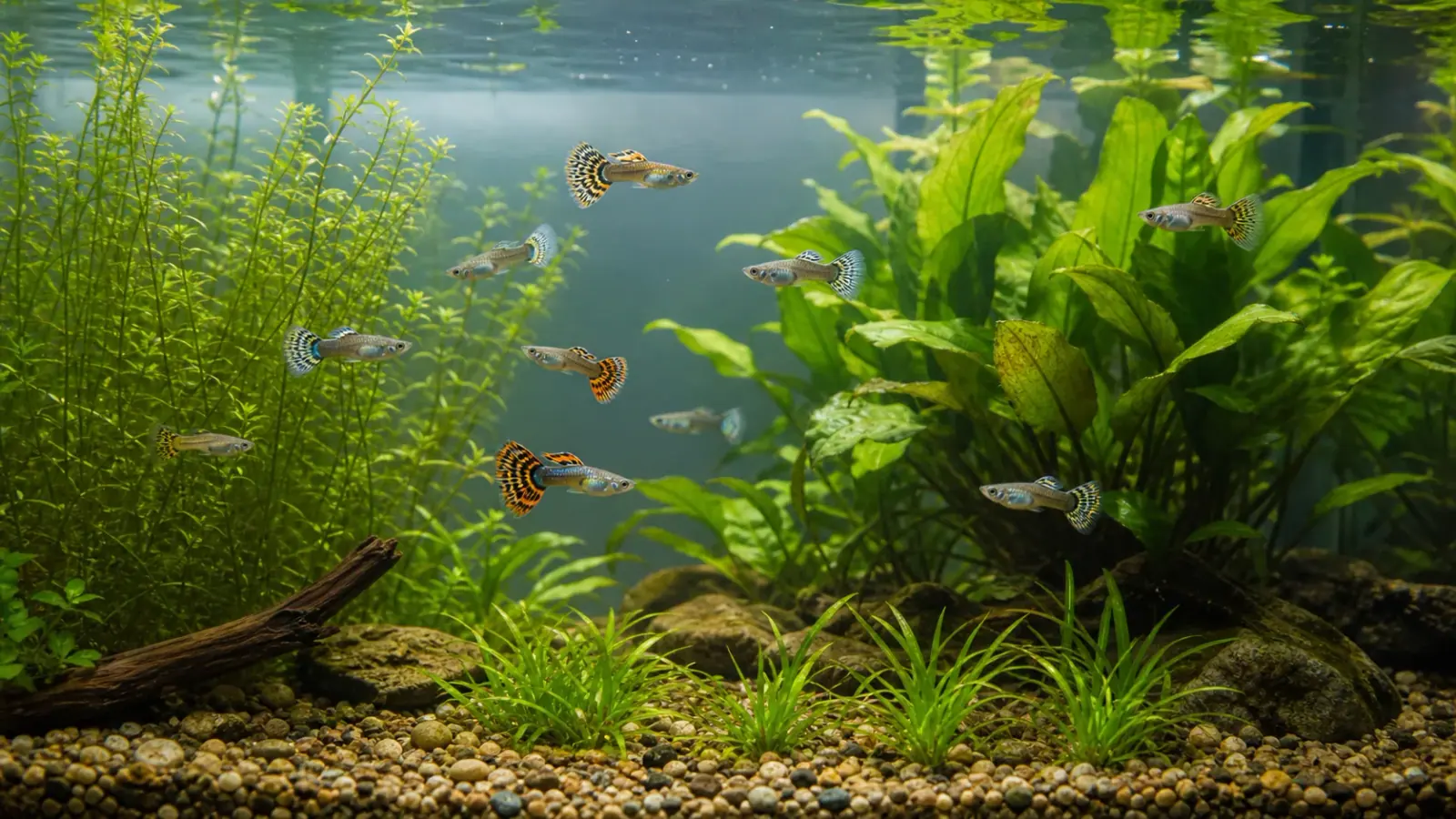
Guppies housed with plants showed favourable behavioural indicators, while lower basal cortisol occurred only in the treatment containing three plant species.
- Sector
- Public aquariums
- Animal groups
- Fish
- Content type
- Scientific news
- Keywords
- StressEnrichmentEthogram
Aquatic plants can provide cover and spatial complexity, but does using several plant species add a further welfare benefit? A study in Applied Animal Behaviour Science compared guppies (Poecilia reticulata) housed without plants, with one plant species or with three species. Planted environments were associated with several favourable indicators, yet lower basal cortisol was found only in the most diverse treatment.
Two separate questions: preference and welfare outcome
Chiara Varracchio and colleagues conducted two experiments. The first offered fish a choice between a zone containing one plant species and a zone containing three. Guppies divided their time similarly between the environments: no significant preference for the higher-diversity side was detected.
This does not mean that plants were irrelevant to the fish. The choice was between two vegetated habitats, not between plants and a barren area. It shows that, in this apparatus and observation period, guppies did not spend more time beside the three-species assemblage.
The second experiment examined longer-term consequences. Fish were reared in one of three conditions: three plant species, a single species or no plants. The authors then combined behavioural and physiological indicators. Separating immediate choice from longer-term outcome is methodologically valuable. Short-term preference is not a complete welfare measure, and a beneficial environment is not necessarily the option that attracts the most time during a brief test.
Plants mattered, but so did plant identity
Behavioural indicators suggested favourable effects in both vegetated treatments compared with the plant-free control. Published findings included reduced anxiety-like behaviour and improved survival. However, one particular plant species contributed strongly to the observed differences.
That influence prevents a conclusion that species number alone caused every result. Moving from one to three plants changes several properties together: architecture, density, leaf area, shade, refuge, water movement and microbial interactions. Species richness is one dimension of habitat, not a universal dose.
Basal cortisol supplied a complementary signal. It was lower in the group housed with three plant species, whereas the one-species condition did not show the same physiological benefit. Cortisol in fish varies with time of day, handling, reproductive state and many environmental factors. A lower value in a controlled protocol should be interpreted with other indicators, not as a stand-alone measure of “happiness”.
What this means for public aquariums
The first lesson is that enrichment is more than an object placed in a tank. Planting changes usable space, sight lines and opportunities to withdraw. It can also alter lighting, nutrient dynamics and maintenance. Habitat design therefore needs an explicit function and monitoring for unintended effects.
For a small social species, planted areas may allow individuals to leave an interaction, reduce visual exposure and explore different microhabitats. Excessive vegetation can nevertheless obstruct clinical observation, trap waste or reduce circulation. The objective is not to maximise plant count; it is to create complexity compatible with fish biology and system operation.
In a public collection, plant choice must also consider water parameters, possible treatments, quarantine and the risk of introducing unwanted invertebrates or infectious agents. Live plants need an appropriate intake pathway. Toxic, fragile or readily ingested species are not automatically suitable for every display.
Designing a local and interpretable trial
Before altering several exhibits, an aquarium can run a pilot with a defined timeline. A baseline period records fish distribution, interactions, feeding, lesions, mortality and water quality. The planting is then introduced without simultaneously changing lighting, animal numbers and diet.
Habitat use should be observed at different times of day. A plant can function as cover, a visual barrier or an exploration site even if fish do not spend most of their time there. Conversely, constant crowding in vegetation may indicate avoidance of flow, a conspecific or an over-lit area.
Water indicators remain essential: day-night oxygen, pH, nitrogen compounds, turbidity and organic matter accumulation. Photosynthesis and plant respiration create their own dynamics. An apparent behavioural improvement must not hide overnight oxygen deterioration or an unmanageable cleaning burden.
The assessment should also consider individual access. Group averages can conceal fish that are displaced from preferred cover. Video mapping, lesion records and repeated observations can reveal whether the habitat expands choice for the group or merely redistributes competition.
Partial and species-specific evidence
The study concerns guppies and specific assemblages of one or three plant species. It cannot be extrapolated to every fish, plant or large mixed-species exhibit. The authors describe partial support for the hypothesis: high plant diversity may improve welfare, particularly given the physiological signal, but behavioural effects also depended on the presence and identity of plants.
The absence of a clear preference for the more diverse environment adds a useful caution. It is not contradictory. It demonstrates why no single indicator—space choice, behaviour or cortisol—can evaluate an environment by itself.
Replication under public-aquarium conditions should therefore preserve the distinction between structural complexity and botanical diversity. Artificial plants, live monocultures and multi-species planting may have different effects and different hygiene costs even when their visible structure looks similar.
Conclusion: habitat quality, not a magic number
In the guppies studied, planting was associated with favourable behavioural outcomes, while lower basal cortisol appeared only with three plant species. The work encourages teams to assess diversity, plant identity, physical structure and water quality together.
Vetofish can help public aquariums define pilots, select observable indicators and integrate planting into health and maintenance plans. The practical question is not “how many plant species are required?” but “what functions should the habitat provide, and how can we show that it delivers them without creating a new risk?”
References
- Varracchio, C., Paci, F. P., Frigato, E., Bertolucci, C., Bertorelle, G. & Lucon-Xiccato, T. (2026). “High biodiversity may improve fish welfare.” Applied Animal Behaviour Science, 300, 107001. https://doi.org/10.1016/j.applanim.2026.107001