

17 July 2026
Carp oedema virus: temperature and stress reshape disease expression
An experimental study links viral load, gill damage and physiological stress in koi exposed to carp oedema virus, with sharply different responses at 12 and 18°C.
- Sector
- Aquaculture
- Content type
- Disease profile
Koi sleepy disease, also known as carp oedema virus disease (CEVD), can cause lethargy, severe gill damage and mortality in common carp (Cyprinus carpio) and ornamental koi. An experimental study in Frontiers in Immunology adds an important layer to disease interpretation: detecting the virus is only part of the picture. Carp strain, water temperature and the host stress response jointly influence viral load, tissue damage and immune-gene expression.
The findings are not a treatment recipe ready for direct use on farms. They do, however, provide a practical framework. When disease is suspected, temperature records, fish movements and differences between stocks deserve the same attention as visible clinical signs.
Two carp profiles at two temperatures
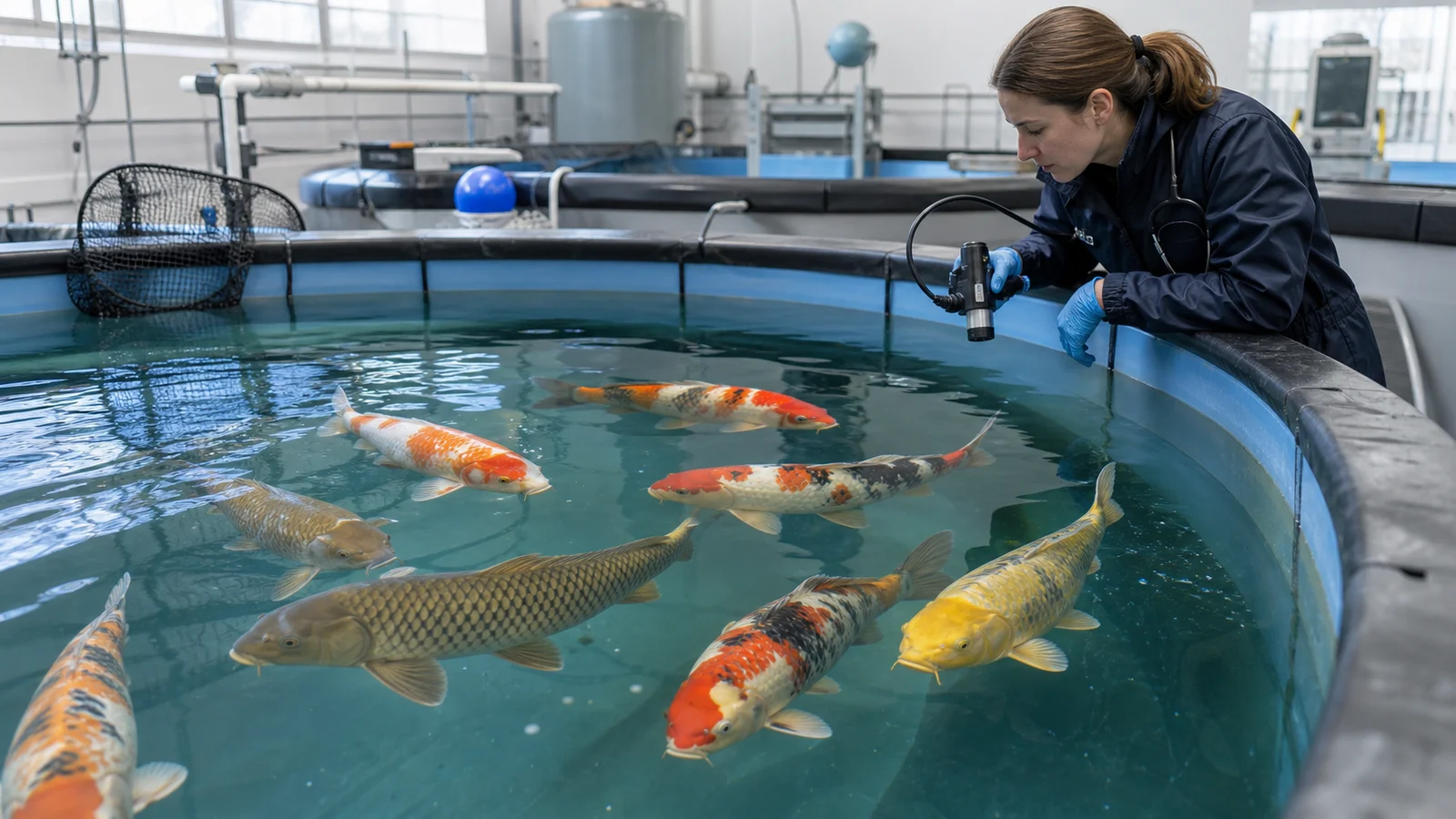
Maria Zawisza and colleagues compared CEV-susceptible koi with Amur sazan carp, which were more resistant in this model. Fish were exposed by cohabitation with three virus-shedding donor fish in each infected tank; control tanks received three uninfected donors. Trials were conducted at 12°C and 18°C. A further koi group was held in water supplemented with 0.6% sodium chloride, an experimental “salt rescue” model.
The team assessed viral load, gill histopathology, antiviral and adaptive immune markers, and physiological stress. Plasma cortisol and glucose were measured six days after exposure, with five to eight individual measurements per group in the reported analysis.
This design separates factors that are often entangled in field outbreaks. It does not mean that every koi is susceptible or every Amur-derived carp is resistant. Breeding line, prior health, infectious dose and husbandry can all modify outcome.
The strongest disease signal appeared in koi at 18°C
Infected koi held at 18°C carried the highest viral load and showed the most severe histopathological changes in their gills. Infection activated antiviral mechanisms, yet the researchers also found clear downregulation of several adaptive immune genes in freshwater koi at 18°C.
Temperature should not be treated as a simple on-off switch. The experiment compared two controlled conditions at defined sampling points. It does not show that an abrupt temperature change cures CEVD or is safe. Thermal manipulation can increase oxygen demand, challenge already damaged gills and add handling stress. In real facilities, stabilising conditions and recording them accurately is more defensible than improvising a temperature shift.
Stress was visible in blood measurements
At 12°C, plasma cortisol in infected koi rose from 11 to 160 ng/mL, while glucose rose from 61 to 434 mg/dL. In salt-supplemented koi, cortisol increased from 16 to 97 ng/mL and glucose from 69 to 198 mg/dL. At 18°C, the contrast was still greater in freshwater koi: cortisol increased from 57 to 573 ng/mL and glucose from 92 to 442 mg/dL. Salt-supplemented koi also showed increases, from 6 to 72 ng/mL for cortisol and from 57 to 180 mg/dL for glucose.
Changes were smaller in Amur sazan. At 18°C, cortisol rose from 7 to 13 ng/mL, while the glucose increase was not significant. The authors therefore connected the strength of the stress response with viral load and disease development. They did not propose cortisol or glucose as specific diagnostic tests for CEV.
These values belong to a controlled experiment. Feeding, capture, density, low oxygen and other infections can alter the same markers in production settings. Diagnosis still depends on a coherent combination of epidemiological context, clinical examination, gill lesions, appropriate sampling and molecular detection.
Salt is not permission to treat blindly
In this model, 0.6% NaCl prevented mortality in infected koi and moderated some stress signals. The fish remained infected and mounted an antiviral response. Salt therefore did not eliminate the virus or turn an exposed stock into a disease-free stock.
Any use of sodium chloride must account for species, water chemistry, filtration, local rules and effluent management. An experimental concentration is not automatically a clinical prescription. Salt should never delay stock isolation, diagnostic sampling or veterinary advice.
Turning the evidence into biosecurity
When fish become unusually lethargic, settle on the bottom or develop gill abnormalities, the first response is organisational. Pause movements, dedicate equipment to affected units, record temperature, dissolved oxygen, pH and mortality, and reconstruct the introduction timeline. Recently affected moribund fish often provide more useful samples than decomposed carcasses.
Because the gills are a major target, oxygenation and minimal handling take priority. Clinically normal exposed stocks should not be assumed safe: absence of signs does not exclude infection. The contrast between koi and Amur sazan also shows how the same pathogen can produce different clinical pictures against different genetic backgrounds.
Vetofish can help farms, dealers and koi collections build sampling plans, interpret laboratory findings and secure animal and equipment flows. The central message is cautious but actionable: measure the environment, minimise avoidable stress and manage stocks as epidemiological units. Temperature and host susceptibility are not background details; they help shape the CEVD phenotype that teams see at the tank or pond side.
References
- Zawisza M, Rebl A, Teitge F, Krzystyniak B, Piackova V, Gela D, Kocour M, Chadzinska M, Adamek M, Rakus K. “Stressing out—carp edema virus induces stress and modulates immune response in common carp.” Frontiers in Immunology. 2024;15:1350197. doi:10.3389/fimmu.2024.1350197.
- Machat R, Pojezdal L, Gebauer J, Tesarik R, Motlova J, Palikova M, Faldyna M. “Immune response in diseased and healthy common carp exposed to carp edema virus.” Journal of Fish Diseases. 2024;47:e14012. doi:10.1111/jfd.14012.