

27 July 2026
Fish density shapes aquatic plants in French ponds
Across 38 French and Belgian fishponds, higher fish densities were associated with lower macrophyte richness, informing production–biodiversity trade-offs.
- Sector
- Environment
- Content type
- Scientific news
- Keywords
- EnrichmentOxygenReproduction
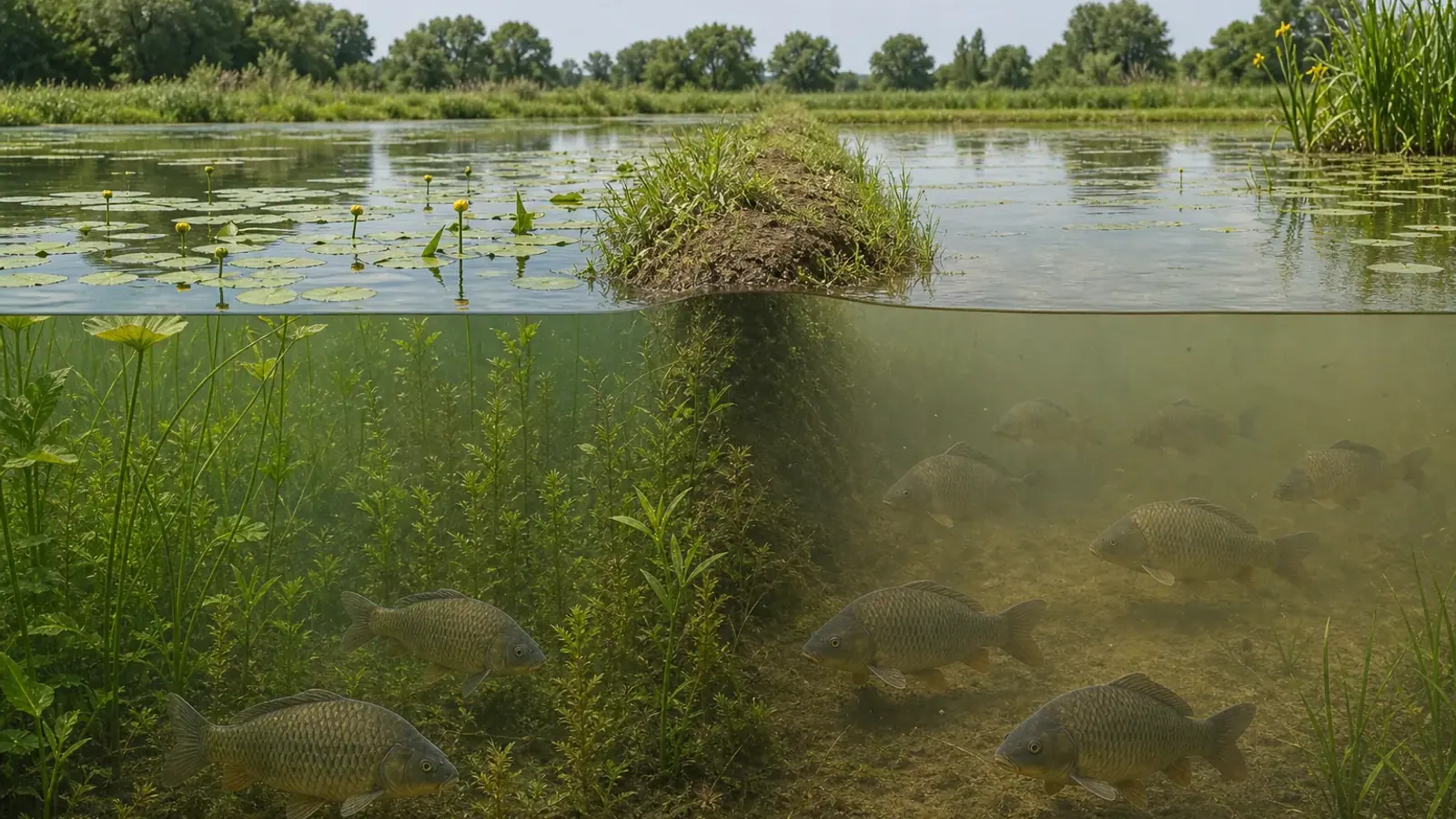
Fish production and biodiversity conservation are not necessarily incompatible goals in managed ponds. However, a 2026 study in Hydrobiologia shows that fish stocking pressure can strongly shape macrophyte richness. Macrophytes are the larger aquatic plants visible without a microscope, and they provide habitat while influencing sediment stability, water clarity and food webs. The researchers compared 38 managed fishponds in France and Belgium, including 17 in the Dombes region. Their central finding is not a universal stocking limit: as fish density increased, local plant communities tended to lose taxa and became nested subsets dominated by common, tolerant plants.
Production ponds can also be valuable habitats
The Dombes landscape contains approximately 1,100 ponds covering 11,500 hectares. These shallow water bodies were created from the Middle Ages onwards, primarily for extensive fish production, and now form a landscape of considerable ecological value. Aquatic vegetation stabilises sediment, offers refuge and breeding structure, increases habitat complexity and can help maintain clearer water.
Fish can alter that vegetation through several pathways. Bottom-feeding species, particularly common carp Cyprinus carpio, may uproot plants and resuspend sediment. Trophic cascades change plankton dynamics, while supplementary feed can affect nutrient inputs and light availability. The relationship is therefore not a simple encounter between one carp and one plant; it reflects the functioning of the whole pond.
To examine the role of fish management, the team compared 17 ponds in Dombes with 21 ponds in Midden-Limburg, Belgium. Both regions contain shallow, managed fishponds, but together they provide a broad gradient from unstocked conservation ponds to intensive production. The French sites represented two forms of extensive management, making the results directly relevant to European pond farmers and landscape managers while still requiring local interpretation.
Thirty-eight ponds and five management regimes
Field surveys took place during the 2021 growing season. In France, where the studied ponds averaged 17 hectares, botanists surveyed 4 m² quadrats every 50 metres along three transects and added a complete shoreline survey. The smaller Belgian ponds were searched across their full area until no additional taxa were found. Total nitrogen and total phosphorus were also measured.
The lower-density Dombes regime started with 100 kg of fish per hectare, used no supplementary feed and produced a final harvest below 500 kg/ha. The second regime began at approximately 200 kg/ha and received 50–150 kg/ha/year of grain or pellets, producing 500–900 kg/ha/year. The Belgian sites covered three further regimes: no deliberate fish stocking, juvenile production yielding 200–400 kg/ha, and intensive production yielding 1,200–1,500 kg/ha with roughly 800 kg/ha/year of additional feed.
These details matter. Fish density, feeding, nutrient concentrations and drainage practices do not vary independently in commercial landscapes. This was an observational comparison of management systems, not an experiment that isolated every mechanism. It supports practical risk assessment but cannot assign every plant response to stocking density alone.
High-density ponds retained mainly a core of common plants
Across all 38 ponds, the researchers recorded 109 macrophyte taxa: 55 hydrophytes, which grow in water, and 54 helophytes, which root in saturated soil but extend above the surface. Dombes contained 64 taxa and Midden-Limburg 75, with 30 shared between the regions.
In both landscapes, higher-density management tended to coincide with fewer taxa per pond. The Belgian contrast was especially clear. Median local richness was 31 taxa in ponds without deliberate stocking, compared with 9 in juvenile-production ponds and 6 under intensive production. Unstocked ponds collectively contained 92% of the Belgian regional species pool, whereas intensive ponds contained only 30%.
In Dombes, the lower-density extensive regime collectively contained 81% of the regional taxa, compared with 61% under the more productive extensive regime. Local richness moved in the same direction, but the difference was not statistically significant. It would therefore be inaccurate to claim that doubling initial stocking density inevitably causes a fixed plant loss in every French pond.
The beta-diversity analysis added an important layer. Across both regions, nestedness accounted for 80.5% of variation in community composition and species turnover for 19.5%. In practical terms, species-poor ponds usually retained subsets of the plants present in richer ponds. High-density management did not consistently create a distinct specialist flora; it filtered out sensitive taxa and left common generalists, often emergent plants growing along pond margins.
The findings are not a regulatory threshold
The study does not establish a maximum fish density that can be transferred to every site. Pond shape, depth, nutrient status, fish-community composition, bottom-feeding activity, supplementary feed and management history all influence whether macrophytes persist. The authors note that common carp have been associated with a shift from clear, plant-dominated water to a turbid, phytoplankton-dominated state below 600 kg/ha in some experimental settings. They explicitly treat the critical density as context-dependent, not as a universal operational limit.
Dombes also has a distinctive practice: after four or five production years, some ponds are left dry for a full growing season. This prolonged drying can favour pioneer vegetation and affect plant richness in subsequent years. It is additional to the short drainage used for harvesting. Results from these managed ponds should therefore not be copied uncritically to permanent lakes, small wildlife ponds or high-intensity tank systems.
Vegetation is also only one component of biodiversity. Macrophyte-friendly management may benefit other organisms, but this study did not simultaneously measure fish health, birds, amphibians and invertebrates across all 38 sites. Production, aquatic-animal welfare, disease prevention and conservation need a multi-criteria assessment.
Turning evidence into a management plan
For pond farmers, owners and conservation managers, the first practical lesson is to monitor realised pressure rather than planned stocking alone. Initial stocking, harvested biomass, feed inputs, nitrogen, phosphorus, dissolved oxygen, water transparency and vegetation cover should be recorded consistently over time. Repeatable botanical surveys conducted in a comparable season can identify gradual simplification before the pond shifts into a persistently different state.
The second lesson operates at landscape scale. Applying the same density and calendar to every pond may homogenise habitats. A deliberate mosaic — lower- and higher-density production ponds, drying phases and, where land-use objectives allow, unstocked refuge ponds — can retain more taxa across the whole landscape. This does not mean removing fish from every pond. It means recognising that ponds can complement one another instead of being managed as interchangeable production units.
Any density reduction must still account for farm economics, predation risk, control of unwanted fish and animal-health objectives. The right decision is not a number copied from a paper. It is a documented local compromise reviewed against pond-level evidence.
Conclusion
This Franco-Belgian study shows that fish-stock management structures aquatic plant communities. Higher fish densities were associated with lower local richness and assemblages dominated by a common core of tolerant species. In Dombes, the direction of the relationship was consistent, but the contrast between the two extensive regimes was not statistically significant. The evidence supports diversified management, joint monitoring of biomass, nutrients and vegetation, and caution against universal stocking thresholds.
How Vetofish can help
Vetofish can help pond farmers and managers design monitoring that links fish health, biomass, water quality, feed inputs and ecological indicators. A site review can define repeatable measurements, align records across multiple ponds and support gradual management adjustments that remain compatible with both production and biodiversity objectives.
References
- Girard L., Robin J., Rouifed S., Tolon V., Wijns R., De Meester L., Wezel A., Lemmens P. Fish stock management as a driver of a nested community structure of macrophytes in fish pond systems. Hydrobiologia. 2026. https://doi.org/10.1007/s10750-026-06203-1.