

17 July 2026
Rainbow trout feeds: replacing fish oil with microalgae needs evidence, not assumptions
An 84-day rainbow trout trial found no detectable health penalty when Tetraselmis chui biomass replaced part of the fish-oil fraction, but commercial validation still requires longer, farm-specific testing.
- Sector
- Aquaculture
- Content type
- Scientific news
- Keywords
- ImmunityHistopathologyMicrobiome
Reducing aquaculture’s reliance on fish oil is a nutritional, economic and environmental priority. An alternative ingredient, however, cannot be assessed from its lipid content alone. It must support growth without undermining feed efficiency, animal health or the quality of the harvested product. A study published in Scientific Reports on 14 June 2026 provides controlled evidence for using biomass from the microalga Tetraselmis chui in juvenile rainbow trout (Oncorhynchus mykiss).
Over 84 days, the researchers compared a fish-oil control with three complete diets in which 33%, 66% or 100% of the tested fish-oil fraction was replaced by algal biomass and the remaining ingredients were rebalanced. The findings support further work on partial replacement, but they do not establish a universal formulation. The trial tested one ingredient, one fish species, one life stage and a tightly managed recirculating system.
A controlled trial with 240 juvenile trout
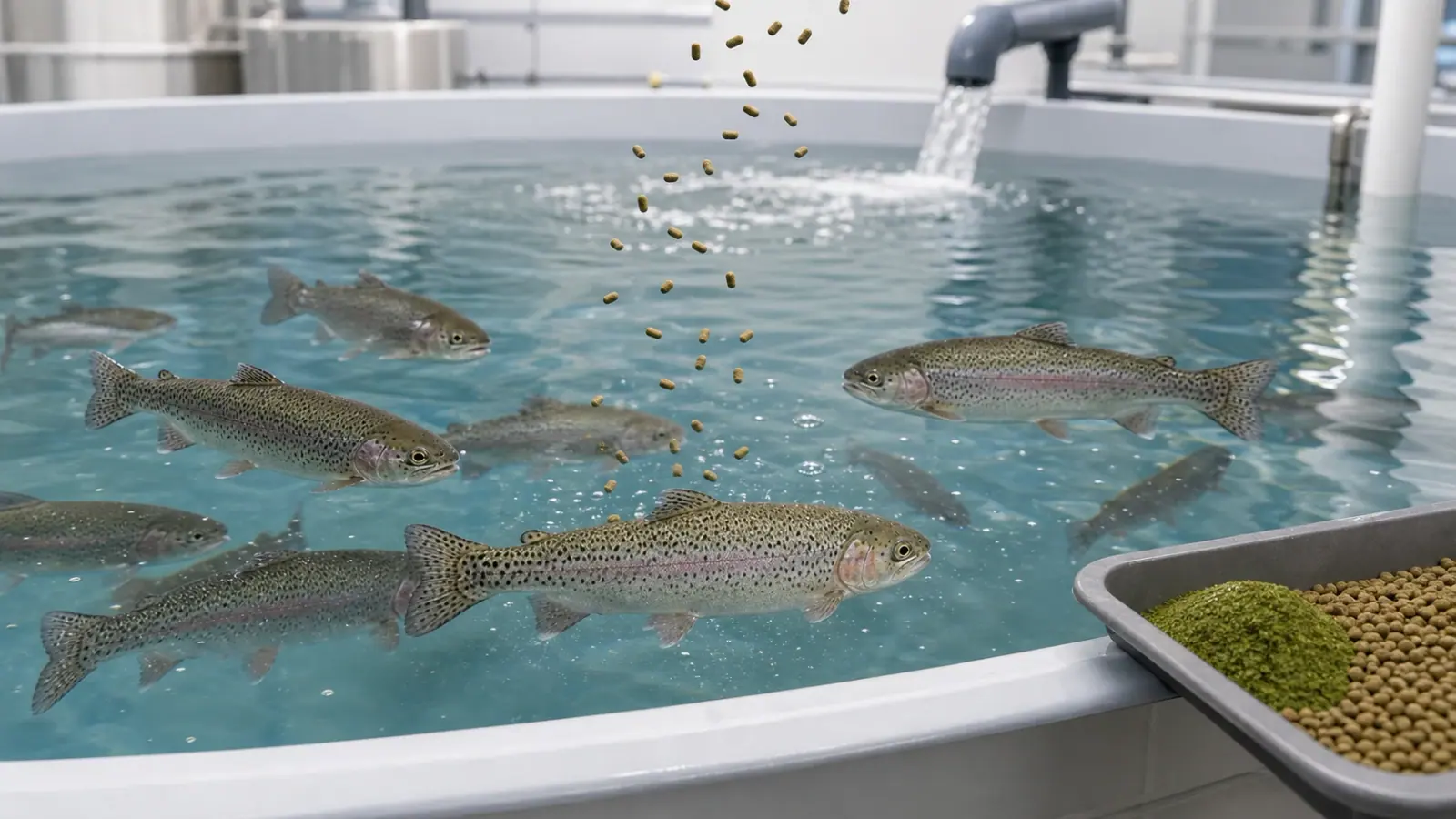
The study used 240 juvenile female trout with a mean starting weight of 89.0 ± 1.10 g. Fish were distributed among twelve 150-L tanks, providing three replicate tanks of 20 fish for each of four diets. Water was held at 14.5 ± 0.6°C, dissolved oxygen at 9.80 ± 0.60 mg/L, pH at 7.24 ± 0.24 and salinity at 5.00 ± 1.00 PSU. The daily ration was set at 1.9% of tank biomass.
The diets were designed to be isonitrogenous, isoenergetic and isolipidic. Fish oil was the main n-3 fatty-acid source in the control. In the experimental diets, T. chui replaced 33%, 66% or 100% of that component. Because oil and whole algal biomass have different compositions, wheat starch, gluten and palm fat were adjusted as well. This matters in practice: the experiment evaluated balanced complete feeds, not algal powder simply added on top of an existing ration.
Growth was recorded every 14 days. At the end of the trial, blood and liver gene-expression analyses used 15 fish per group, while liver and intestinal histology used nine fish per group. The team therefore examined the diets through several complementary endpoints: production performance, blood chemistry, leukocyte profiles, tissue architecture, and hepatic immune and antioxidant gene expression.
The 66% diet maintained the strongest overall performance
Growth trajectories did not differ significantly among treatments from day 14 through day 70. At day 84, final tank biomass in the control was 7,321.65 ± 60.03 g. This was significantly higher than the 33% group at 6,984.70 ± 86.15 g and the 100% group at 6,823.93 ± 160.42 g, but statistically similar to the 66% group at 7,051.77 ± 107.30 g.
Control weight gain was 5,519.65 ± 57.16 g and exceeded the 100% group’s 5,043.93 ± 142.09 g. It did not differ significantly from the 33% and 66% groups, which gained 5,220.70 ± 73.95 g and 5,281.77 ± 110.86 g, respectively. Feed conversion ratios of 0.9–1.2 and specific growth rates were comparable among the four diets.
These figures do not make 66% a transferable optimum. It was the most convincing replacement level under this formulation and experimental setting. Variability emerging late in the trial led the authors to call for longer studies. Commercial decisions must also consider ingredient cost and consistency, pellet stability, feed intake and the fatty-acid profile of the final fillet.
No adverse health signal was detected after 84 days
Major leukocyte populations — neutrophils, basophils, lymphocytes, eosinophils and monocytes — remained statistically comparable with the control. The measured biochemical indices, including markers used to assess hepatic function and metabolism, did not show a consistent adverse shift attributable to Tetraselmis inclusion.
Histological examination found no algal-diet-associated inflammatory response in liver or intestine. Goblet-cell density, mucosal-fold architecture and intestinal lumen surface area remained comparable. The authors reported minor changes, including moderate sinusoidal dilation in the liver and slight intestinal-villus changes in the 33% group, but no coherent pathological pattern.
Hepatic expression of the antioxidant genes cat, gpx, sod1 and sod2 also did not differ significantly from the control. The immune-related genes assessed were similarly stable. The defensible interpretation is therefore “no adverse effect detected by these endpoints and at this sample size,” not proof of unlimited long-term safety.
Important questions remain outside the trial
Eighty-four days covers a juvenile growth phase, not a full production cycle to harvest. This health-focused paper did not test sensory quality, disease resistance through a pathogen challenge or multiple commercial sources of T. chui. It also does not establish that all algal biomasses are interchangeable. Culture medium, growth conditions, harvesting and drying can materially alter their nutritional profile.
All fish were female and maintained in a stable experimental system. Responses may change with strain, body size, temperature, water quality, health pressure and the rest of the ingredient matrix. Fishmeal was excluded to reduce confounding from its naturally high n-3 content, a useful experimental choice that also makes the diets different from some commercial formulations.
The study should therefore be read as evidence supporting a formulation pathway. It is not a recommendation to replace fish oil without nutrient specifications, quality control or local performance data.
How to test a novel ingredient responsibly
Feed manufacturers and farms first need to define what is being replaced: the percentage of fish oil, the resulting EPA and DHA supply, protein, energy, digestibility and any antinutritional components. “Microalgae” is not a fixed composition. Each ingredient batch needs specifications, and every complete feed must be recalculated rather than amended by volume.
A pilot should retain comparable control groups and track intake, growth, feed conversion, mortality and water quality. Reduced palatability can emerge before a clear growth difference. Histology and blood chemistry will not be necessary for every routine feed change, but they can be valuable in a structured validation study or when clinical signs and performance losses cannot be explained by routine records.
Predefined stopping rules also matter: persistent feed refusal, increased mortality, faecal changes, sustained growth loss or clinical abnormalities. Changing several ingredients at the same time makes attribution difficult. The 2026 trial illustrates the value of controlled formulations and replicated tanks.
From experimental evidence to a farm decision
The study supports the feasibility of partially replacing fish oil with T. chui biomass in juvenile rainbow trout feed. The 66% replacement diet maintained performance comparable with the control, and none of the selected health markers identified a detrimental effect after 84 days. Complete replacement was less convincing for final weight gain.
Vetofish can help design on-farm feed trials, define production and health indicators, interpret differences between groups and coordinate targeted laboratory examinations. The practical question is not whether “algae can replace fish oil” in the abstract. It is whether a characterised ingredient, incorporated into a balanced formulation, remains safe and effective under the farm’s own biological and operational conditions.
References
- Iheanacho S, Simon A, Mueller J, Lippemer S, Rebl A, Hasler M, et al. “Replacing fish oil with Tetraselmis chui microalgae biomass does not compromise rainbow trout health: Biochemical, histologic, antioxidant and immune gene expression.” Scientific Reports. 2026;16:18375. doi:10.1038/s41598-026-54873-7.
- Ma M, Hu Q. “Microalgae as feed sources and feed additives for sustainable aquaculture: prospects and challenges.” Reviews in Aquaculture. 2024;16:818–835. doi:10.1111/raq.12869.