

27 July 2026
EPA/DHA balance shapes salmon fry growth and viral response
Atlantic salmon fry given equal total EPA and DHA in three different proportions showed distinct growth and disease outcomes after a salmonid alphavirus challenge.
- Sector
- Aquaculture
- Animal groups
- Fish
- Content type
- Scientific news
- Keywords
- ImmunityHistopathologyStress
Two feeds can contain the same total amount of long-chain omega-3 fatty acids yet produce different biological outcomes. A study in Atlantic salmon fry finds that the relative proportions of eicosapentaenoic acid (EPA) and docosahexaenoic acid (DHA) affect growth and several components of the response to salmonid alphavirus. Crucially, the experiment does not identify one ratio that improves every disease endpoint: viral load, tissue damage and mortality did not always move in the same direction.
Holding total EPA and DHA constant
EPA and DHA are long-chain omega-3 polyunsaturated fatty acids involved in membrane structure and lipid mediator production, among other functions. New feed ingredients—including microalgal and genetically modified oil sources—make it possible to adjust their supply, but may also change their proportions. Reporting only the combined EPA + DHA content can therefore conceal a biologically relevant difference.
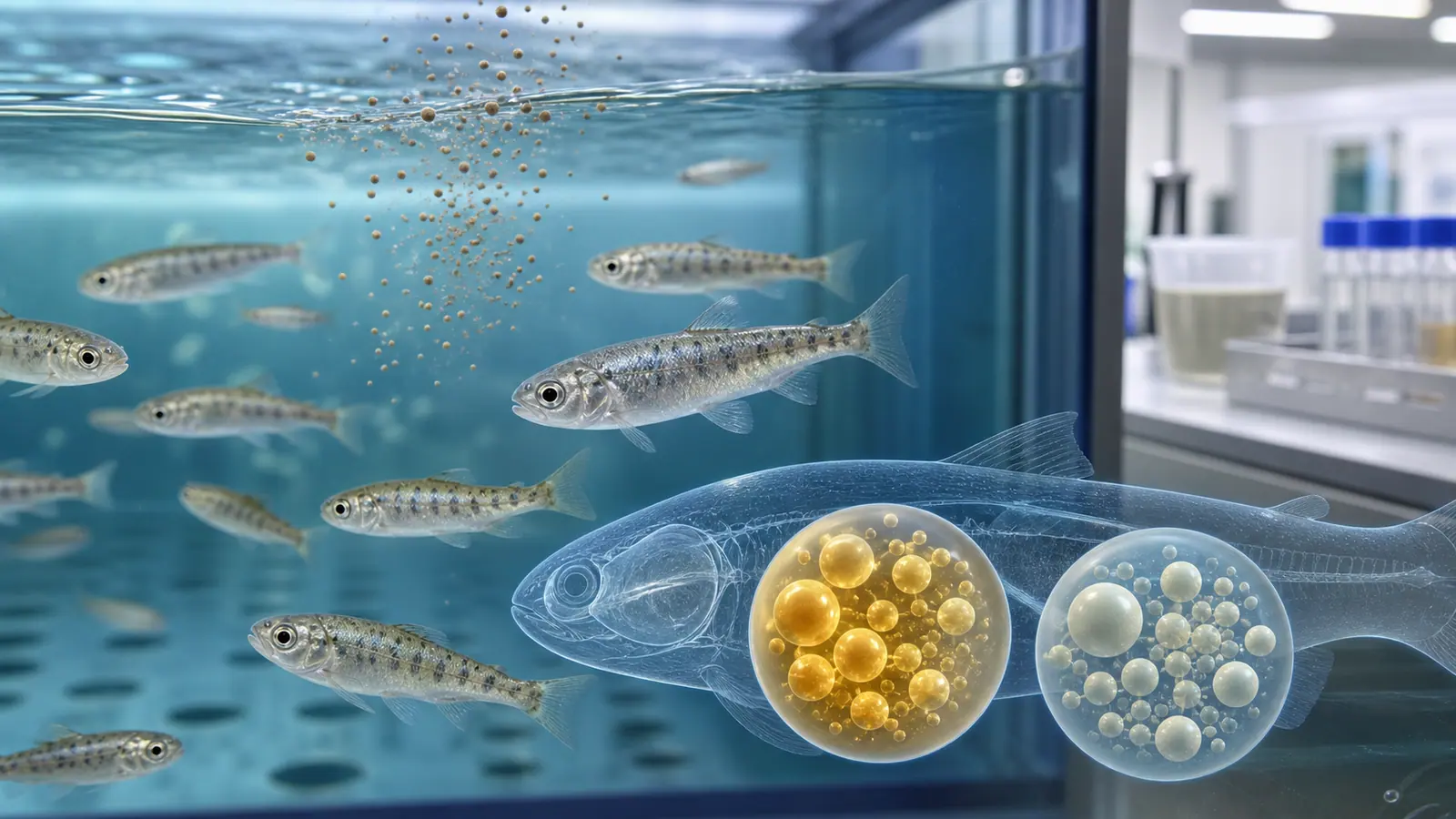
Zhuang and colleagues studied Salmo salar fry with a starting weight of 0.15 g. For four weeks, fish received one of three experimental diets. Total EPA + DHA remained constant, while the EPA/DHA ratio was set at 0.2, 0.9 or 2.2. This design helps isolate the effect of relative balance without confusing it with a larger or smaller total dose of long-chain omega-3 fatty acids.
The fry remained on their assigned diets and were then challenged with either wild-type salmonid alphavirus (SAV-WT) or an attenuated strain (SAV-Att). Follow-up continued for up to 28 days, by which point fish weighed approximately 1.1 g. The team assessed growth, tissue fatty-acid profiles, viral load, histopathological lesions and mortality.
A higher EPA-to-DHA ratio did not improve growth
Growth performance declined significantly as the EPA/DHA ratio increased. At the same total inclusion, the diet containing the most EPA relative to DHA was therefore not the best-performing option for these first-feeding fry. This result is specific to the formulation, life stage and experimental conditions; it does not establish a universal optimum for all salmon or production phases.
Following infection with the wild-type virus, overall fatty-acid stores clearly declined. Monounsaturated fatty acids were preferentially depleted, whereas long-chain omega-3 content was more strongly preserved in tissues. That pattern was not observed after the attenuated-virus challenge. The study supports selective lipid mobilisation during active infection, but it cannot reduce the response to a single metabolic mechanism.
Disease outcomes were more complicated than growth. Fish fed the low 0.2 ratio had a higher overall viral load, yet showed improved histopathology at the end of the trial. Fish on the high 2.2 ratio also had signs of improved final histopathology, but recorded the numerically highest mortality following SAV-WT exposure; the mortality difference was not statistically significant. The intermediate 0.9 group had poorer final histopathological scores without elevated mortality.
Those apparently conflicting results carry the paper’s most useful message: no single endpoint captures resilience. A higher viral load does not mechanically predict the severity of lesions at the final sampling point, and a more favourable tissue score does not guarantee better survival. Sampling time also matters because the same final snapshot may follow different inflammatory trajectories.
What the experiment does and does not show
The work establishes the EPA/DHA ratio as a formulation variable distinct from total EPA + DHA. Trials of novel oils should document both, rather than reporting combined omega-3 content alone. It also demonstrates why feed evaluations benefit from pairing production performance with virology, histopathology and survival.
The study does not show that a particular feed prevents or treats pancreas disease under commercial conditions. It involved very small fish, an experimental environment and a controlled challenge. Outcomes may change with genetics, water temperature, viral dose, seawater stage, other nutrients, feeding duration or the complete lipid profile. Because the numerically higher mortality in the 2.2 group was not significant, it should not be described as an established harmful effect of a high ratio.
Virus phenotype also matters. The reduction in fatty-acid stores observed with SAV-WT was absent with SAV-Att. Responses to an attenuated agent therefore cannot automatically stand in for the metabolic cost of virulent infection.
The experiment should also not be read as evidence that DHA alone explains better growth. Changing a ratio alters two relative proportions simultaneously, and biological effects can arise from their interaction. Follow-up dose-response work is needed to separate minimum requirements, tissue deposition and disease-stage effects.
A practical framework for farms and feed developers
For feed manufacturers and farming operations, the immediate implication is methodological. Any change in lipid source should be evaluated through verified feed composition, tissue analysis and complementary health outcomes. Decisions should not be based on one ratio in isolation, and findings in first-feeding fry should not be extrapolated directly to seawater salmon.
During a clinical episode compatible with salmonid alphavirus, feed does not replace diagnosis, biosecurity or a health strategy agreed with veterinary and competent authorities. Nutrition may support robustness, but it does not justify attributing poor growth or tissue damage to a fatty-acid imbalance without appropriate investigation.
Vetofish can support critical appraisal of nutrition trials, sampling-plan design and integrated interpretation of production, histological and virological data. The aim is to turn a publication into a locally testable hypothesis, rather than a premature universal feed recommendation.
Reference
- Zhuang, Z., Hundal, B. K., Belghit, I., Sindre, H., Grove, S. & Liland, N. S. (2026). “Varying dietary EPA/DHA ratios influence growth and viral disease response in Atlantic Salmon (Salmo salar L.) fry.” Frontiers in Aquaculture. https://doi.org/10.3389/faquc.2026.1860524