

17 July 2026
Spironucleus in salmon RAS: UV inactivates the parasite, but transmission remains uncertain
A new Atlantic salmon study measures Spironucleus salmonicida sensitivity to UV, while a RAS biosecurity trial that remained negative even in untreated controls exposes the limits of prevention claims.
- Sector
- Aquaculture
- Themes
- DiseasesWater quality
- Content type
- Scientific news
Systemic spironucleosis caused by Spironucleus salmonicida remains a difficult threat to control in Atlantic salmon (Salmo salar). With no authorised treatment available, prevention depends heavily on biosecurity. A 2026 study in Scientific Reports provides one encouraging result: under controlled laboratory conditions, medium-pressure ultraviolet (UV) irradiation strongly inactivated the parasite at doses of 50 mJ/cm² and above. Its recirculating aquaculture system (RAS) trial, however, requires a much more cautious interpretation.
After the parasite was introduced through make-up water, no fish became infected in UV-treated, ozone-treated or untreated control units. The study therefore demonstrates UV sensitivity in a controlled exposure system; it does not demonstrate that UV or ozone prevented transmission in RAS. Keeping that distinction visible is essential when translating an experimental result into health-management decisions.
A parasite with no straightforward treatment option
S. salmonicida is a flagellated diplomonad that can cause systemic infection. Reported disease includes internal haemorrhage, enlargement of the spleen and granulomatous lesions in several organs. The parasite can occur in the intestine before crossing mucosal barriers and spreading through the bloodstream. Outbreaks affecting farmed salmon in northern Norway have renewed efforts to understand how it enters facilities and persists within production systems.
Metronidazole has activity against spironucleosis, but it is not authorised for this use in food-producing animals in the European Union. Prevention, flow separation and water management are therefore central. RAS can reduce some forms of external exposure, yet it is not a sealed environment: make-up water, fish, equipment, sludge and biofilms may create different transmission routes for different pathogens.
Two experiments addressed two different questions
Carlo C. Lazado and colleagues first exposed S. salmonicida cultures to low-pressure (LP) or medium-pressure (MP) UV lamps. Doses ranged from 0 to 200 mJ/cm² for LP lamps and from 0 to 75 mJ/cm² for MP lamps. The suspension had UV transmittance above 70% at 254 nm and contained little organic material in low-salinity water.
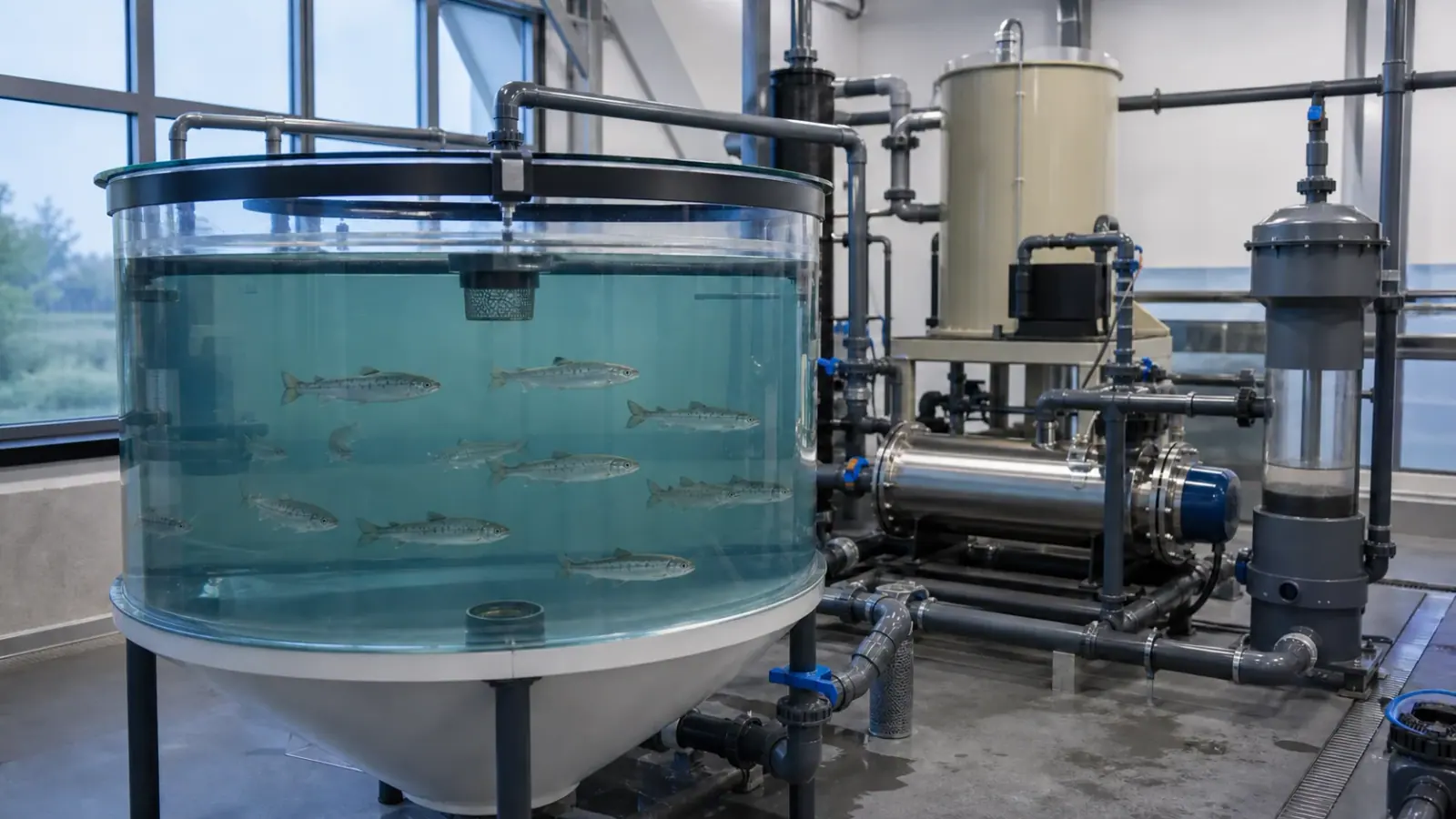
The team then operated nine independent experimental RAS units. Each had a 0.5 m³ cylindro-conical fish tank connected to water-treatment equipment. Total system volume was 0.8 m³, tank flow was 1,500 L/h and tank hydraulic retention time was 20 minutes. Each unit held 100 smolts initially weighing about 70–80 g. Three units had no loop disinfection, three used LP UV delivering an estimated 70–80 mJ/cm² at 100% transmission, and three used ozone at an oxidation-reduction potential of 300–350 mV.
After two weeks of acclimation, the researchers simulated a three-day “breach”. A fresh culture containing 10,000 flagellates/mL entered through the make-up-water pump sump at 1% of the 20 L daily make-up volume. Fish were then monitored for four weeks at 12°C, 12 ppt salinity and dissolved oxygen saturation above 80%.
Medium-pressure UV produced a five-log reduction
In the controlled trial, MP UV achieved a five-log reduction in viable parasite counts immediately after exposure to 50 mJ/cm² or more. A 5-log reduction represents 99.999% inactivation. At 10 mJ/cm², a few organisms retained limited movement after 24 hours, but a 5-log reduction was recorded after 48 hours. At doses above 10 mJ/cm², motility had ceased by 24 hours.
LP UV was less effective in this apparatus. Only a 1-log immediate reduction was achieved at 150 mJ/cm² and above, while slight movement remained detectable 96 hours after exposure to 25 mJ/cm². Lamp type therefore matters alongside the nominal dose: a result generated with an MP source cannot simply be transferred to an LP installation.
Nor should 50 mJ/cm² be treated as a universal operating prescription. It was established in a suspension with high transmittance and very low organic loading. On farms, particles, water colour, dissolved matter, sleeve fouling, real flow and lamp ageing all change the dose delivered to organisms. Validation must address the installation and the water passing through it, not just the setting displayed on a control panel.
A negative RAS trial does not prove preventive efficacy
All parasite tests remained negative across the nine units. Plasma, gills, head kidney, foregut and hindgut produced no positive RT-qPCR results. Swabs from tank walls and biofilter media were negative as well. Fish length, weight and condition factor did not differ significantly among treatment groups.
The absence of infection cannot be attributed to disinfection because untreated controls were negative too. The researchers did not measure parasite viability immediately after introduction into the RAS. The culture may have rapidly lost infectivity; dose, exposure frequency or route may have been insufficient; or establishment in RAS may depend on other vectors and conditions. Entry through intake water remains a plausible hypothesis, but this experiment does not validate it on its own.
For health managers, the correct conclusion is neither “disinfection is useless” nor “disinfection guarantees protection”. The dose-response experiment supports the potential value of MP UV against the tested parasite stage. The fish trial mainly shows that the breach model needs further refinement before a preventive effect can be quantified in a complex system.
Ozone, water quality and gill responses
UV- and ozone-treated groups maintained higher UV transmittance and lower turbidity than controls during part of the follow-up. Nevertheless, measured water-quality variables remained within the thresholds targeted for smolts in every group. Microbial communities differed most clearly between biofilter media and tank walls. Disinfection also shifted aspects of community structure without producing a general loss of diversity.
Ozone was associated with increasing expression of several oxidative-stress markers in the gills over time, including gsta, gpx and mnsod. At the final sampling, gsta and gpx expression was higher in the ozone group than in control and UV groups. This does not mean that the fish were clinically diseased: histological assessment found no clear treatment-related loss of mucosal integrity. It does show that ozonation is a biological exposure requiring active control, especially in brackish or saline water where persistent brominated by-products may form.
The 300–350 mV oxidation-reduction potential used here describes one experimental protocol, not a transferable target for every RAS. Salinity, organic matter, contact time, off-gassing, residual destruction and injection-point location must all be included in a site-specific risk assessment.
Practical lessons for farms
A robust strategy separates the technical barrier from evidence that the barrier is working. UV records should cover lamp spectrum and type, flow, validated dose, actual transmittance, fouling and maintenance. Ozone monitoring should address contact, residuals and by-products, with fish-safe interlocks. In both cases, biofilms, biofilter media, sludge and hydraulic bypasses deserve surveillance separate from that of free water.
When spironucleosis is suspected, treated water and an absence of visible signs are not sufficient to close an investigation. Teams should reconstruct movements, isolate affected units, secure dedicated equipment, select appropriate fish and tissues for testing, and interpret results with the laboratory and attending veterinarian. Vetofish can support this process from hydraulic-flow review to sampling-plan design.
The study provides a useful engineering datum and an equally important methodological lesson: inactivation measured in a laboratory does not automatically equal disease prevention demonstrated in fish. Preserving that limitation is what makes the finding credible and usable for aquaculture biosecurity.
References
- Lazado CC, Brenne H, Olaisen D, Johansson GS, Hansen M, Saether B-S, Kolarevic J, Timmerhaus G, Tengs T, Johansen L-H. “Interplay between disinfection and the enigmatic diplomonad parasite Spironucleus salmonicida in Atlantic salmon.” Scientific Reports. 2026;16:21163. doi:10.1038/s41598-026-51626-4.
- Kvamme BO, Lazado C, Johansen L-H, Hansen H, Sterud E, Svärd S, Tjessem A, Heggebø R, Sævareid I, Karlsbakk E. “Spironucleus salmonicida infections and spironucleosis in Norwegian aquaculture: transmission routes, host range and prevention.” Rapport fra havforskningen. 2026-4. Norwegian Institute of Marine Research.
- Lazado CC, Stiller KT, Reiten B-KM, Osório J, Kolarevic J, Johansen L-H. “Consequences of continuous ozonation on the health and welfare of Atlantic salmon post-smolts in a brackish water recirculating aquaculture system.” Aquatic Toxicology. 2021;238:105935. doi:10.1016/j.aquatox.2021.105935.