

16 July 2026
Acoustic tags in sharks: should every incision be sutured?
In Port Jackson sharks, suturing internal-tag incisions reduced protrusion risk but increased inflammation and bacterial colonisation, revealing a protocol trade-off rather than a universal rule.
- Sector
- Environment
- Animal groups
- FishElasmobranchs
- Content type
- Protocol / technique
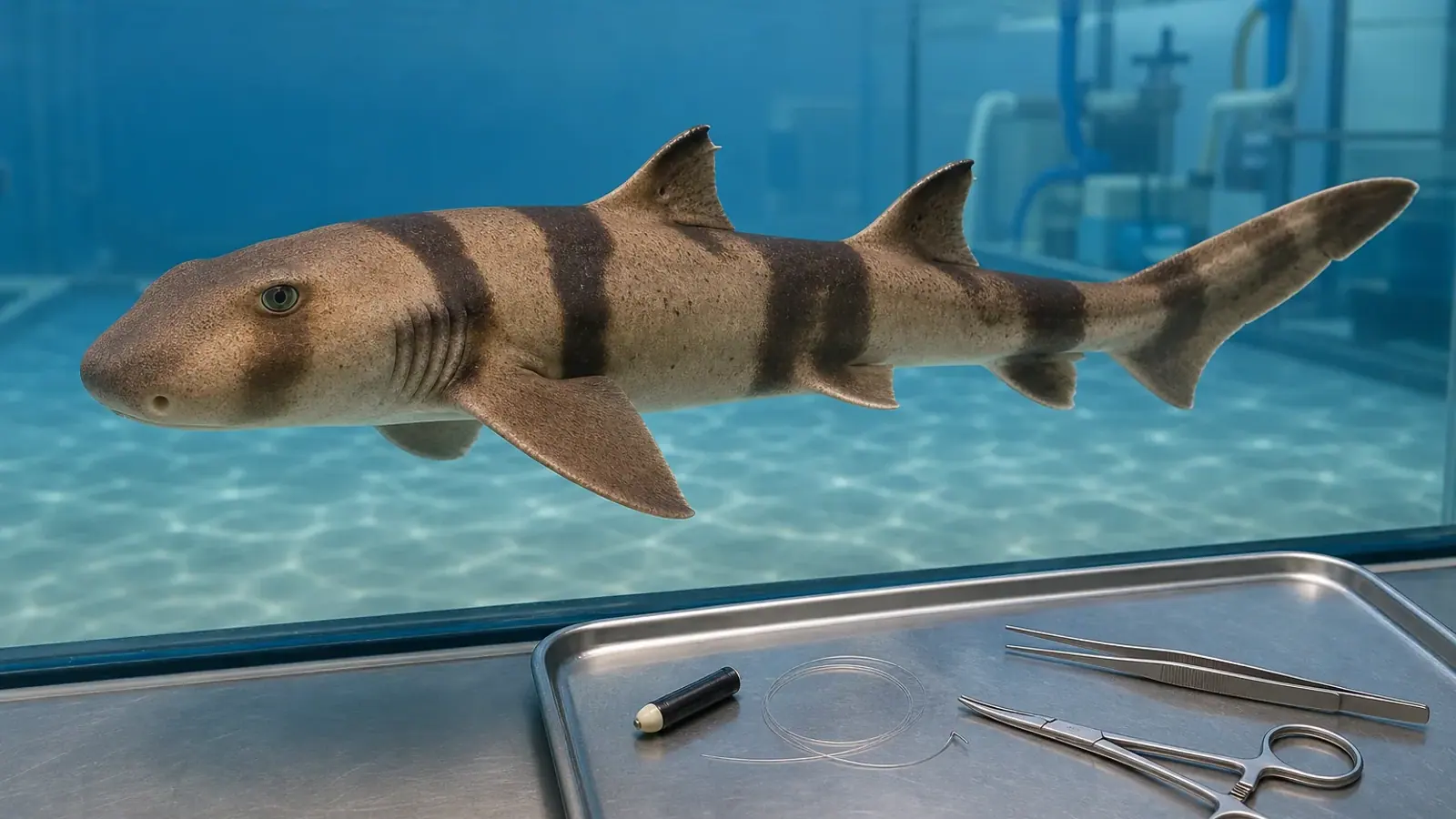
Acoustic telemetry has transformed the study of movements, habitat use and survival in animals that are difficult to observe directly. Internal transmitters, however, require an incision that is commonly closed with sutures. A study of Port Jackson sharks (Heterodontus portusjacksoni) shows why that step should not be treated as biologically neutral. Sutures reduced the occurrence of tissue protrusion, yet sutured wounds showed more inflammation, swelling and bacterial colonies. The practical lesson is not to abandon wound closure, but to evaluate tagging as a balance between transmitter retention, healing and animal safety.
A within-animal comparison
Brittany Heath and colleagues studied twelve wild-caught sharks in South Australia. Total length ranged from 57 to 90 cm, with a median of 70 cm; body mass ranged from 1.74 to 6.35 kg, with a median of 2.4 kg. Each shark received two ventral incisions. One was closed with sutures and the other was left unsutured. One incision contained a dummy acoustic tag, while the other was a sham procedure, with side and tag placement distributed among treatment groups.
This paired design matters because every shark contributed both wound-closure conditions. Individual differences in skin, immune response or behaviour therefore had less influence on the central comparison. The animals were followed for 42 days. Standardised photographs were taken at ten time points to measure inflamed area, incision length and incision width. Researchers also scored incisional swelling and protrusion, cultured bacterial swabs on days 7, 14 and 21, and measured blood glucose and lactate.
Procedures used sterilised equipment in a controlled environment. The experienced surgeon averaged approximately 13 minutes from capture to return to water, compared with approximately 18 minutes for the novice. Within this small sample, surgeon experience was not significantly associated with inflamed area, incision length or incision width.
Comparable closure does not mean identical healing
Tag retention was 100% under both closure methods during the 42-day trial. Incision length followed a broadly similar course, with rapid healing between days 35 and 42. Unsutured wounds initially narrowed more slowly and with greater variation during the first ten days. After day 14 their width remained relatively stable, whereas sutured incision width increased until day 35 before declining sharply by day 42.
Local tissue response created a clearer contrast. The interaction between time and treatment significantly affected inflamed area, incision length and incision width (P < 0.001 for each metric). Sutured incisions retained inflamed areas at roughly 70% of their initial values according to the authors’ graphical interpretation, with no evident decline by day 42. In unsutured wounds, relative inflamed area decreased steadily to below 25%.
Incisional swelling was also significantly greater with sutures (P < 0.001). It increased during the observation period, while unsutured incisions showed little or no swelling. Swelling can be part of tissue repair, but it also reflects the response to a foreign material and cannot, by itself, be equated with better functional healing.
Lower inflammation came with a different hazard
Leaving the incision unsutured increased the risk of dehiscence and tissue protrusion. Seven of the twelve sharks, or 58.3%, experienced at least one protrusion event during the 42-day observation period. Six occurred at unsutured incisions and one at a sutured incision. Most events were minor and healed completely.
One case prevents a simple recommendation in favour of unsutured wounds. A severe visceral protrusion developed from an unsutured incision on day 28. The shark was euthanised for welfare reasons after the experimental period, on day 89. The result highlights the need to consider incision length, position relative to the ventral midline, tag dimensions and species anatomy together.
The authors propose further work on smaller tags and incisions, and on positioning the surgical site farther from the ventral midline. These are research directions, not established clinical instructions. The experiment cannot demonstrate that an unsutured protocol would be safe in other shark species, or even in every Port Jackson shark under different field conditions.
Sutures as a surface for bacterial colonisation
Researchers distinguished two bacterial colony morphotypes by colour, shape and motility, but did not identify them genetically to species level. Both morphotypes were more abundant at sutured sites than at unsutured wounds, control skin and water samples. For morphotype 1, changes over time differed significantly by treatment (P = 0.042); counts peaked on day 7 and then declined. Morphotype 2 peaked on day 14, but its treatment-by-time interaction was not significant (P = 0.147).
These cultures do not establish clinical infection or identify a pathogen. They demonstrate greater colonisation in the presence of suture material despite instrument sterilisation. The material itself, local inflammation and the small interfaces between thread and tissue may support bacterial attachment. Suture construction is also relevant: multifilament material can retain more bacteria than monofilament.
The recirculating water system is an important limitation. Its microbial load may not represent open coastal habitats. Conversely, released animals face sediment, changing temperature, sustained swimming and ecological interactions that were absent from the captive trial.
Blood chemistry did not resolve the wound-level question
Glucose remained between 0.08 and 0.64 mmol/L and lactate between 0.32 and 8.36 mmol/L. The tested effects of protrusion, time and the time-by-sex interaction were not significant for either variable. This does not demonstrate an absence of stress. Because every shark carried both a sutured and an unsutured incision, a whole-animal blood measurement could not be assigned to one wound treatment.
The sample of twelve animals and the 42-day main observation period also constrain inference. This study identifies mechanisms and competing risks; it does not provide a universal tag-size threshold or a protocol for all elasmobranchs. Complete tag retention in captivity likewise does not guarantee unchanged behaviour or survival after release.
Protecting animal welfare and data quality together
A retained transmitter is scientifically valuable only if the implantation procedure does not alter the animal enough to bias its movement or survival. A field protocol should therefore document the species, tag mass and dimensions, incision length and position, suture material and pattern, asepsis, handling time and veterinary intervention criteria. Controlled pilot work can compare closure, inflammation, dehiscence, retention and behaviour before the method is scaled up.
Vetofish can support environmental monitoring teams with protocol risk assessment, standard operating procedures, operator training and post-operative scoring systems. The Port Jackson shark study reinforces a central principle of responsible biotelemetry: neither “always suture” nor “never suture” is an adequate evidence-based rule. The preferred method is the one whose benefits and hazards have been measured for the species, device and deployment context in question.
References
- Heath B, Huveneers C, Hesse RD, Vaughan L, Crino OL, Roberts CN, Venn X, Matley JK. “Are sutures a pathway to infection? A multidisciplinary assessment of wound healing in sharks following internal acoustic tagging.” Wildlife Research. 2025;52(8):WR25009. doi:10.1071/WR25009.