

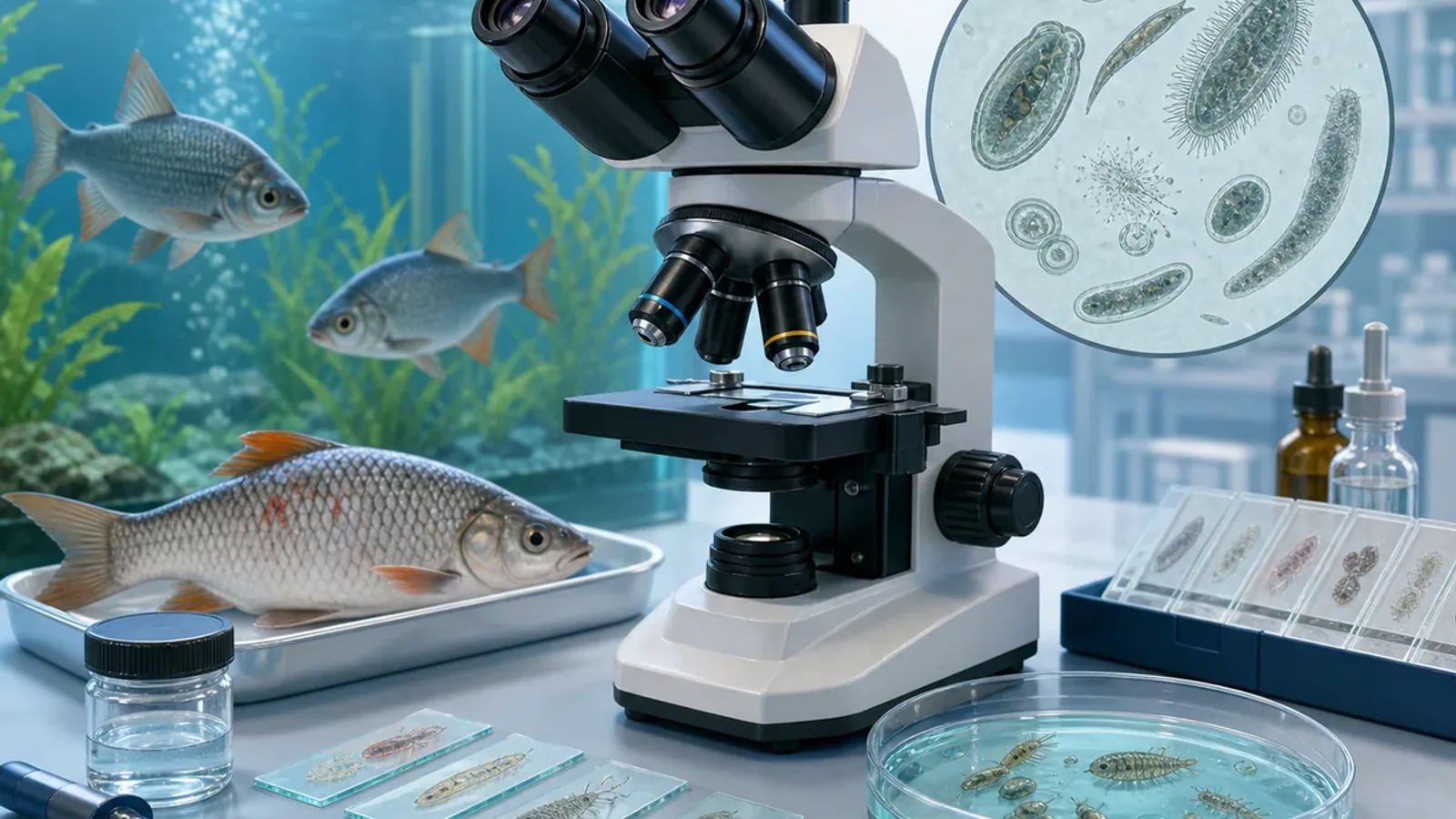
Which microscope is suitable for detecting the main parasites of fish?
It is useful to have a microscope to detect ectoparasites (skin, gills) and endoparasites (intestine) of fish. This makes it possible to reduce the use of antiparasitic drugs by treating only when necessary, but also to monitor the effectiveness of the therapies undertaken.
Obviously, this type of equipment represents a significant cost, and requires prior training (taking samples, preparing samples, adjusting the microscope, identifying the main parasites).
Recommended minimum characteristics
-
Eyepieces: WF 10x/18
-
Binocular : 2 eyepieces to position the eyes
-
Magnification: 10x minimum
-
Wide field (WF) type: 18 mm minimum (this is the diameter of the field that can be seen when looking through the microscope).
-
Objectives: 4x / 10x / 40x / 60x
-
Revolver of 3 to 4 objectives
-
DIN achromatic, if possible semi-planar
-
Magnification: 4x/0.10, 10x/0.25, 40x/0.65 and 60x/0.85 (avoid 100x - immersion oil)
-
Object stage: overstage with orthogonal movements (displacements on the 2 axes)
-
Focusing: macrometric and micrometric screw coaxial
-
Lighting:
-
Type: LED light-emitting diode (does not heat up, more robust, long lifespan)
-
Power: 1 W minimum
-
Color temperature: 6300°K
-
Intensity adjustable by a dimmer
-
Condenser:
-
Abbe type pre-centered O.N. 1.2 or 1.25
-
Height adjustable
-
Iris diaphragm
-
Rechargeable battery: optional but practical when working near a body of water.
Recommended models
- Optika B-157 (version without battery): from €400 incl. tax
- Optika B-157-R (version with battery): from €450 incl. tax
- Optika B-192s (no battery): from €480 incl. tax
- Euromex BB-4260 (with battery): from €430 incl. tax