

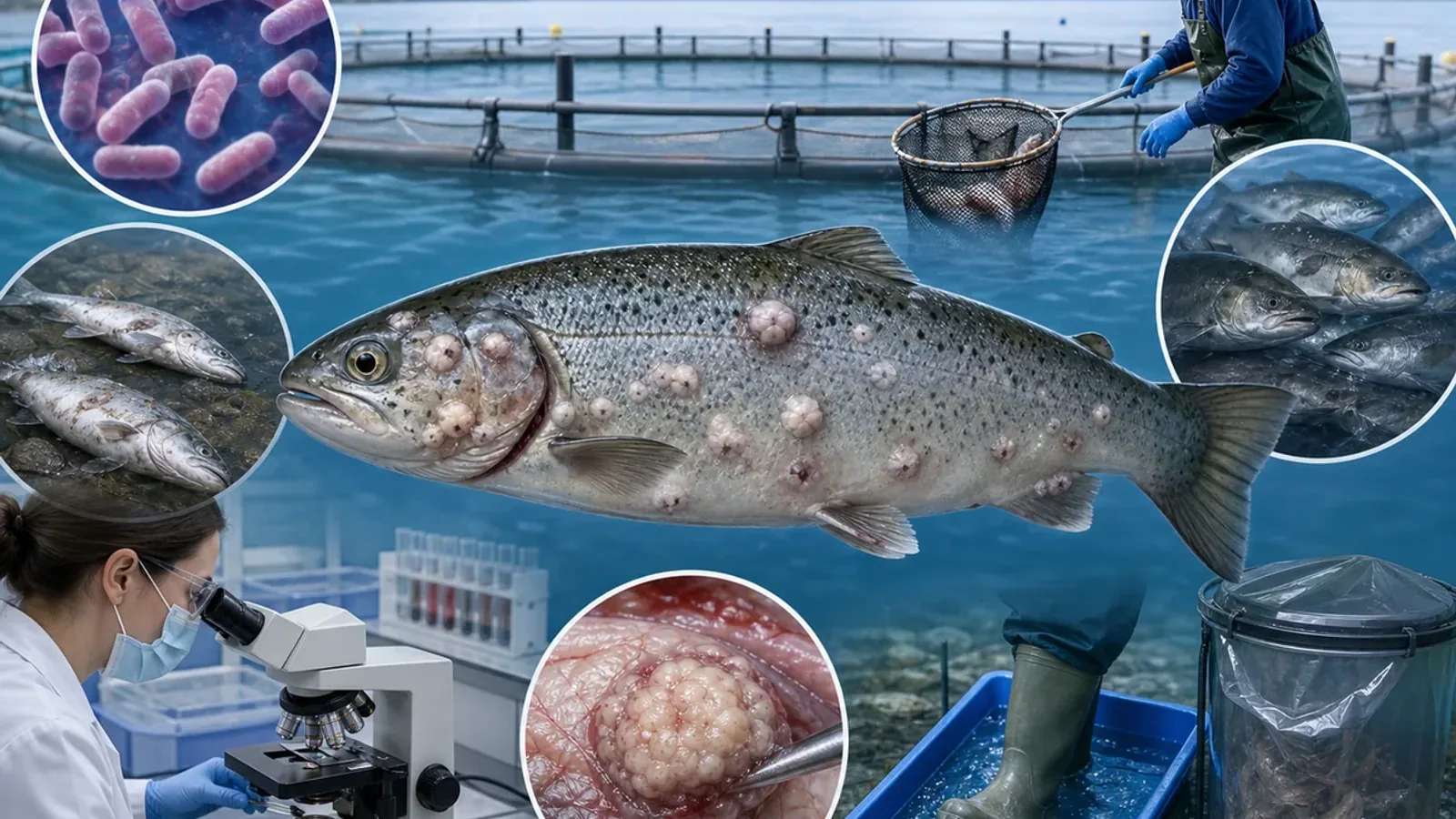
What are the risks associated with a fish affected by mycobacteriosis?
Mycobacteriosis is a bacterial disease caused by mycobacteria. It can affect both freshwater and sea fish.
Certain species of mycobacteria such as Mycobacterium marinum or Mycobacterium fortuitum can also be transmitted to humans (this is called zoonosis).
In fish
The symptoms are very varied. The progression of the disease is generally slow (chronic disease).
We first note a progressive weight loss of the fish, discoloration, apathy, difficult swimming. At a more advanced stage, in acute forms we can see skin inflammations, exophthalmos, nodules (skin and on organs), necrosis of the skin and bone lesions (deformation of the spine).
The definitive diagnosis in fish requires the use of histological examination and molecular biology (PCR).
In humans
Infections with non Tuberculosis (NTM) mainly affects immunocompromised subjects, although immunocompetent patients can also be affected. Common symptoms are lymphadenitis (inflammation of the lymph nodes) or single papulonodular lesions confined to one limb, which may eventually become ulcerative. Contamination of humans follows the penetration of the germ through a skin lesion exposed to contaminated water from an aquarium.
Control measures and prevention
In order to limit the risk of propagation, the sick fish must be at least isolated from other animals, but it is preferable to euthanize it. It is not recommended to treat a fish affected by mycobacteriosis because the effectiveness of antibiotic therapy is low (a disease considered incurable in fish) and poses a very high risk of the appearance of antibiotic resistance that is detrimental to the treatment of humans.
It is essential to wear gloves when handling in a contaminated aquarium, especially in the presence of small cuts on the hands or any other part of the arm that could come into contact with it. water.
Mycobacteria are more resistant to disinfectants than vegetative bacteria. Atypical mycobacteria are generally sensitive to sodium hydroxide, chlorine dioxide, ethylene oxide, 0.35% peracetic acid, and orthophthalaldehyde. 70% ethanol can be used for surface disinfection. Some atypical mycobacteria, such as M. marinum, M. smegmatis and M. fortuitum, are very sensitive to 2% alkaline glutaraldehyde, while others, such as M. gordonae, M. avium complex, M. xenopi and M. chelonae, are resistant.
Mycobacteria are easily inactivated by heat (> 65 °C for at least 30 min) and by UV rays, but not by freezing or by desiccation (they can survive for weeks or months on inanimate objects if protected from the sun).