

How toxic is ammonia in fresh water?
Fish metabolism produces nitrogen waste in the form of ammonia. In an aquarium, the ammonia in solution in the water is transformed in the biological filter into less and less toxic molecules (into nitrites then into nitrates); we are talking about the nitrogen cycle.
However, it should be noted that there is no nitrogen compound that is completely devoid of effect on the fish organism. All these compounds will not have the same toxicity depending on the form in which they are presented, their concentration, and depending on the animal species considered.
Chemical particularity
There are two forms of ammonia in water: the non-ionized form (NH3 called ammonia) and the ionized form (NH4+ called ammonium). The transition from one of these two forms to the other depends mainly on the pH of the water (and temperature). The reaction is as follows: NH3 + H2O is in equilibrium with NH4+ + OH-.
The non-ionized part (NH3) is by far the most toxic form, and its share increases when the pH of the water increases. In any case, these two forms are toxic to fish even at very low doses, and, in an aquarium where the nitrogen cycle is well established, the concentrations of these elements are not likely to induce stress on the population: ammonia is quickly oxidized into less toxic compounds (nitrites then nitrates).
Occurrence
Even in an aquarium in which the nitrogen cycle is established, it can happen that the ammonia concentration increases rapidly, following for example overfeeding, the presence of a corpse or during overpopulation or destruction of the biological filter (too thorough cleaning, electrical failure, biocide treatment with disinfectant action, etc.).
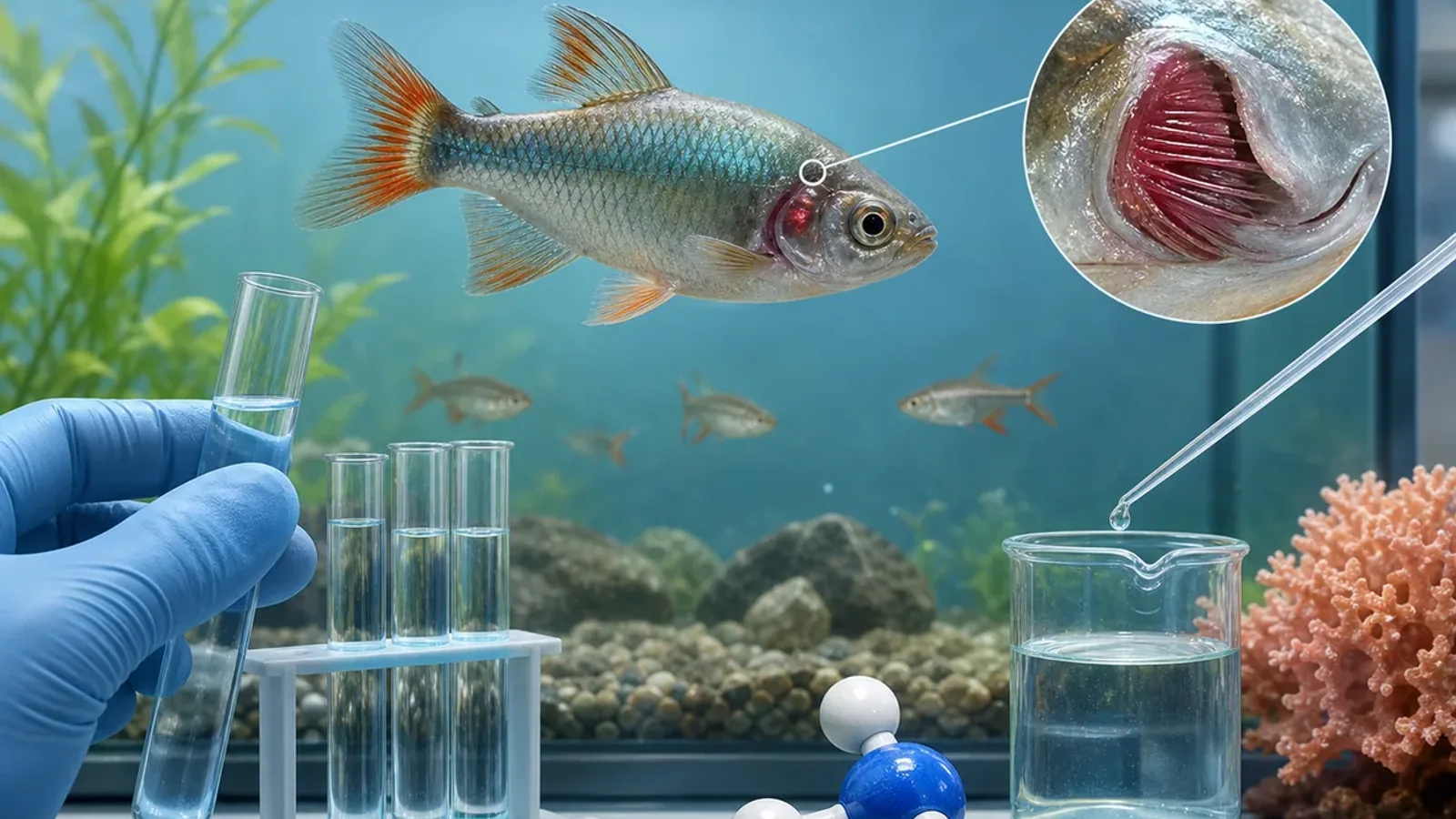
The fish then defends itself by producing more mucus, by increasing the thickness of the epithelium of its gills… We therefore understand that, even if the fish partially succeeds in preventing ammonia from entering the body, “useful” exchanges with the external environment will be greatly disrupted: the penetration of oxygen into the gills will decrease considerably, leading to respiratory distress which can be fatal. Under these conditions, damage to under-oxygenated internal organs will be inevitable. The liver and kidney being affected, the fish will poison itself as soon as it is no longer able to eliminate the products of its metabolism.
Limit thresholds
pH valueMaximum acceptable concentration of NH3If pH less than 8,50,20 mg/LSi pH greater than 8,50,05 mg/L
At the usual pH in fresh water, the NH3 concentration should never exceed 1 mg/L and routinely be as close as possible to 0.
Remarks
Commercially available tests measure the sum of the two forms of ammonia: ammonia + ammonium.
Order online
Consult our boutique to order a fresh water analysis.