

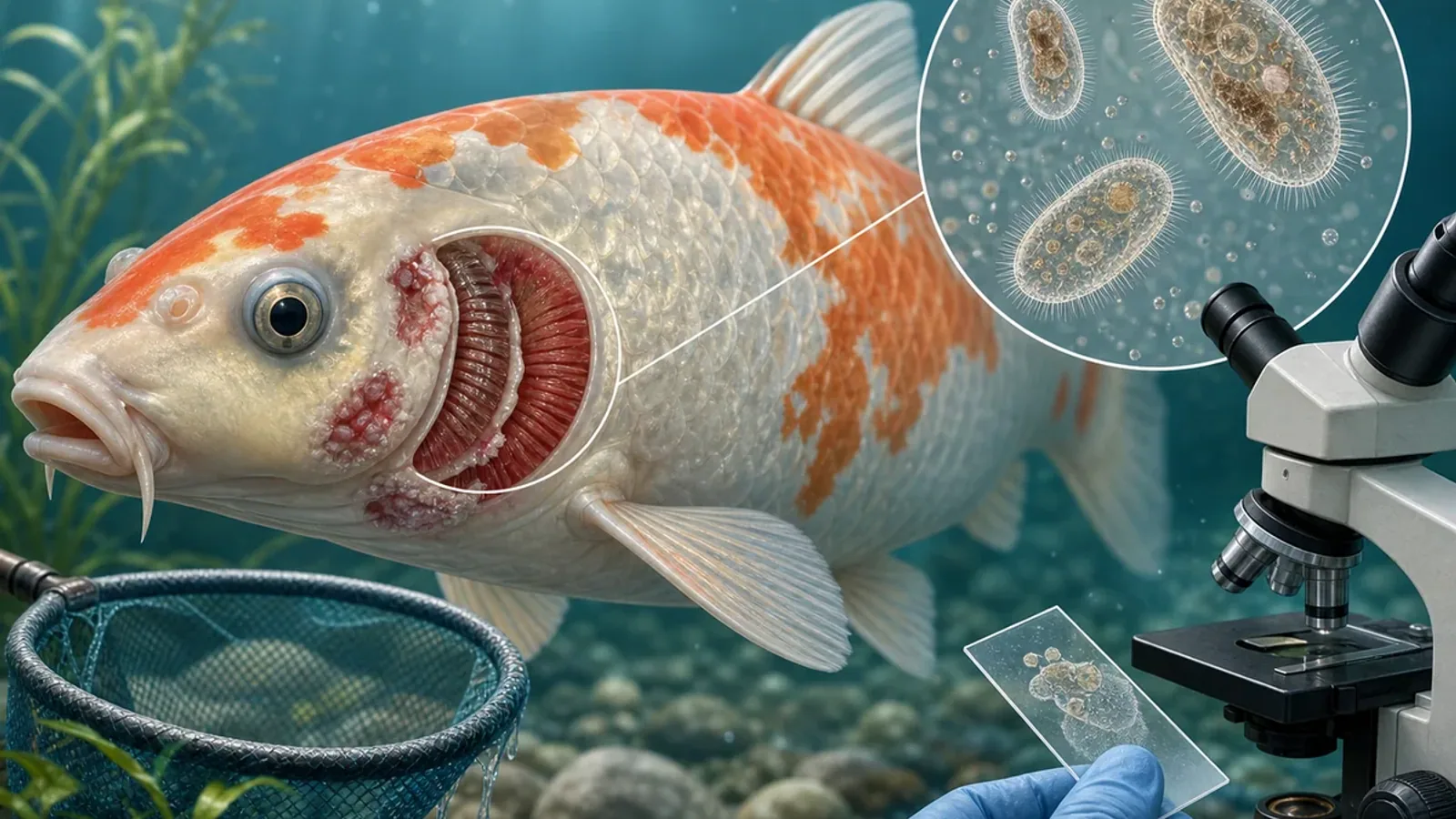
What is costiosis?
This is a parasitic infestation caused by Ichthyobodo necatrix (formerly called Costia), a flagellated protozoan, which affects the skin and gills of many freshwater fish (carps, goldfish, salmonids, etc.) in a wide temperature range 2-30°C.
Due to its direct and very rapid multiplication, this ectoparasite is often the cause of very significant mortalities over a very short time interval.
Clinical signs
Clinical signs are common to many ectoprotozooses.
Skin and fins:
Hyperproduction of mucus, then skin erythema (redness), pinching of the fins and in the terminal phase desquamations which may or may not be associated with superinfections fungal.
Gills:
Hyperplasia of the gill lamellae, respiratory distress.
Diagnosis
The parasite is found in two forms on the skin or gills: attached to the fish, or free on its surface.
To highlight the parasite it is essential to carry out microscopic observation of a scraping of skin or gill mucus with a magnification of at least 400x and strong bright contrast. The parasite is very small (5-15 µm) and its general shape is that of a bean with two long flagella involved in attachment to fish cells.
It is very difficult to observe given its small size, the rapid speed of movement of free forms, and becomes very difficult or even impossible to detect if the mucus sample is not examined immediately.