

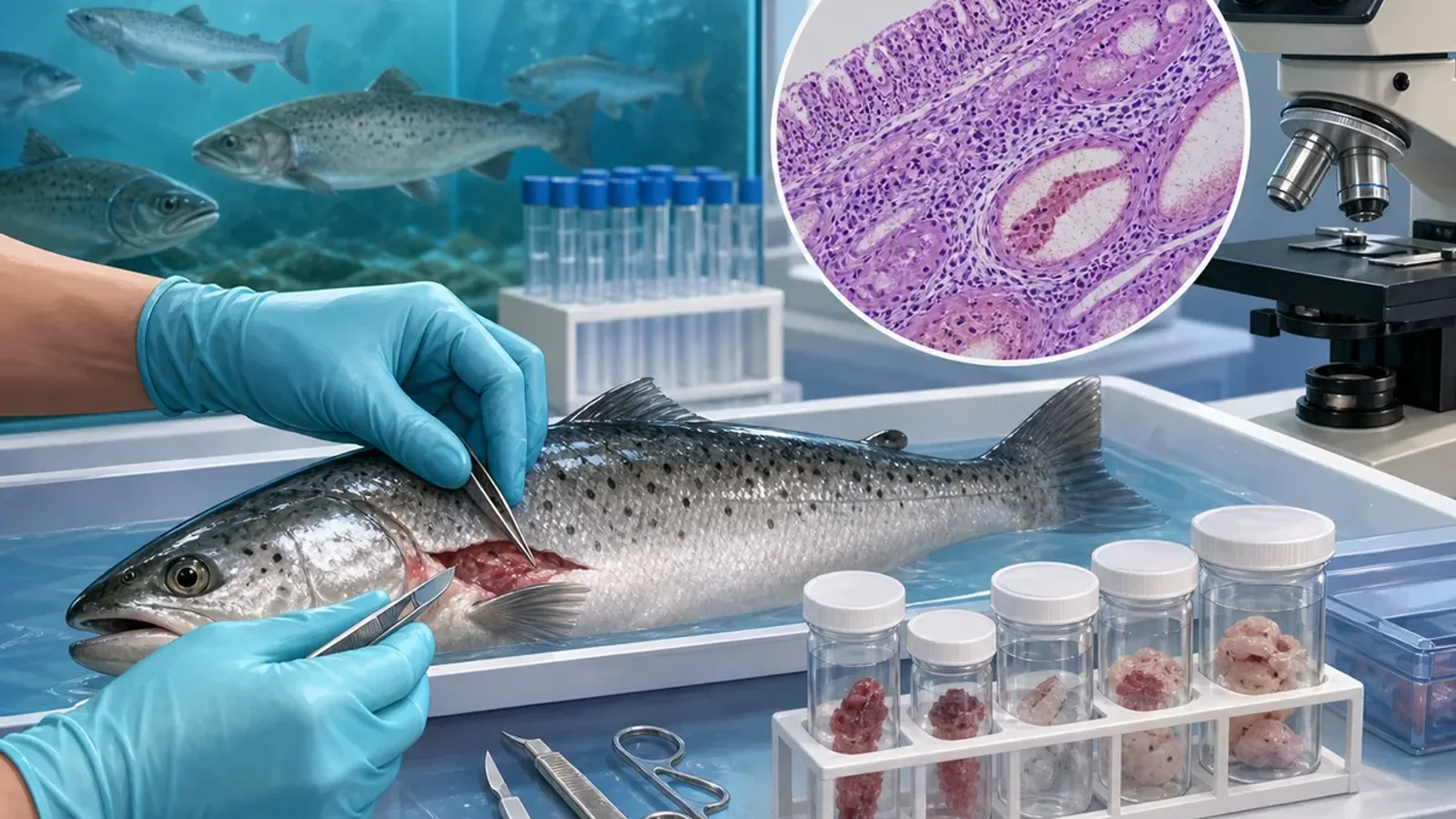
What are the recommendations for tissue samples intended for histological analyses?
The samples must be taken and fixed within 5 minutes following the death/euthanasia of the animal in order to avoid damage linked to the phenomena of autolysis and bacterial development which can take place very quickly.
The thickness of each sample must not exceed 1 cm (if necessary, make organ sections): the samples must be small enough to allow the fixative to diffuse quickly within the animal. the sample.
1 maximum volume of sample for 10 volumes of fixative: the quantity of fixative must be sufficient to stabilize all biological tissues.
Do not mix different species in the same sample pot. Clearly identify the contents of each sampling pot.
Recommendations based on the size of the fish
Fish less than 3 cm in length
-
Open the abdomen of the fish with a scalpel, along the midline;
-
Place the entire fish in the fixative, ensuring that no air remains in its abdominal cavity. Fish between 3 and 6 cm in length
-
Decapitate the fish;
-
Place the 2 pieces of fish in the fixative. Fish between 6 and 15 cm in length
-
Take all the organs from the abdominal cavity;
-
Take the head previously split vertically and lengthwise;
-
Take a 1 cm thick steak from the middle of the abdomen;
-
Place all the previously collected pieces of fish in the fixative. Fish over 15 cm in length
-
Take a sample of all organs (heart, liver, intestine with pancreas, spleen, kidney);
-
Take two gill arches from each side;
-
Take the brain after incising the head vertically and lengthwise ;
-
Take a piece of skin with the underlying muscle at the level of the lateral line;
-
Place all the pieces of fish previously collected in the fixative.
Choice of the fixative
The samples must be preserved in a histological fixative which contains 4% formalin (=10% formaldehyde) as well as a buffer. We can send you histological sample pots as part of our analyses.
Warnings
Formol is volatile and even at low concentrations it is irritating (above a concentration of 0.1 mg/kg in air): it can irritate the eyes and mucous membranes, causing conjunctivitis, headaches and difficulty breathing accompanied by pain in the throat.