15 July 2026
New fish colonies: a biosecurity framework for research facilities
FELASA–AALAS recommendations provide a structured way to introduce fish colonies while protecting health status, staff safety and the reliability of research.
- Sector
- Research
- Content type
- Practical guide
Bringing a new line into an aquatic research facility is more than a shipping task. Fish may arrive with apparently normal behaviour while carrying a subclinical agent, and water, wet equipment or live feeds can create additional routes of entry. A joint FELASA–AALAS recommendation offers facilities a practical framework for assessing those risks, designing quarantine and protecting colonies, staff and the scientific value of ongoing work.
A decision framework, not a universal rulebook
Published in Comparative Medicine in 2022, the guidance was developed by an international group of laboratory animal veterinarians, aquatic facility professionals and fish-health specialists. It describes good practices for exchanging fish used in research. FELASA explicitly presents its recommendations as state-of-the-art proposals rather than regulations, so they must be interpreted alongside applicable law, institutional policies and a facility-specific risk assessment.
That distinction prevents false precision. No quarantine duration, diagnostic panel or preventive treatment fits every transfer. Decisions depend on the species and life stage, the source population’s health information, the agents a receiving unit needs to exclude, the hydraulic design of the facility and the intended research.
Why introductions deserve special attention
An outwardly healthy colony may carry an infection that becomes clinically apparent only after transport or exposure to a new environment. An introduction can therefore lead to disease and losses, but its scientific consequences may begin earlier. Subclinical infection, persistent inflammation or an unplanned treatment can alter measured outcomes and become a hidden source of variability.
The authors recommend thinking in terms of epidemiological units. Quarantine should operate independently enough from the main colony to prevent shared water, equipment and staff movements from joining the two populations. A separate room is not a secure barrier if everyday workflows repeatedly reconnect it to established units.
What the working group’s survey found
The guidance drew on a survey conducted in spring 2018 with 145 respondents: 111 in Europe and 24 in North America. Most respondents reported accepting fish even when health information was limited. Roughly one in six lacked quarantine facilities or procedures, while only 5% described arrangements the authors considered reliably secure.
These figures are not a current census of all aquatic research facilities. Their practical value lies in highlighting common weak points. Information may be incomplete, responsibilities may be divided between scientific and animal-care teams, and decisions may be compressed into the period between an exchange agreement and a shipment’s arrival.
Four decisions before release to the colony
The recommendation structures a new introduction around four connected steps.
First, facilities should identify international, national and local restrictions before shipment. Requirements may relate to species, origin, transport, animal health, invasive species or genetically altered organisms. Discovering a constraint at the receiving door is too late for sound risk management.
Second, the receiving team assesses risk using the source and the material being transferred. Disinfectable embryos, adult fish, shipping water and accompanying organisms do not represent the same exposure. Useful source information includes surveillance results, recent clinical events, previous treatments and the health history of the population. Missing evidence should not be treated as evidence of freedom from infection; it should increase the uncertainty assigned to the transfer.
Third, the facility establishes an appropriate quarantine barrier. The paper discusses observation for at least two weeks, with six weeks or longer considered in some situations according to risk and applicable requirements. These numbers are not universal release criteria. The period should allow meaningful clinical observation, sampling and interpretation for the specific agents under consideration.
Fourth, incoming animals are triaged and examined, then screened or treated where justified, before a release decision. Diagnostic testing needs to answer a pre-defined health question. A negative result is informative only when the sampling design, timing, method and test performance are appropriate for that question.
Biosecurity extends beyond the quarantine room
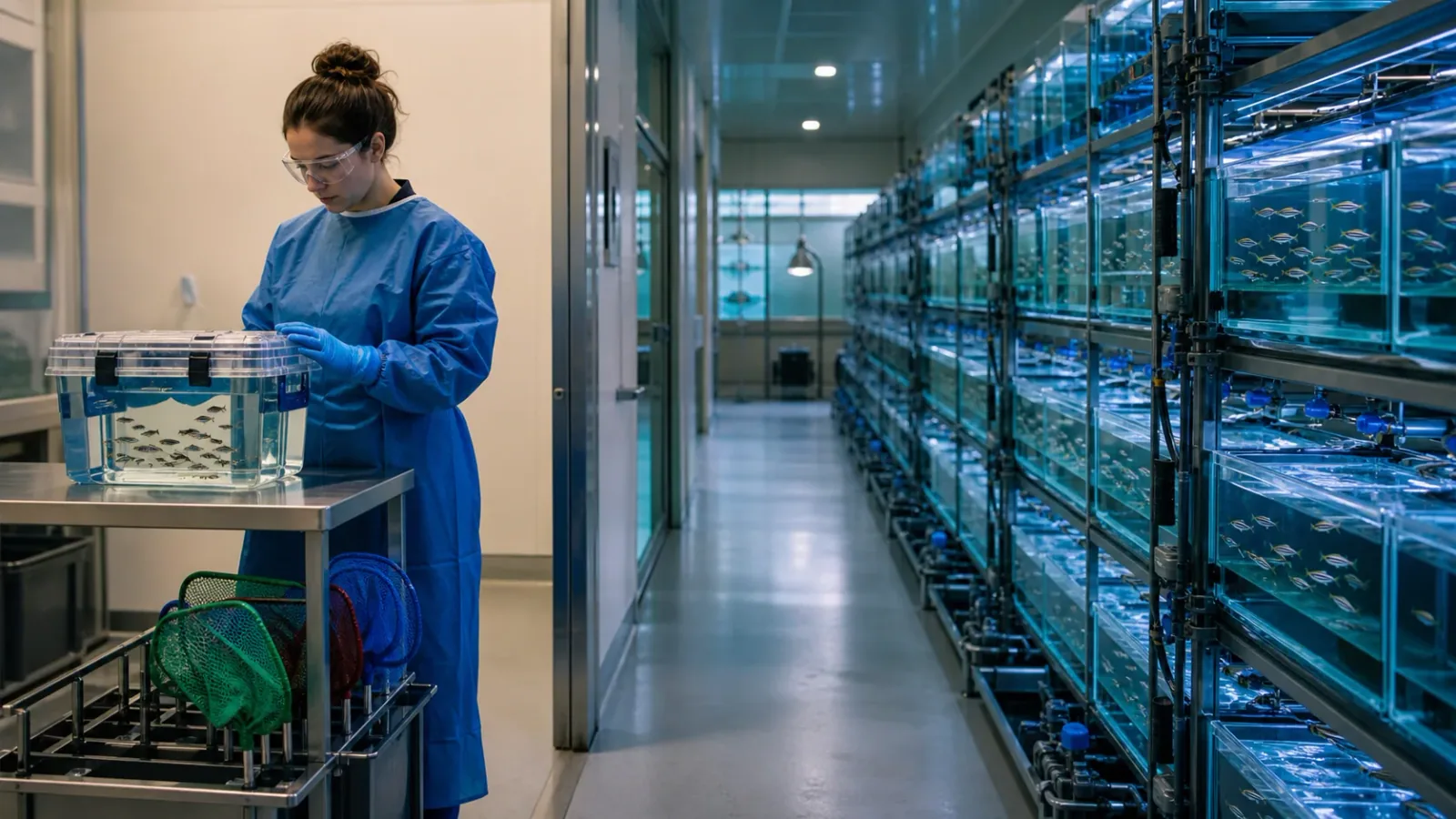
People and equipment can bypass an otherwise strong physical barrier. Working from lower-risk units towards higher-risk areas, dedicating nets and maintenance tools, using appropriate protective clothing and validating sanitation methods all reduce indirect transmission. Water treatment, system maintenance, splash and aerosol control, feed management and waste routes must support the same epidemiological boundaries.
Worker protection belongs in the programme as well. Some bacteria associated with fish, system water and biofilms have zoonotic potential. Hand hygiene, waterproof gloves where the exposure warrants them, clear injury procedures and staff training help control that risk. The authors nevertheless characterise fish husbandry as low risk for immunocompetent personnel when sound procedures and suitable personal protective equipment are consistently used.
Turning guidance into a workable procedure
A useful introduction procedure assigns decisions rather than merely listing precautions. It identifies who approves a shipment, which evidence the source must provide, where the animals are received, what equipment is dedicated to them and which findings lead to release, extended quarantine or rejection. It also covers exceptions: ambiguous results, mortality during observation, hydraulic failure, weekend staffing and the need to preserve an irreplaceable line.
The companion FELASA–AALAS recommendation on health monitoring strengthens this approach. It promotes transparent reporting of the health status of each unit, the methods used and their limitations. Shared terminology and traceable records make exchanges easier to evaluate and help research teams account for health context when interpreting data.
How Vetofish can support research teams
Vetofish can help aquatic research facilities map animal, water, staff and equipment flows; define epidemiological units; assess an intended introduction; and build a proportionate quarantine plan. Support may combine a facility audit, targeted diagnostic planning, written release criteria, health monitoring and practical team training.
The aim is not to impose one facility model. It is to make every introduction decision explicit, documented and compatible with scientific objectives, regulatory duties and technical constraints. Well-designed biosecurity protects animals and people, while also supporting reproducible research.
References
- Mocho J-P, Collymore C, Farmer SC, et al. “FELASA-AALAS Recommendations for Biosecurity in an Aquatic Facility, Including Prevention of Zoonosis, Introduction of New Fish Colonies, and Quarantine.” Comparative Medicine. 2022;72(3):149–168. 10.30802/AALAS-CM-22-000042.
- Mocho J-P, Murray KN, Varga ZM, et al. “FELASA-AALAS Recommendations for Monitoring and Reporting of Laboratory Fish Diseases and Health Status, With an Emphasis on Zebrafish (Danio rerio).” Comparative Medicine. 2022;72(3):127–148. 10.30802/AALAS-CM-22-000034.
- FELASA. “Guidelines and recommendations.” Publication framework for recommendations.