02 August 2026
European seabass: which welfare indicators matter?
For sea-caged European seabass, useful welfare monitoring combines mortality, health, behaviour and water quality without mistaking consensus for validation.
- Sector
- Aquaculture
- Themes
- Animal welfare
- Animal groups
- Fish
- Content type
- Scientific news
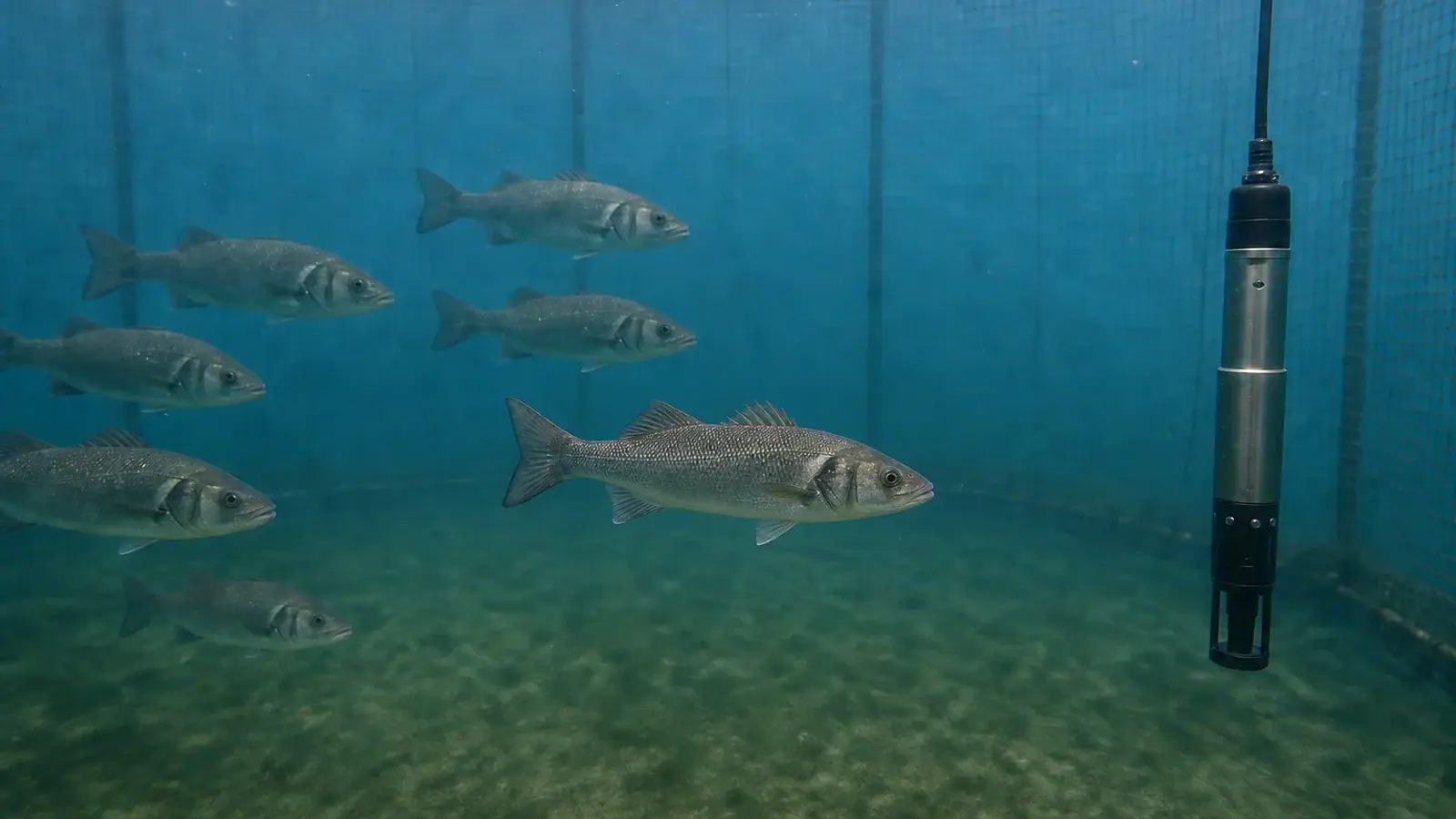
Assessing European seabass welfare on a farm cannot be reduced to one reading. A Delphi study published in Aquaculture brought together scientists, producers, authorities, NGOs and other specialists to prioritise indicators that can be used during grow-out in marine net pens. Their consensus placed mortality, disease and injury, swimming and feeding behaviour, temperature, oxygen and salinity at the centre of practical monitoring. It offers a framework for organising observations, but it does not establish universal thresholds or a protocol validated for every farm.
From a general impression to an operational dashboard
Fish welfare depends on the resources provided, husbandry practices and the animals’ responses. Technically acceptable water therefore does not guarantee satisfactory welfare on its own. Equally, reduced appetite or altered swimming does not identify a single cause. An operational welfare indicator is useful only when staff can measure or observe it consistently, interpret it in context and connect it to a decision.
Angeliki Mitropoulou and colleagues used a modified Delphi process. Participants first discussed challenges and possible solutions, then rated indicators anonymously while receiving immediate feedback on the group’s responses. The panel included 31 experts from eleven European countries, including France: ten scientists, eight producers, five NGO representatives, five people from national authorities or ministries and three opinion leaders. Twenty-six participants completed the indicator evaluation.
That mix is valuable when practical feasibility matters. It also defines an important limitation: the result is stakeholder consensus. It is not a longitudinal validation study demonstrating the sensitivity, specificity and repeatability of each indicator across diverse commercial conditions.
Five dimensions that need to be read together
The most strongly supported indicators can be organised into five complementary dimensions.
The first is mortality. It should be recorded daily, related to the population actually at risk and examined as a time series. A monthly total can hide a sudden break from baseline. Presumed causes, removals, handling events and environmental changes should remain traceable.
The second dimension combines the presence of disease with injury prevalence. External observation must remain distinct from diagnosis. Skin damage, fin condition, gill status or deformities can guide an examination, but they cannot identify a causal agent without investigation. A stable scoring method, comparable photographs and a defined sampling approach make trends more interpretable.
The third dimension covers swimming behaviour and space use. A concise ethogram can specify expected patterns, position in the cage, school cohesion, escape reactions and abnormal activity. Observation times need to be standardised against light, feeding, weather and farm operations because each can naturally alter activity.
The fourth dimension is feeding. Time to approach feed, distribution within the school, refusals and changes in intake may provide early warning. They must be interpreted with ration, pellet size, estimated biomass, temperature and previous meals. Feed conversion ratio reached consensus during part of the exercise but was later removed from the proposed scheme: a production performance indicator does not automatically describe the fishes’ welfare state.
The fifth dimension is water quality. Temperature, dissolved oxygen and salinity received strong support. Their value lies less in an isolated reading than in time-stamped measurements, the magnitude of variation and their relationship with depth, stocking conditions, feeding and school responses. Water pH generated more disagreement among stakeholder groups, so it should be retained within the physicochemical context rather than treated as a stand-alone diagnosis.
What farm teams can change now
A farm can begin by mapping the information it already collects. Each indicator needs a definition, frequency, owner, method, unit and escalation rule. Automated sensor records and staff observations should share the same timeline. That alignment makes it possible to ask whether reduced feeding followed an oxygen change, net maintenance or a health event.
Operations require particular attention. The experts identified handling and transport as important stressors. A dashboard should therefore separate routine baseline periods from grading, transfer, treatment, cleaning or intense human activity. Recovery after an event matters as much as the initial peak: time to resume feeding, return to usual swimming, injury development and delayed mortality all add useful context.
Teams can define three response levels without pretending that locally chosen triggers are universal scientific thresholds. A small deviation prompts a sensor and context check. Agreement between several indicators leads to intensified observation, verification of water conditions and consultation with the health team. Rapid deterioration in respiration, swimming, mortality or oxygen requires immediate use of the site-specific emergency plan and veterinary input where indicated.
Limits: consensus is not a standard
The study focused on European seabass during grow-out in marine cages. Its priorities should not be transferred automatically to larvae, broodstock, recirculating systems or other species. The panel was limited in size, and the scores combine expertise, experience and operational acceptability rather than experimental comparisons of diagnostic performance.
The authors also discuss the limitations of laboratory markers. Capture, air exposure and sampling can themselves rapidly raise cortisol, glucose and lactate in a species that is sensitive to handling. These measurements can be informative within a controlled protocol, but the panel recommended removing laboratory-based indicators as a group from the routine operational scheme; gill status was the exception that achieved consensus.
Longitudinal validation is still needed across farms, seasons and production settings, using repeatable methods and documented health outcomes. Indicators should be treated as converging lines of evidence, not as a single score that claims to summarise every dimension of welfare.
Monitoring should lead to a proportionate decision
The practical message is straightforward: a short set of defined, synchronised and actionable indicators is more useful than a long checklist that is rarely reviewed. Mortality, external health, swimming, feeding and environmental records cover different information. When several change together, they can reveal an unusual situation earlier and guide investigation without claiming to provide a diagnosis on their own.
Vetofish can help seabass farms design observation sheets, audit monitoring points, connect water data with animal-based observations, train teams and define site-specific health escalation procedures. The aim is not to impose a generic threshold, but to turn comparable information into proportionate decisions.
References
- Mitropoulou, A., Mougiakou, E., Koumparelou, A., Samaras, A., Seriatos, A. & Pavlidis, M. (2026). “Developing operational welfare indicators for European Sea bass (Dicentrarchus labrax): Delphi-informed reflections on advancing farmed fish welfare.” Aquaculture, 614, 743474. 10.1016/j.aquaculture.2025.743474
- Pavlidis, M., Samaras, A. & Papaharisis, L. (2024). Welfare assessment study for European sea bass: A scientific approach towards improvement of welfare status and welfare assessment of on-growing European sea bass. University of Crete. ISBN 978-960-9430-28-9. https://zenodo.org/records/13928405
- European Parliament, Policy Department for Structural and Cohesion Policies (2023). Animal welfare of farmed fish. Study PE 747.257. https://www.europarl.europa.eu/thinktank/en/document/IPOL_STU(2023)747257