14 July 2026
Public aquariums: habitat choice becomes measurable fish enrichment
Research at the Tennessee Aquarium shows how flow, depth and substrate shape fish space use, turning microhabitat choice into evidence-based enrichment.
- Sector
- Public aquariums
- Animal groups
- Fish
- Content type
- Scientific news
- Keywords
- EnrichmentEthogramStress
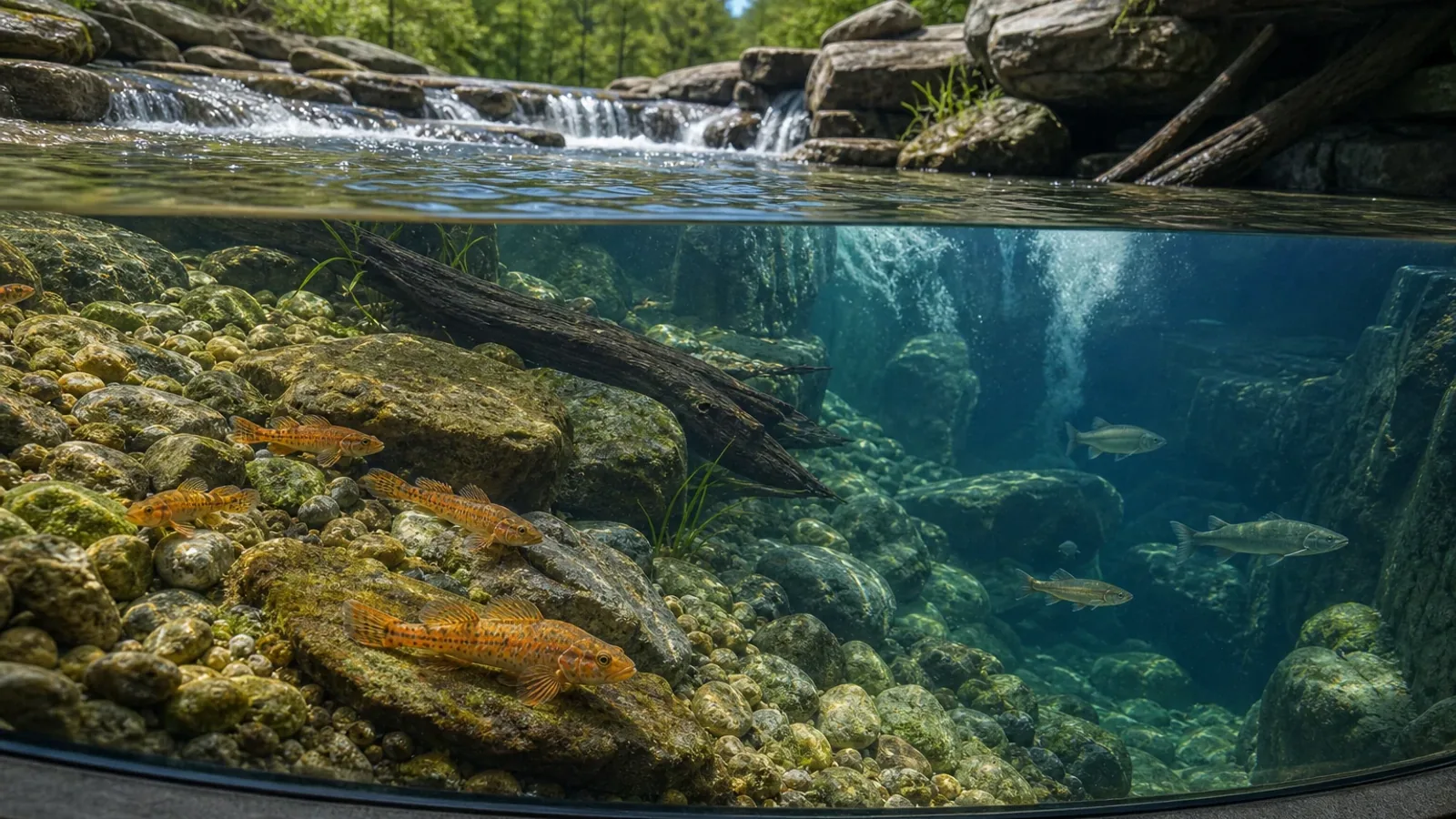
A natural-looking display is not automatically enriching. To provide meaningful opportunities for fish, exhibit design must create conditions they can choose and use in biologically relevant ways. Research in the Tennessee Aquarium’s Ridges to Rivers exhibit found that fish did not distribute themselves randomly among a plunge pool, riffle and run. Tangerine darters concentrated in stream features resembling their wild habitat and expressed characteristic station-holding and swimming behaviour near rocks and flowing water.
From scenic display to functional habitat mosaic
The exhibit represents an Appalachian stream through three connected microhabitats. The Plunge Pool is deeper, the Riffle is shallow and turbulent, and the Run provides steadier flow. Depth, velocity and physical structure vary among them, while fish remain free to move between zones.
That choice is central to environmental enrichment. Adding a rock or plant is not sufficient if it offers no relevant function. A microhabitat may instead create an appropriate current for station-holding, a resting substrate, shelter, feeding opportunities or a place to withdraw. Its value can then be assessed through animal use rather than human impressions alone.
The researchers focused on the tangerine darter (Percina aurantiaca), a small benthic fish native to the Tennessee River drainage. Wild tangerine darters inhabit clear, cool and relatively shallow Appalachian streams with coarse rocky substrate. Their body form and behaviour are associated with life near the bottom in flowing water.
Measuring preference rather than merely counting fish
The team recorded all three microhabitats across ten video episodes. Eleven observers contributed to data collection. During each ten-minute recording, tangerine darters were counted at ten-second intervals, while all fish were counted every sixty seconds. Three observers analysed each video and their estimates were averaged to improve precision.
The study asked whether darters used each zone equally, whether their distribution matched that of the complete fish community and whether stationary behaviour, swimming, chasing and foraging changed across habitats.
Comparing the focal species with all fish was particularly important. A zone might contain many darters simply because it contains many fish overall. The authors therefore calculated relative abundance by dividing the darter count by the total fish count in each microhabitat.
Observer counts did not differ significantly for space use, suggesting limited observer bias. Most behavioural categories were also applied consistently, although the observers differed at the threshold of significance when recording swimming in the Riffle. This is a useful reminder that ethograms require training and reliability checks.
The riffle was a species-specific resource
Tangerine darter numbers varied significantly among microhabitats (F2,18 = 8.37, p = 0.003). Darters occurred more frequently in the Run and Riffle than in the Plunge Pool. The full fish community showed a different pattern: total fish numbers were higher in the Plunge Pool and Run than in the Riffle (F2,18 = 20.0, p < 0.001).
Adjustment for total fish abundance sharpened the distinction. Relative darter abundance differed across all three habitats (F2,18 = 20.1, p < 0.001), with especially high representation in the Riffle. Although the Riffle was the smallest zone, tangerine darters were its principal users and occupied it more densely than community-wide distribution would predict.
The result aligns with natural history. Wild tangerine darters are commonly associated with rocky riffles and runs. The aquarium was therefore providing a functional habitat option, not just visual resemblance.
Behaviour supported the space-use pattern
The researchers also conducted ten-minute focal observations of individual darters selected across the exhibit. Stationary behaviour occurred more often in the Riffle than in the Pool or Run (χ² = 9.03, p = 0.011). When stationary, fish were found near rocks more frequently than near plants, wood or other structures (χ² = 28.3, p < 0.001).
Swimming and station-holding were the most frequent behaviours. Swimming was recorded more often in the Riffle (χ² = 9.07, p = 0.011). Chasing and foraging did not differ significantly among microhabitats, and transitions between adjacent zones occurred at similar frequencies.
These observations do not directly prove a positive emotional state. They show nonrandom use of available choices and species-typical behaviour in the riffle. That supports the interpretation of habitat choice as enrichment, but it is not a complete welfare assessment by itself.
Design for fish biology, then test the result
For public aquariums, the study offers a stronger framework than aesthetic judgement. Exhibit planning can begin with species-specific requirements: depth, flow velocity, turbulence, substrate grain size, overhead cover, calm refuges, structural edges and seasonal variation. Multi-species displays need several options because one species’ preferred resource may be avoided by another.
Post-occupancy observation is essential. Fixed cameras and a concise ethogram can map space use, identify avoided areas and compare behaviours. Counts should be interpreted relative to available area or volume and total population abundance. Otherwise, crowding in one zone may be mistaken for preference.
Time also matters. This work took place outside the tangerine darter breeding season. Males can become territorial before spawning, potentially changing habitat use and chasing rates. Time of day, feeding, visitor attendance, maintenance and temperature are further variables worth recording.
Repeated observation can make enrichment adaptive. If a zone remains unused, teams can examine flow, access, cover or social competition rather than assuming that the original design is successful. If one habitat becomes heavily concentrated, its capacity and escape routes may need review.
Enrichment must remain compatible with health management
Physical complexity should not undermine the sanitary operation of an exhibit. Rocks and wood can provide valuable shelter but may also trap waste or obstruct inspection. Flow differences affect oxygen distribution, particle transport and feed delivery. Aquarists, veterinarians, biologists and life-support technicians should therefore design and evaluate microhabitats together.
Behavioural and health monitoring reinforce each other. Reduced use of a riffle, unusual station-holding in slow water or a sudden aggregation may reflect a hydraulic, thermal, social or clinical change. These observations are not diagnoses, but they can trigger focused checks before more obvious signs appear.
Evidence-based enrichment is a continuing process
This study covers one exhibit, one focal species and a defined observation period. It cannot prescribe identical currents or substrates for every fish. Its main contribution is a transferable method: offer contrasting habitats, quantify their use, compare the focal species with the whole assemblage and relate distribution to natural behaviour.
Environmental enrichment in public aquariums can therefore become testable and revisable. Vetofish can support behavioural and health indicator design, space-use analysis, maintenance-risk assessment and integration of findings into species-appropriate welfare plans. The strongest exhibit is not simply the one that tells visitors a convincing habitat story; it is the one that provides fish with demonstrably functional choices.
References
- Millard, A. et al. (2026). “Fish Space Use and Behavior in an Aquarium: The Use of Microhabitats as Enrichment.” Zoo Biology. 10.1002/zoo.70061
- PubMed bibliographic record, PMID 41867072. https://pubmed.ncbi.nlm.nih.gov/41867072/