14 July 2026
PFAS in wild fish: connecting contamination with ecosystem health
A US field study combines PFAS measurements in wild fish with tissue pathology and molecular responses, offering a practical model for integrated aquatic surveillance.
- Sector
- Environment
- Animal groups
- Fish
- Content type
- Scientific news
A water sample can confirm that a contaminant is present, but it cannot by itself show how much reaches fish or how exposed animals are responding. A study in Aquatic Toxicology addresses that gap by combining analytical chemistry, tissue distribution, histopathology and gene transcription in wild fish from Massachusetts. Its value extends beyond one region: it illustrates how environmental surveillance can connect pollution sources, internal exposure and biological effects while avoiding the common mistake of treating field associations as automatic proof of causation.
A field design built around contrasting exposure settings
Heather L. Walsh and colleagues examined fish from three aquatic settings. Ashumet Pond on Cape Cod has a history of contamination associated in part with firefighting foam use. The Sudbury River was sampled upstream and downstream of the mouth of Hop Brook, while Great Herring Pond provided a reference setting. This spatial design allowed the investigators to compare chemical profiles linked to point and non-point sources instead of treating PFAS as a single, evenly distributed exposure.
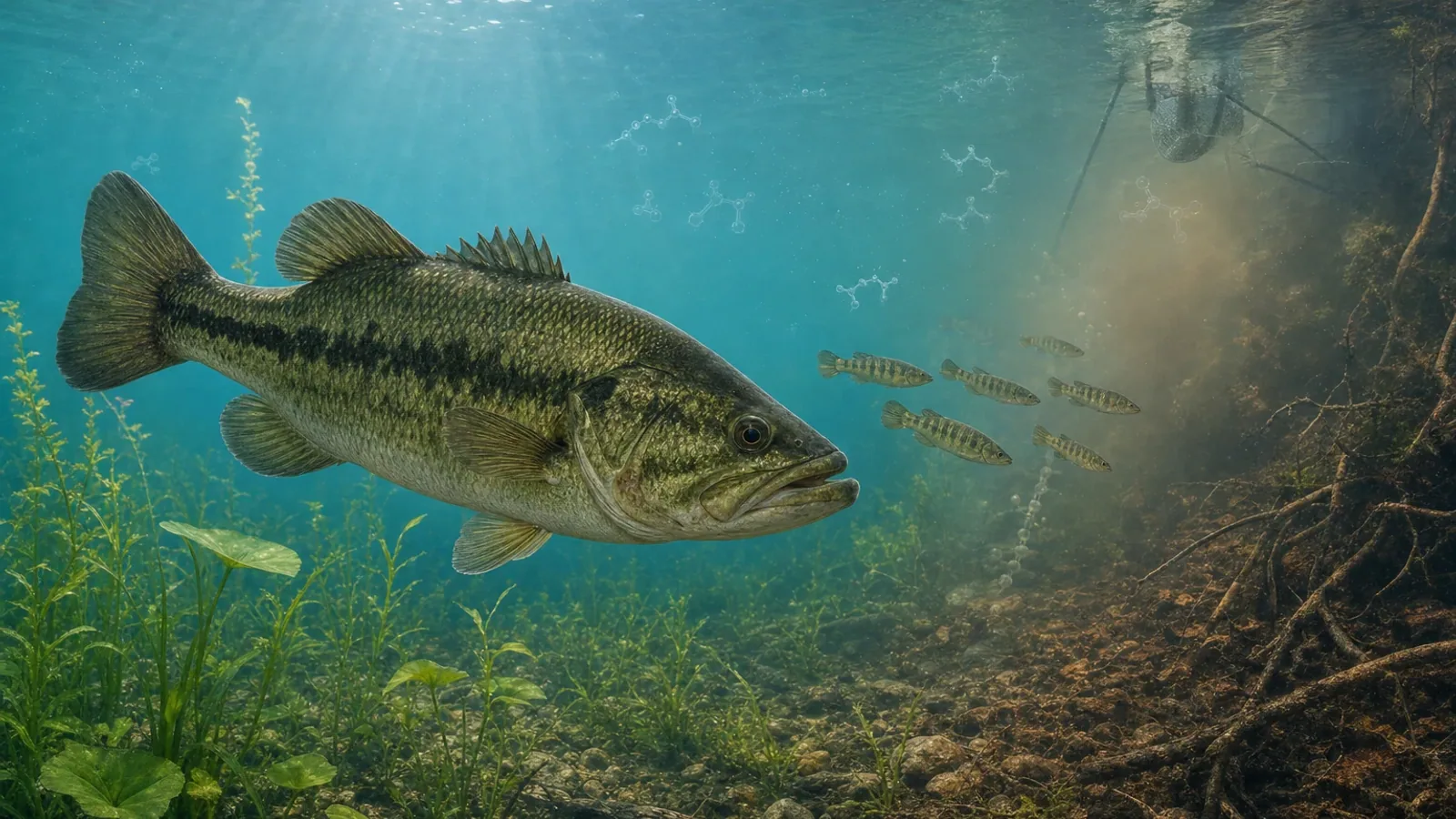
The team studied largemouth bass (Micropterus nigricans), a relatively high-trophic-level predator, and banded killifish (Fundulus diaphanus), a much smaller species. At Ashumet Pond, PFAS were measured in bass plasma, liver and muscle and in whole killifish. Comparisons at the other locations relied on bass plasma. The underlying measurements are available through a US Geological Survey data release, strengthening transparency and allowing readers to look beyond the headline findings.
This approach matters because water and fish samples answer different questions. Water chemistry characterises a medium at a particular place and time. A biological sample integrates uptake, elimination, diet, movement and physiological handling. Biota monitoring should therefore complement—not replace—water and sediment investigations.
Plasma, liver and muscle are not interchangeable
PFAS concentrations were highest at Ashumet Pond, followed by the Sudbury River and the reference pond. Plasma PFOS in fish from Ashumet Pond was almost 650 times the level at the reference site. That number describes a site contrast within this study. It is not a universal toxicity threshold, a regulatory limit or a ratio that can be transferred directly to another catchment.
Within largemouth bass, the overall tissue pattern was plasma first, then liver, then muscle. This is consistent with the affinity of many PFAS for blood and liver proteins and differs from the behaviour of contaminants that primarily partition into fat. A comparatively low muscle concentration therefore does not demonstrate that a fish has experienced little exposure.
Matrix choice must follow the surveillance question. Assessing fish exposure, ecosystem condition and human food safety may require different tissues, analytical designs and interpretation criteria. The study informs the first two objectives most directly; it does not establish a fish-consumption advisory.
The authors also found a substantial rise in plasma PFOS and PFDA at Ashumet Pond between samples collected in 2020 and 2022. Two sampling rounds alone do not establish a persistent trend, but they provide a strong reason to repeat measurements with a planned temporal design.
Species ecology can dominate the comparison
At Ashumet Pond, PFAS levels in largemouth bass were reported as much as 220-fold higher than in banded killifish. The authors identify trophic position and dietary exposure as plausible contributors. For surveillance teams, this finding is a reminder to standardise species, size or age class, season and sampled tissue wherever possible. A comparison between a small forage fish and an adult predator may reveal ecological differences as much as geographic contamination.
The two species can nevertheless provide complementary information. A small, locally abundant fish may represent exposure within a restricted area. A longer-lived predator can integrate a different history and trophic pathway. Neither should be presented as a complete proxy for the whole ecosystem.
Biological coherence without overclaiming causality
The investigation went beyond chemical measurement. The researchers examined tissue pathology and gene transcripts linked to inflammatory processes, oxidative stress, immune function and endocrine pathways. The strongest molecular alterations occurred in bass from Ashumet Pond and the downstream Sudbury River location. Together, the chemical and biological findings form a coherent pattern consistent with greater PFAS exposure at the more impacted sites.
“Consistent with” is the appropriate formulation. Wild fish encounter mixtures of contaminants alongside changes in temperature, oxygen, food, parasites, age and reproductive status. An observational field study can identify associations and generate mechanistic hypotheses, but it cannot assign every lesion or transcriptional change to one PFAS compound. Nor should a single molecular marker be used as an individual clinical diagnosis.
That limitation does not make the evidence unhelpful. Convergence across chemistry, histology and molecular biology is more informative than any single endpoint. It can identify priority sites, support source investigations and guide controlled or longitudinal follow-up studies.
Translating the study into a monitoring programme
For environmental managers, fish-health professionals and diagnostic laboratories, the paper supports a staged approach. Begin with a conceptual model of possible sources and transport routes. Pair water, sediment and biota where the question requires it. Predefine target species, size classes, tissues and season. Build analytical quality assurance and suitable reference sites into the design. Repeat sampling often enough to distinguish a transient episode from a sustained change.
Health endpoints need equally careful planning. Histopathology offers structural evidence, whereas transcriptional biomarkers may detect earlier but less specific responses. Combining them requires harmonised collection protocols, complete metadata and species-appropriate reference information. Chain of custody is especially important when plasma, liver and muscle from the same fish are routed to different analytical workflows.
Programmes should also keep three endpoints separate: ecological condition, fish health and risk to people who eat fish. Each has its own evidence requirements and decision authorities. The tissue ranking observed in this study cannot be converted directly into consumption advice; public-health agencies use dedicated sampling plans and health-based values for that purpose.
An integrated view of aquatic health
PFAS comprise a large chemical family with different sources, environmental behaviour and toxicological profiles. The Massachusetts results are therefore not a universal template for expected concentrations. Their broader contribution is methodological: the apparent signal changes with source location, sentinel species and sampled tissue.
Aquatic-health teams should not choose between chemistry and biology when the investigation calls for both. Linking robust chemical measurements with pathological and molecular observations can move surveillance beyond simple detection towards a structured assessment of exposure and possible effects. Vetofish can support sampling design, matrix selection, pathological interpretation and integration with environmental records, working alongside accredited laboratories and the relevant authorities. The aim is not to overdiagnose from a biomarker, but to build a defensible chain of evidence around fish and ecosystem health.
References
- Walsh, H. L., Blazer, V. S., Lord, E., Hurley, S. T. & LeBlanc, D. R. (2025). “Occurrence and tissue distribution of per- and polyfluoroalkyl substances (PFAS) in fishes from waterbodies with point and non-point sources in Massachusetts, USA.” Aquatic Toxicology, 287, 107499. 10.1016/j.aquatox.2025.107499
- Walsh, H. L., Blazer, V. S., Lord, E., Hurley, S. T. & LeBlanc, D. R. (2025). “PFAS in largemouth bass (Micropterus nigricans) and banded killifish (Fundulus diaphanus) from select waterbodies in Massachusetts.” US Geological Survey data release. 10.5066/P13HCMLE