15 July 2026
Zebrafish reveal a pH sequence during tissue regeneration
A fluorescent biosensor tracks an early fall and sustained rise in intracellular pH as the amputated zebrafish larval tail begins to regenerate.
- Sector
- Research
- Themes
- Research and innovation
- Content type
- Scientific news
- Keywords
- pHReproductionStress
Regeneration is often described through genes, growth factors and dividing cells. Yet every cell also has a changing chemical environment that can influence what those molecular components do. A study published online in Developmental Biology on 8 July 2026 identifies intracellular pH as one such dynamic feature in zebrafish larvae. Following experimental tail amputation, the researchers recorded a transient drop in intracellular pH and then a sustained increase above the pre-injury level.
The experiments do not establish pH as a single master switch. Instead, they support a role for pH dynamics in coordinating several parts of the regenerative response, including proliferation, inflammation, myeloid-cell behaviour and reactive oxygen species. That distinction matters when moving from a mechanistic model to claims about animal health or treatment.
Watching pH change in a living vertebrate
Intracellular pH, commonly written as pHi, reflects the balance of hydrogen ions produced, transported and buffered by a cell. It can affect enzyme activity, cytoskeletal organisation, migration and progression through the cell cycle. Measuring an average in homogenised tissue, however, would erase differences between locations and time points.
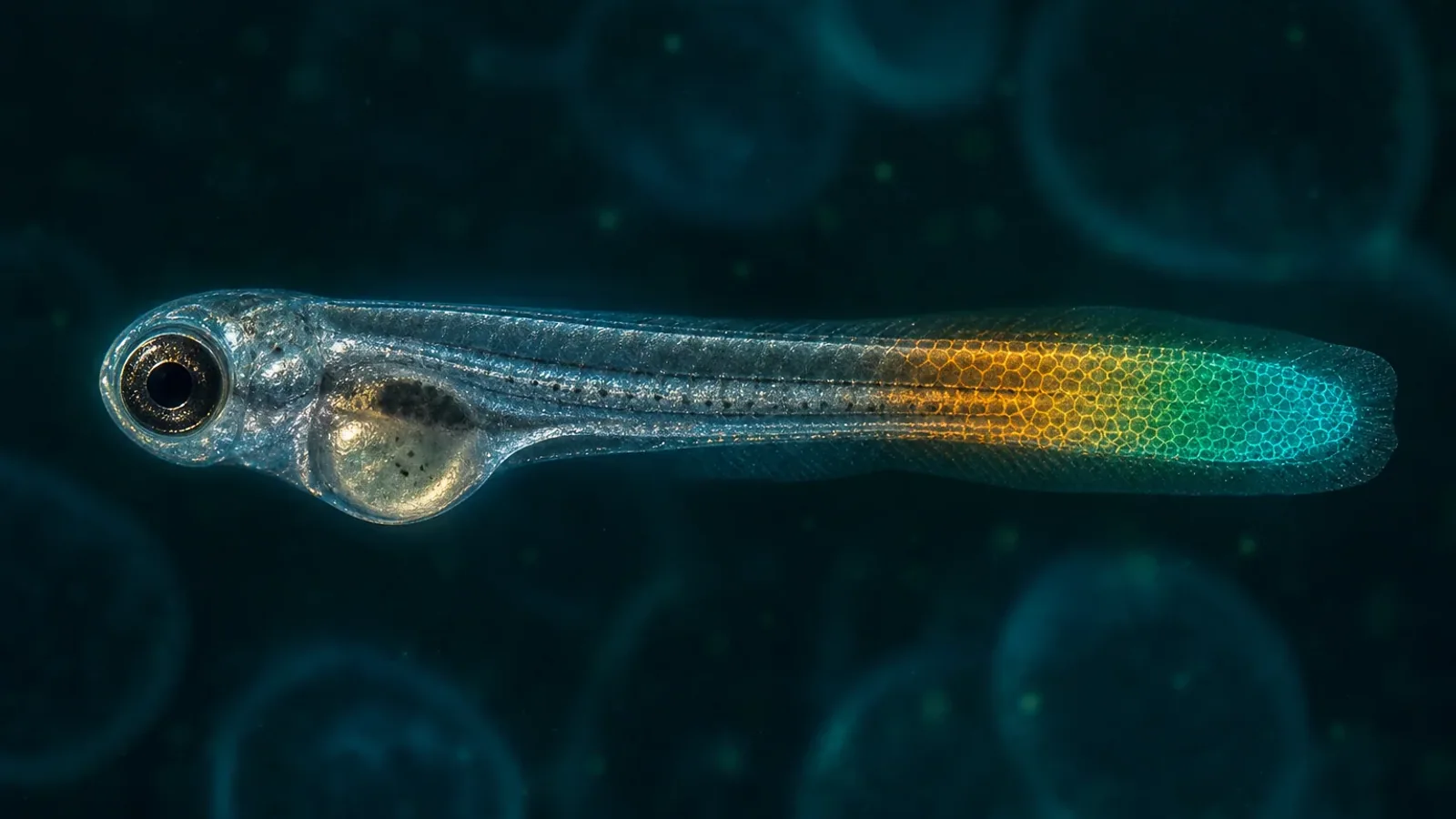
The team therefore generated a transgenic zebrafish line expressing a ratiometric fluorescent pH biosensor. Rather than relying on one fluorescence intensity, a ratiometric sensor compares optical signals. This helps control for some variation in probe abundance and imaging conditions while allowing pHi to be followed in living tissue over time.
Larval zebrafish offer unusual access to this process. They are small and optically transparent, and their tail can rebuild multiple tissue types following a controlled injury. Researchers can therefore observe cell behaviour that would be difficult to track continuously in an opaque vertebrate. The same advantages define the model’s limits: a standardised larval amputation is not an accidental wound in an adult fish, and it does not reproduce human tissue repair.
Regeneration followed a two-stage pH pattern
The central finding is a sequence rather than a fixed value. Amputation first produced a temporary intracellular acidification. This was followed by a rise in pHi that remained above the pre-amputation baseline during the observed regenerative period. The transition suggests that cells experience different chemical requirements during the immediate wound response and subsequent tissue rebuilding.
To ask whether the later pHi rise was merely correlated with regeneration or contributed to it, the authors disrupted ion exchange. They pharmacologically inhibited sodium–hydrogen exchanger activity. These NHE proteins can raise cytoplasmic pH by exporting hydrogen ions in exchange for sodium. The investigators also lowered extracellular pH as a separate way of limiting the intracellular rise.
Both approaches attenuated the post-amputation increase in pHi. Subsequent cell proliferation fell, and tail regeneration was impaired. Agreement between the manipulations strengthens the case that pHi has a functional role. It does not show that one NHE family member is solely responsible, nor does it rule out additional effects of the treatments on other cell functions.
Linking ionic control, immunity and redox signals
NHE inhibition affected more than tissue outgrowth. The researchers reported increased inflammation and altered myeloid-cell behaviour. Myeloid cells include rapid responders to injury, and an early inflammatory phase can be necessary for repair. Its scale, timing and resolution must nevertheless be closely regulated; persistent or mistimed inflammation may hinder rebuilding.
Reactive oxygen species also decreased when NHE activity was inhibited. These molecules are frequently discussed only as causes of oxidative damage. At controlled levels and over defined periods, however, reactive oxygen species act as wound signals and contribute to cell recruitment and regeneration. The observation cautions against assuming that indiscriminately suppressing redox activity will always help an injured tissue.
The study further found increased glycogen synthase kinase 3 (GSK3) activity after pHi dynamics were disrupted. Pharmacological GSK3 inhibitors partially rescued the regeneration defect. A partial rescue identifies GSK3 as a plausible downstream component but not a complete explanation. Ion transport, metabolism, immune activity and cell-cycle control are likely connected through more than one route.
A strong mechanistic clue with defined boundaries
The work combines live dynamic imaging with functional perturbation. Observing a pH shift alone would establish an association. Reducing that shift and finding coherent effects across proliferation, immune behaviour and tissue outgrowth provides stronger causal evidence. The partial pharmacological rescue adds a potential mechanistic link.
Important uncertainties remain. Pharmacological compounds may influence multiple targets or cellular compartments. The injury is standardised and performed in transgenic larvae under controlled experimental conditions. The findings do not justify changing aquarium-water pH to promote healing, and they do not support clinical use of NHE or GSK3 inhibitors in fish. Water pH affects the gills, whole-animal acid–base balance and many aspects of physiology; it is not interchangeable with the pH measured inside a regenerating cell.
Future experiments can identify which cell populations require the pHi transition, distinguish individual exchanger proteins and resolve the order linking pHi, reactive oxygen species, inflammation and GSK3. Targeted genetic approaches will be particularly helpful for separating direct mechanisms from broader consequences of disturbed ion homeostasis.
How Vetofish can support research facilities
For institutions working with zebrafish, Vetofish can support colony-health assessment, biosecurity, water-quality control and standardisation of husbandry conditions. These factors are not background details when experiments measure inflammation, metabolism or repair. Unrecognised infection, variable density or unstable water chemistry can change the very responses under investigation.
Translation also requires disciplined boundaries. A discovery in a larval model can reveal conserved principles and generate testable hypotheses without becoming an immediate treatment recommendation. This study provides a valuable view of how a basic cellular variable may organise a complex response. It also reinforces a broader lesson: successful regeneration depends on the timing and resolution of signals, not simply on keeping one pathway permanently active.
References
- Chou-Freed C, Prinz CK, Margaryan A, Theriot JA, Wagner DE, Barber DL. “Intracellular pH Dynamics Promotes Zebrafish Larval Tail Regeneration.” Developmental Biology. Published online 8 July 2026. 10.1016/j.ydbio.2026.07.004.
- Gauron C, Rampon C, Bouzaffour M, Ipendey E, Teillon J, Volovitch M, Vriz S. “Sustained production of ROS triggers compensatory proliferation and is required for regeneration to proceed.” Scientific Reports. 2013;3:2084. 10.1038/srep02084.
- Spear JS, White KA. “Single-cell intracellular pH dynamics regulate the cell cycle by timing the G1 exit and G2 transition.” Journal of Cell Science. 2023;136(9):jcs260458. 10.1242/jcs.260458.