14 July 2026
Zebrafish reproducibility starts with housing and husbandry
A 20-laboratory study shows how noise, transport, feeding and stocking density can shape zebrafish behavioural outcomes.
- Sector
- Research facilities
- Content type
- Scientific news
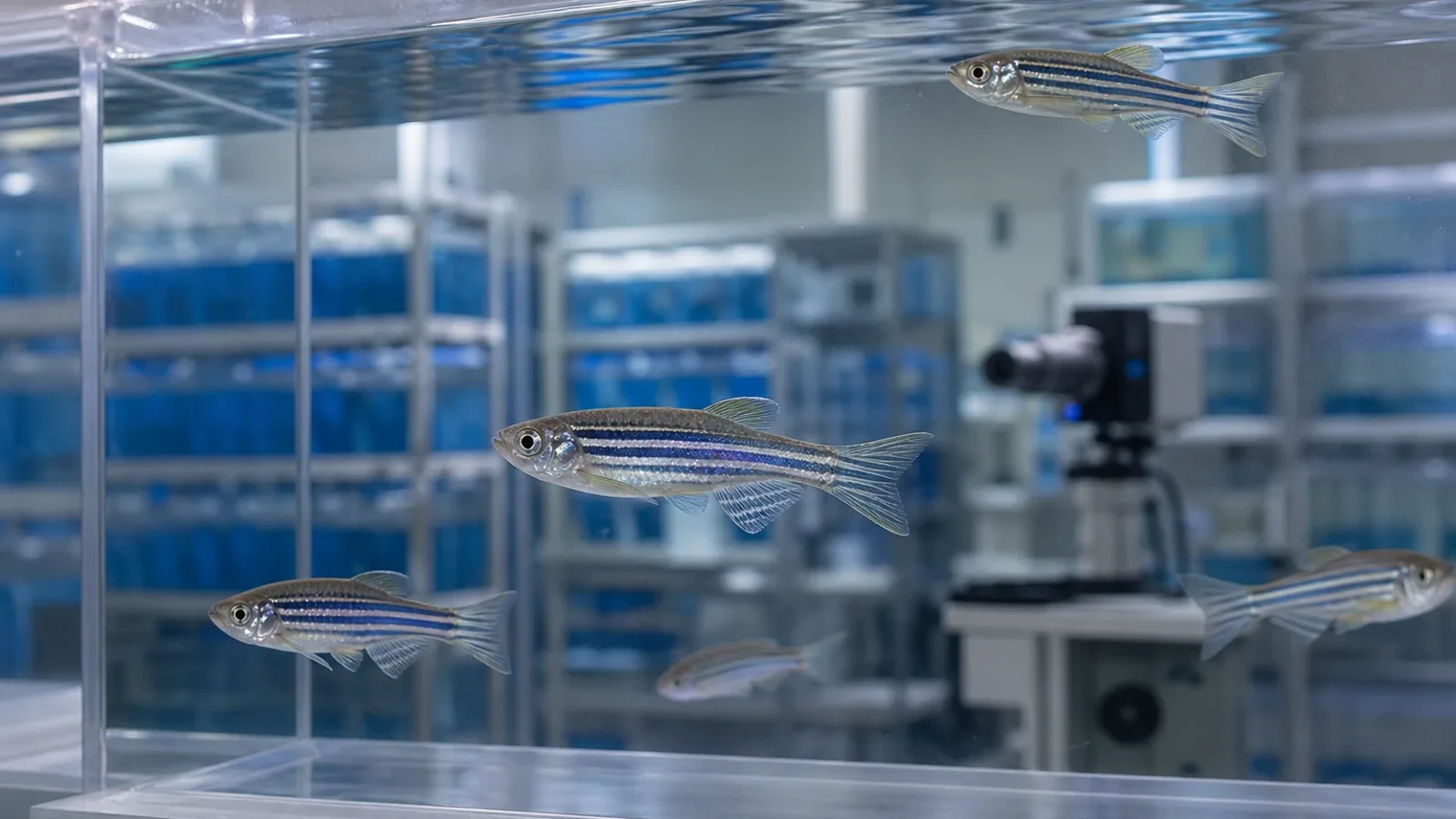
The novel tank test is a familiar tool in zebrafish (Danio rerio) behavioural research. It is widely used to investigate anxiety-like responses, yet laboratories following apparently similar methods do not always obtain comparable measurements. A global study published in Lab Animal helps explain why. Housing, feeding, background noise and moving fish immediately before testing can all contribute to the variation recorded. The wider lesson for aquatic research facilities is important: husbandry is not merely background information. It forms part of the biological model and should be treated as experimental metadata.
One protocol across 20 laboratories
The novel tank test draws on a consistent behavioural sequence. An adult zebrafish introduced into an unfamiliar tank generally remains near the bottom at first, then explores higher areas as it habituates. Researchers commonly measure total distance travelled, time in the upper zone and the number of entries into that zone. Depending on the endpoint and context, these variables are interpreted as measures of locomotion, exploration or anxiety-like behaviour.
To investigate which factors vary across facilities, 20 laboratories ran a common five-minute protocol. The study included 488 experimentally naïve adult fish: 240 females and 248 males, aged three to seven months. Participating sites aimed to test 12 fish of each sex. The resulting dataset contained 2,435 observations and 47 variables covering the animals, housing environment, husbandry practices and experimental setup.
This multi-laboratory design provides something that a tightly controlled single-site experiment cannot. It captures genuine diversity in systems, facility size, stocking density, diets, acoustic conditions and test-room arrangements. The authors used Lasso regression to identify potentially influential predictors and then assessed those predictors in linear mixed models.
Variation between sites without loss of the overall response
All three behavioural outcomes differed among laboratories. For time spent in the upper zone, two laboratories recorded values above the overall average and seven recorded lower values at a statistical threshold of p < 0.05. Top-zone entries were higher in two laboratories and lower in five.
This does not mean that the assay failed. Across sites, fish still showed the broad pattern of remaining low initially and exploring upwards over time. Time within the five-minute test was a critical factor. The findings instead warn against treating different endpoints as interchangeable. Distance travelled showed a moderate correlation with the number of upper-zone entries (ρ = 0.45; p < 0.001), but only a weak correlation with time spent in the upper zone (ρ = 0.14; p = 0.002). Entry counts may therefore capture general movement as well as an anxiety-like response.
Sex should also be built into study design and reporting. Differences appeared in some laboratories and during variable selection, but were not consistently confirmed in the validation models. This is neither evidence that sex can be ignored nor proof of a universal sex effect. It supports transparent reporting, appropriate balancing and explicit analysis of interactions with other conditions.
Background noise and the journey to the test room
Background noise emerged as an important predictor of upper-zone entries, with its association changing over the course of the test. Moving fish to another room was also associated with time spent in the upper zone. Sixteen laboratories tested animals away from their housing room. Fish tested in the room where they were housed spent more time near the top overall, while transported fish gradually reached a similar level by the end of the session.
The interpretation needs care. The study did not standardise acclimation time after transfer and could not fully separate handling, transport and unfamiliar visual or acoustic cues. Nevertheless, it challenges the assumption that a dedicated quiet room is automatically neutral when animals must be moved immediately before recording.
Facilities can respond by documenting the complete pre-test sequence: removal time, capture method, transfer duration, water source, waiting period, acoustic conditions and staff activity. Any acclimation interval should be defined prospectively rather than selected after results are examined, and it should be applied consistently across experimental groups.
Stocking density and diet are signals, not universal prescriptions
Stocking densities across the participating laboratories ranged from 1 to 8 fish per litre. Mean density was 3 fish/L in static tanks and 4.75 fish/L in recirculating systems. Within this dataset, higher density was associated with more time spent in the upper zone. The authors relate this observation to earlier evidence suggesting that densities around 5 fish/L may be favourable for this particular behavioural response.
That figure should not be converted into a universal limit. Extreme densities were absent from the study, system type is likely to interact with density, and welfare also depends on usable volume, water quality, flow, social composition, life stage and genotype. The robust conclusion is that density should be controlled and reported—not that every facility should adopt one number.
Feeding generated another potentially useful signal. Fish given rotifers showed a trajectory consistent with a less anxious initial response. However, only two laboratories reported using rotifers, and they used them at different life stages. The authors therefore describe this as preliminary and do not recommend a particular diet. The defensible operational lesson is to record diet composition and format, feeding frequency and timing, and any fasting period before testing.
A husbandry passport for behavioural experiments
The study’s questionnaires and data are available through the Open Science Framework, and the paper provides a list of parameters that should be reported for the novel tank test. This supports practical harmonisation without pretending that every aquatic facility can or should be identical.
A concise study record could include fish source and genotype, age, sex, density, tank volume, system type, water parameters, diet, photoperiod, noise, recent handling, breeding status, test location and the interval after transport. Keeping these variables alongside the experimental data makes unexpected results easier to investigate and cross-site replication easier to plan.
Useful standardisation does not always mean absolute uniformity. It begins by making biologically relevant differences visible, stabilising them where feasible and incorporating unavoidable variation into the design and analysis.
How Vetofish can support research facilities
In aquatic animal facilities, welfare and research quality often point in the same direction. Stable, observable and traceable husbandry reduces confounding while improving animal care. Vetofish can support facilities by reviewing husbandry practices, defining health and behavioural indicators, developing transfer and acclimation procedures, and designing traceability records that fit specific experimental programmes.
This study does not offer a single recipe for the perfect novel tank test. Its more valuable conclusion is that the animal’s experimental environment begins long before recording starts. Documenting that journey with the same rigour as the treatment itself is a practical step towards both refinement and reproducibility.
References
- Hillman C., Fontana B. D., Amstislavskaya T. G. et al. (2025). “Housing and husbandry factors affecting zebrafish novel tank test responses: a global multi-laboratory study.” Lab Animal, 54, 156–164. 10.1038/s41684-025-01548-x
- Hillman C. et al. Data and questionnaires associated with the multi-laboratory study, Open Science Framework. https://osf.io/4chwt/