14 July 2026
Oral vaccination offers a new route against Aeromonas in farmed catfish
An experimental killed bacterial vaccine delivered in feed improved channel catfish survival after Aeromonas challenge, highlighting both the promise and constraints of oral boosters.
- Sector
- Aquaculture
- Animal groups
- Fish
- Content type
- Scientific news
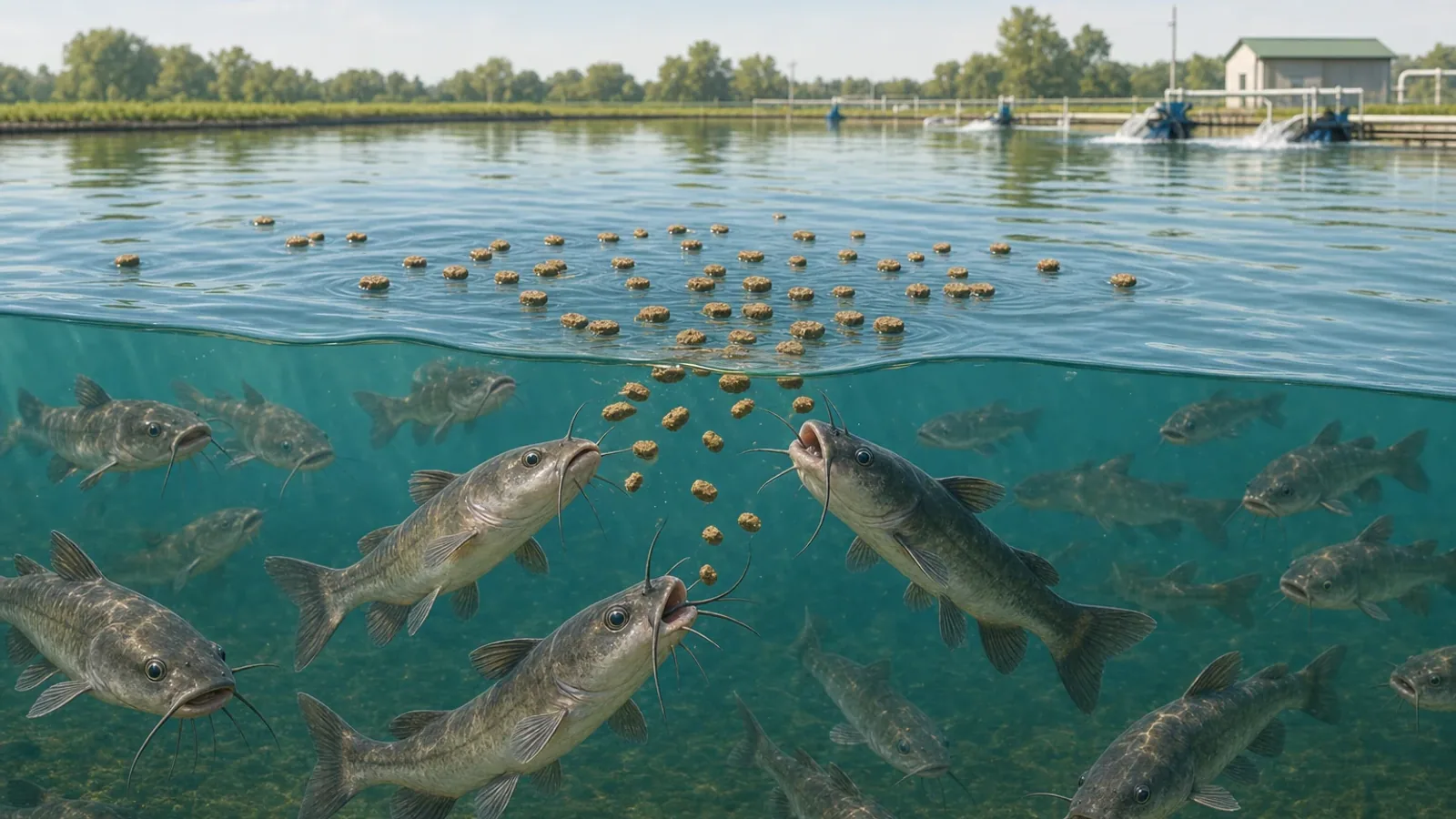
Delivering vaccine to an entire population through feed, without catching and injecting individual fish, could materially change preventive health management in aquaculture. A study in Aquaculture tested oral killed-bacterial vaccines against virulent Aeromonas hydrophila in juvenile channel catfish. Vaccinated groups survived experimental challenges better, particularly after a booster. The findings are encouraging, but they describe an experimental platform—not a licensed product or a farm protocol ready for unsupervised use.
Prevention for a disease that can move quickly
Virulent A. hydrophila, commonly abbreviated vAh in US catfish research, causes motile Aeromonas septicaemia. Affected fish may develop skin necrosis, internal and external haemorrhage and exophthalmia. The paper notes that mortality in affected US production systems can exceed 50% within a week. By the time feeding and behaviour change visibly, the window for diagnosis and intervention may already be narrowing.
That speed makes prevention especially valuable. Vaccination can only be one element of it. Water quality, stocking and handling stress, mortality removal, biosecurity and early diagnostic sampling remain essential. Strain identity matters as well: bacteria carrying the same species name can differ in virulence and antigenic profile.
Injected vaccines can induce strong responses but require individual handling. Immersion allows group delivery yet depends on exposure conditions. Oral vaccination fits routine feeding and reduces handling, but introduces different uncertainties. Antigen must remain stable in feed and water, withstand the digestive environment, reach relevant immune tissues and be consumed at a sufficiently uniform dose across the population.
Testing two outbreak isolates and an adjuvant
Allison Wise and colleagues worked with juvenile channel catfish (Ictalurus punctatus). They prepared bacterins—killed bacterial vaccines—from two virulent isolates collected during commercial disease events. ALG-15-097 originated from an Alabama outbreak in 2015, while S14-452 came from the Mississippi Delta. Fish received oral preparations with or without an adjuvant, alongside placebo controls.
The first bacterial challenge took place 21 days after vaccination. Every vaccine treatment except the adjuvanted S14-452 preparation produced significantly greater protection than placebo. The non-adjuvanted ALG-15-097 bacterin achieved the highest cumulative percentage survival, 48.0 ± 6.11%. This is a result from a defined experimental challenge. It is not a guaranteed farm efficacy figure and should not be compared with another vaccine tested under different conditions.
Remaining fish received an oral booster nine weeks after the initial vaccination. At twelve weeks, they underwent a second challenge using both vAh isolates. All formulations then improved survival, irrespective of adjuvant inclusion. Hazard analysis found significantly better survival odds for all vaccinated treatments than for controls, with P < 0.001.
The design therefore supports two practical ideas: oral delivery can generate protective priming, and a planned booster may be important for sustained or broader protection. It does not determine the optimal schedule for another species, temperature or production cycle.
More ingredients did not mean more protection
Adjuvants are intended to increase or extend immune responses, but the tested adjuvant did not improve protection here. For ALG-15-097, survival did not differ significantly between bacterin alone and the adjuvanted version during the first challenge (P = 0.08). The only formulation that failed to outperform placebo at day 21 contained adjuvant.
This result should not be generalised into a claim that oral fish vaccines never benefit from adjuvants. It applies to a particular ingredient, antigen preparation, dose and schedule. It does show that added complexity must earn its place through evidence. Protection, safety, stability and feed acceptance all need to be tested rather than assumed.
A simpler formulation could ultimately reduce manufacturing steps and quality-control variables. Commercial development, however, must address far more than challenge survival: coating uniformity, storage, leaching, palatability, dose consistency, cost and performance at production scale all matter.
Antibodies reveal priming after exposure
The researchers measured serum antibody responses at 21 days, nine weeks and twelve weeks after vaccination. Before challenge, vaccinated fish did not show clear antibody differences from controls. Five days after bacterial challenge, surviving vaccinated fish had significantly higher antibody levels.
The authors interpret this as immune priming: vaccination prepared the fish to mount a faster response when they later encountered the pathogen. The pattern is a useful caution against relying on a single pre-challenge antibody measurement as a complete correlate of protection. Fish vaccine assessment is stronger when survival, disease progression, pathogen burden and immune kinetics are considered together.
Protection after the booster extended across the two isolates used in the experiment, suggesting some cross-protective potential. It does not establish coverage against every virulent A. hydrophila strain. Antigenic diversity and the locally circulating population remain central to vaccine design.
The farm-level opportunity—and the current boundary
Oral vaccination is operationally attractive because it can treat growing fish collectively and deliver a booster without an injection campaign. Its main advantage is also a source of variability: dosing depends on feeding. Subordinate, stressed, anorexic or already ill fish may consume less vaccine. Feed allocation, delivery duration, water stability and appetite become part of the vaccination system.
The study should not be used as instructions to manufacture a farm-made bacterin. Experimental vaccines require the appropriate scientific, veterinary and regulatory framework. Product authorisation and permitted use vary by jurisdiction. Results in I. punctatus cannot be transferred directly to salmonids, carp, tilapia or marine species.
An effective health plan still begins with a documented diagnosis and an understanding of the strains involved. Water quality, nutrition, density, handling and mortality management remain part of disease control. Vaccination cannot compensate for a deteriorating production environment; its role is to add a targeted preventive layer.
Building evidence for scalable fish vaccination
This study provides a persuasive proof of concept for a boosted oral bacterin in channel catfish. It also demonstrates why vaccine development is more nuanced than adding an adjuvant or checking antibody titres before challenge. Isolate selection, formulation, timing and actual feed intake all shape the outcome.
Further work will need to test larger production populations, duration of protection, batch-to-batch consistency, safety and performance under farm conditions. Regulatory pathways must then define whether and how a product can be used. Vetofish can support bacterial outbreak investigation, sampling strategies, interpretation of antimicrobial susceptibility results and the design of preventive plans with veterinary and laboratory partners. Where an authorised vaccine is available and justified, it should be integrated into that evidence-based system rather than treated as a substitute for diagnosis and husbandry control.
References
- Wise, A. L., Beck, B. H., Richardson, B. M., Bader, T. J., Peatman, E., Liles, M. R., Barger, P. C. & Shoemaker, C. A. (2026). “Efficacy of orally-delivered virulent Aeromonas hydrophila bacterin vaccines in channel catfish (Ictalurus punctatus).” Aquaculture, 611, 743066. 10.1016/j.aquaculture.2025.743066
- USDA Agricultural Research Service (2026). Publication no. 425533, “Efficacy of orally-delivered virulent Aeromonas hydrophila bacterin vaccines in channel catfish.” https://www.ars.usda.gov/research/publications/publication/?seqNo115=425533