

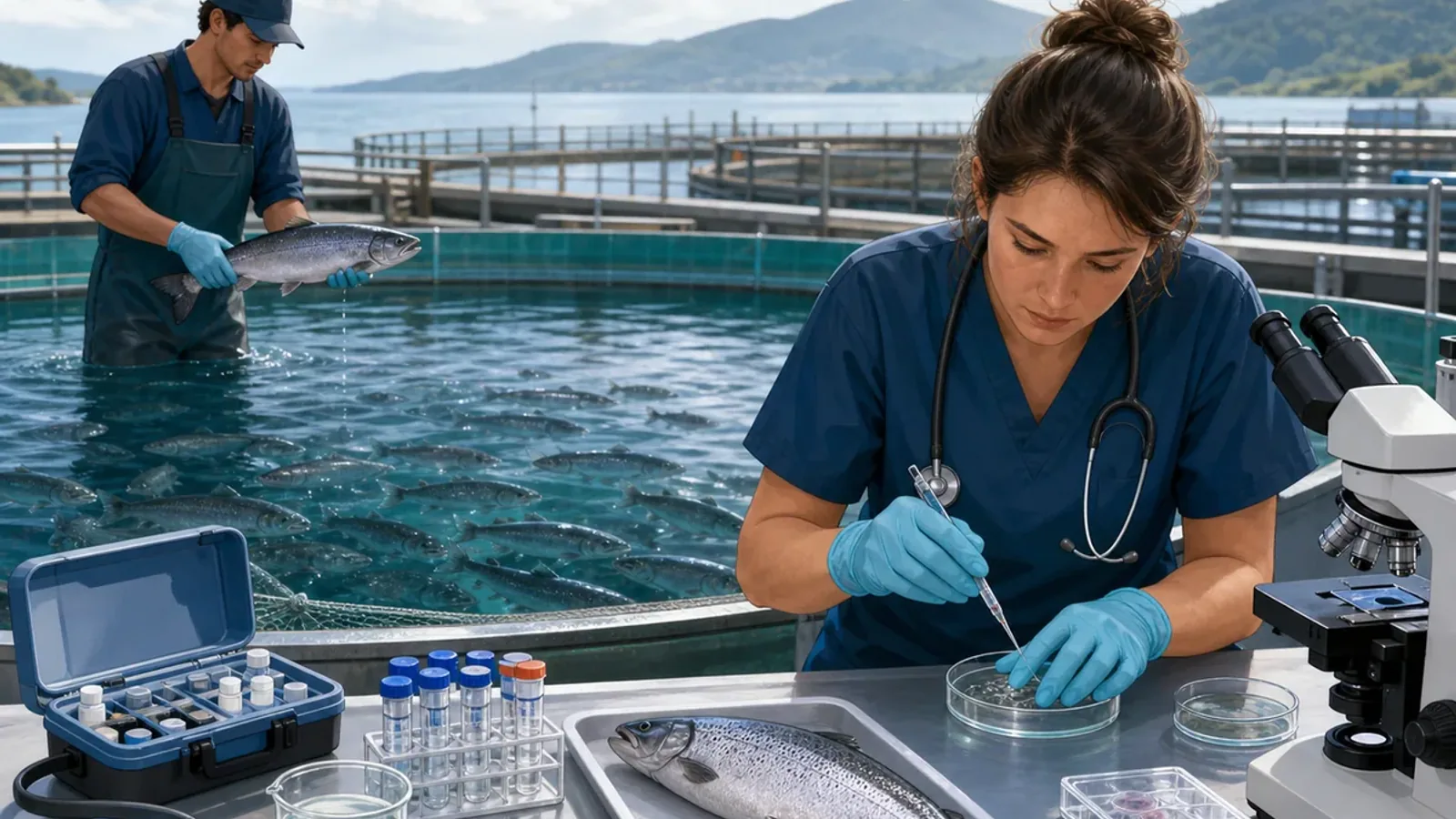
What does the livestock health assessment consist of?
The breeding health assessment (BSE) is a system introduced by the decree of April 24, 2007 relating to health surveillance and care regularly entrusted to the veterinarian.
It is carried out by a veterinarian during a scheduled visit to the advance made on the farm in the presence of the animal holder and during the period of holding a band or batch of animals representative of the species and, where applicable, the type of production.
Its objective is to define the reference health status of a fish farm by identifying in particular the main conditions observed in the farm during the previous year, some of which are considered priorities. At the end of the BSE, the veterinarian will develop a care protocol with the breeder; a list of preventive and curative measures to be put in place to control the main health problems identified.
In order to prepare the breeding health report, the veterinarian must collect a certain amount of data concerning the breeding over the period of the previous twelve months, in particular during the regular provision of care. These data come from the analysis of health interventions recorded in the breeding register, the results of laboratory analyzes (biological, parasitological, necropsy, etc.) and any other data made available by the breeder.
Farm health assessment visit
During the breeding health assessment visit, the veterinarian assesses the state of health of the animals but without carrying out an individual clinical examination of all the animals.
At based on the information collected and the examinations carried out, the veterinarian establishes a list of conditions that the farm has already been confronted with. For each condition, it estimates the prevalence and importance. The importance takes into account the impact on public health, particularly with regard to the quality of food produced for human consumption, the impact on animal health, the economic impact for the farm as well as criteria specific to the situation of the breeder and his breeding. These data represent the reference health status of the farm.
On this occasion, the veterinarian and the keeper of the animals determine the conditions against which it is appropriate to combat as a priority within the farm.
For these conditions deemed priority, the veterinarian studies all the possible causes taking into account their multifactorial aspect. As such, it may be necessary to collect information concerning:
- the environment of the animals, such as the organization of breeding structures, the design and maintenance of equipment;
- the feeding of the animals;
- the animals, such as the methods of conducting breeding or carrying out care.
For each species and, where applicable, for each type of production, the analysis following the health assessment visit breeding is the subject of the drafting of a summary document.
The breeding health assessment is subject to an update at least annually.
To plan your health assessment, contact us by telephone or by clicking here.