15 July 2026
RAMP assessments: reading fish condition before release
A standardised set of reflex observations can provide a rapid field measure of fish vitality, provided the protocol is validated for the species and release context.
- Sector
- Environment
- Animal groups
- Fish
- Content type
- Protocol / technique
A fish that swims away after release has passed an important milestone, but not necessarily escaped the consequences of capture. Exhaustion, air exposure, temperature, compression, barotrauma and injury may disrupt behaviour and contribute to delayed mortality. Reflex Action Mortality Predictors, widely known as RAMP, use a short series of reflex observations to quantify functional impairment. The attraction is obvious in field settings, yet the method only becomes informative when tests are selected for the species and calibrated against an appropriate survival endpoint.
Measuring integrated function in the field
Blood variables can help explain physiological disturbance, but sampling requires equipment, time and additional handling. Reflex testing answers a different question: can the animal still produce an immediate, coordinated response? Righting, avoidance, visual tracking, ventilation and responses to stimulation can reveal whole-animal neuromuscular impairment without laboratory analysis.
Many RAMP protocols score each response as present or absent, then calculate the proportion that is impaired. A higher score means that a greater share of the tested reflexes was missing. It does not mean that the same percentage of fish will die. To predict mortality, the relationship between the initial score and later survival has to be established for the relevant population, gear, environment and monitoring period.
Broad evidence does not create a universal checklist
A 2024 evidence synthesis by Robert Lennox and colleagues identified 136 fisheries studies using vitality indicators. Ninety were conducted in marine systems and 46 in freshwater. Reflex impairment was the most common indicator, while visible injury, barotrauma signs, ventilation and activity were also used alone or in combination.
This body of work supports the feasibility of rapid assessments outside a laboratory. It also shows why protocols cannot simply be copied between species. Body form, ecology, temperature tolerance, capture depth and behavioural strategy affect both the response to capture and whether a candidate reflex is useful. The literature includes fishes, crustaceans and turtles, so the RAMP label encompasses markedly different test batteries.
Selecting responses that can be scored consistently
A useful reflex should be reliably expressed by an unimpaired animal, quick to test, minimally invasive and interpreted consistently by different observers. A righting test commonly examines whether a fish briefly placed in an unusual orientation in water returns to its normal posture. Other assessments may record eye movement as the body is turned, an escape response to an approaching object or stable opercular movement.
Species-specific validation is essential. Cara Rodgveller, Christiane Löhr and John Dimond assessed 21 shortspine thornyhead (Sebastolobus alaskanus) after deepwater capture. On deck, 43% righted successfully and another 19% responded slowly; all evaluated fish righted after laboratory holding. In contrast, tail-grab, gag and opercular-flare responses were present in 95–100% of fish both on deck and later. The tests were not interchangeable: some detected acute functional change, while others showed little variation under the same capture conditions.
A predictor requires a survival outcome
RAMP becomes a mortality predictor only when initial scores are linked to subsequent observations. Fish may be held under controlled conditions, tracked using telemetry, marked or followed through another suitable design. The observation period should encompass the plausible window of delayed effects. Monitoring that ends too early may count later deaths as survival, whereas holding itself can introduce conditions that differ from a natural release.
The 2024 synthesis found that vitality indicators did not consistently predict survival in every study. Performance varied by taxon, fishery and method. Injury and reflex observations may also capture different dimensions of condition. A local wound need not eliminate an immediate reflex, while a fish with no obvious external injury can still show substantial functional impairment.
Comparing handling practices, not labelling individual fish
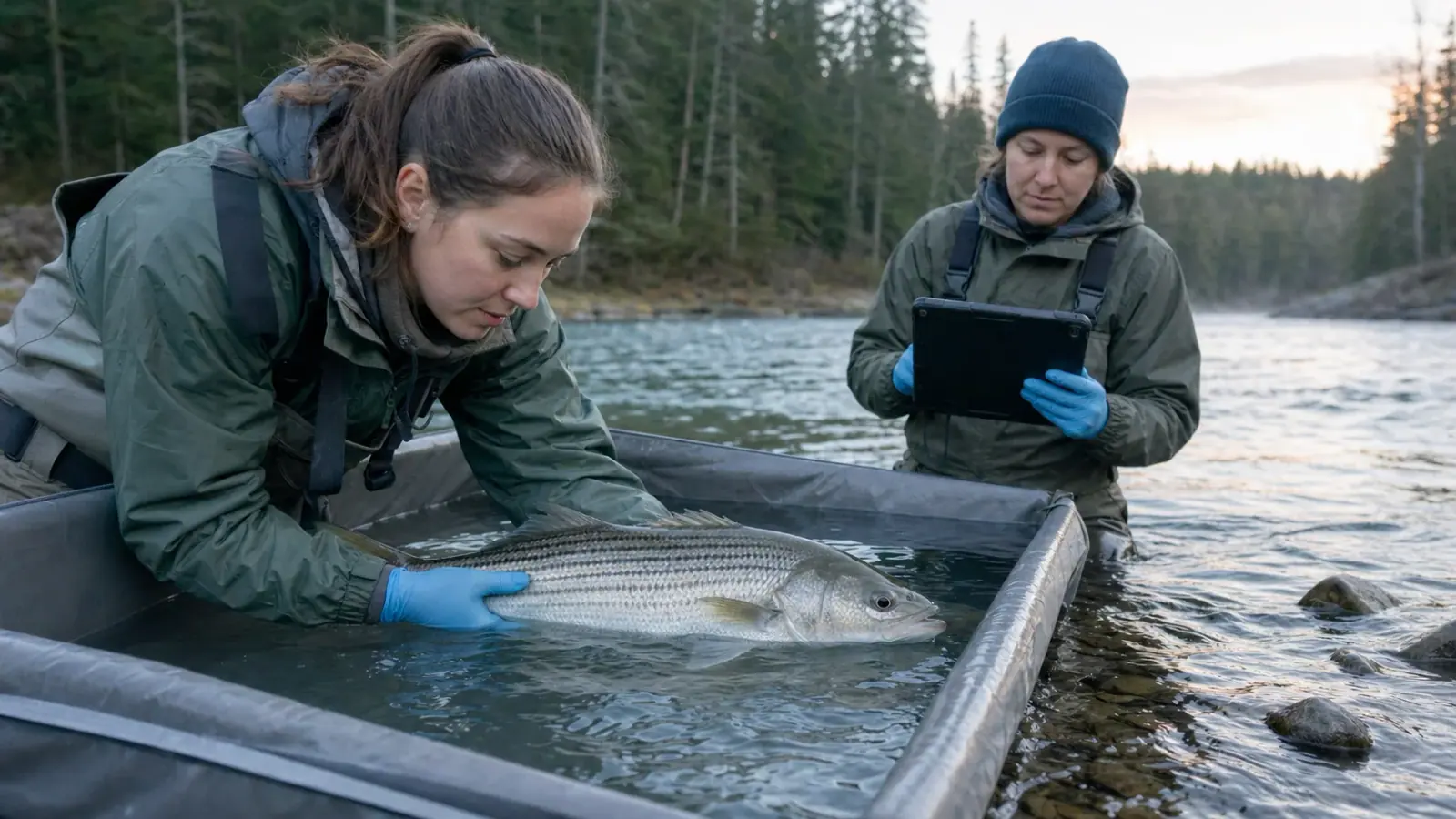
Once validated, a reflex score can help compare modifiable capture factors such as fight duration, handling time, air exposure, gear, depth, water temperature and release technique. A recent study of coastal recreationally caught striped bass (Morone saxatilis) reported greater reflex impairment with longer fight, handling and air-exposure times. Fish size and warmer water also contributed under the conditions studied.
Context changes the interpretation. All fish in that experiment survived the twenty-minute post-release observation period. Reflex impairment therefore described cumulative capture effects and short-term activity rather than demonstrated mortality within the monitoring window. This is still useful for screening practices and identifying stressors, but longer monitoring is needed when the management question is delayed mortality.
Building a defensible field protocol
Small procedural choices determine data quality. Observers need operational definitions, shared training and preferably an assessment of agreement between scorers. Test order, time since capture, water temperature, air exposure, handling duration and injuries should be recorded. Assessments must be rapid, using wet hands or wet contact surfaces and avoiding extra air exposure created solely for data collection.
Video can support later quality control, provided filming does not extend handling. The analysis plan should specify how slow or ambiguous responses are treated. Forcing every observation into present or absent without a shared rule creates artificial precision. Pilot work with control animals can identify responses that are naturally variable, difficult to elicit or poorly suited to the species.
Researchers must also decide whether a combined index is biologically meaningful. If one reflex is almost always absent and another almost always present, averaging them may conceal more than it reveals. Reporting the individual responses alongside the summary score preserves information and makes comparisons between studies more transparent.
How Vetofish can support monitoring programmes
Vetofish can assist environmental managers, consultants and research teams in developing species- and context-specific vitality protocols. Support may include selecting candidate responses, designing field forms, training observers, recording environmental covariates and planning delayed-survival validation.
The purpose is not to add handling to every release. It is to obtain useful information without increasing the burden on the animal. A well-designed RAMP approach can help identify less harmful procedures, interpret scientific or incidental captures and provide evidence for management decisions. It remains a calibrated population-level tool, not a universal verdict on the fate of an individual fish.
References
- Lennox RJ, Donaldson MR, Raby GD, Cook KV, LaRochelle L, Madden JC, Cooke SJ, Patterson DA, Hinch SG. “Using vitality indicators to predict survival of aquatic animals released from fisheries.” Conservation Physiology. 2024;12(1):coae034. 10.1093/conphys/coae034.
- Rodgveller C, Löhr CV, Dimond JA. “Effects of capture on acute and long-term reflex impairment, survival, and health of a deepwater fish: Shortspine thornyhead (Sebastolobus alaskanus).” PLOS ONE. 2022;17(10):e0276132. 10.1371/journal.pone.0276132.
- Griffin LP, Brownscombe JW, Gagne TO, et al. “Effects of capture and handling on striped bass (Morone saxatilis) in the recreational fishery of coastal Massachusetts.” Fisheries Research. 2025;288:107459. 10.1016/j.fishres.2025.107459.