15 July 2026
Public aquariums: measuring how visitors affect fish
A two-species study shows how food enrichment, competition and visitor attendance can interact with fish behaviour in a public aquarium exhibit.
- Sector
- Public aquariums
- Animal groups
- Fish
- Content type
- Scientific news
- Keywords
- EthogramEnrichmentStress
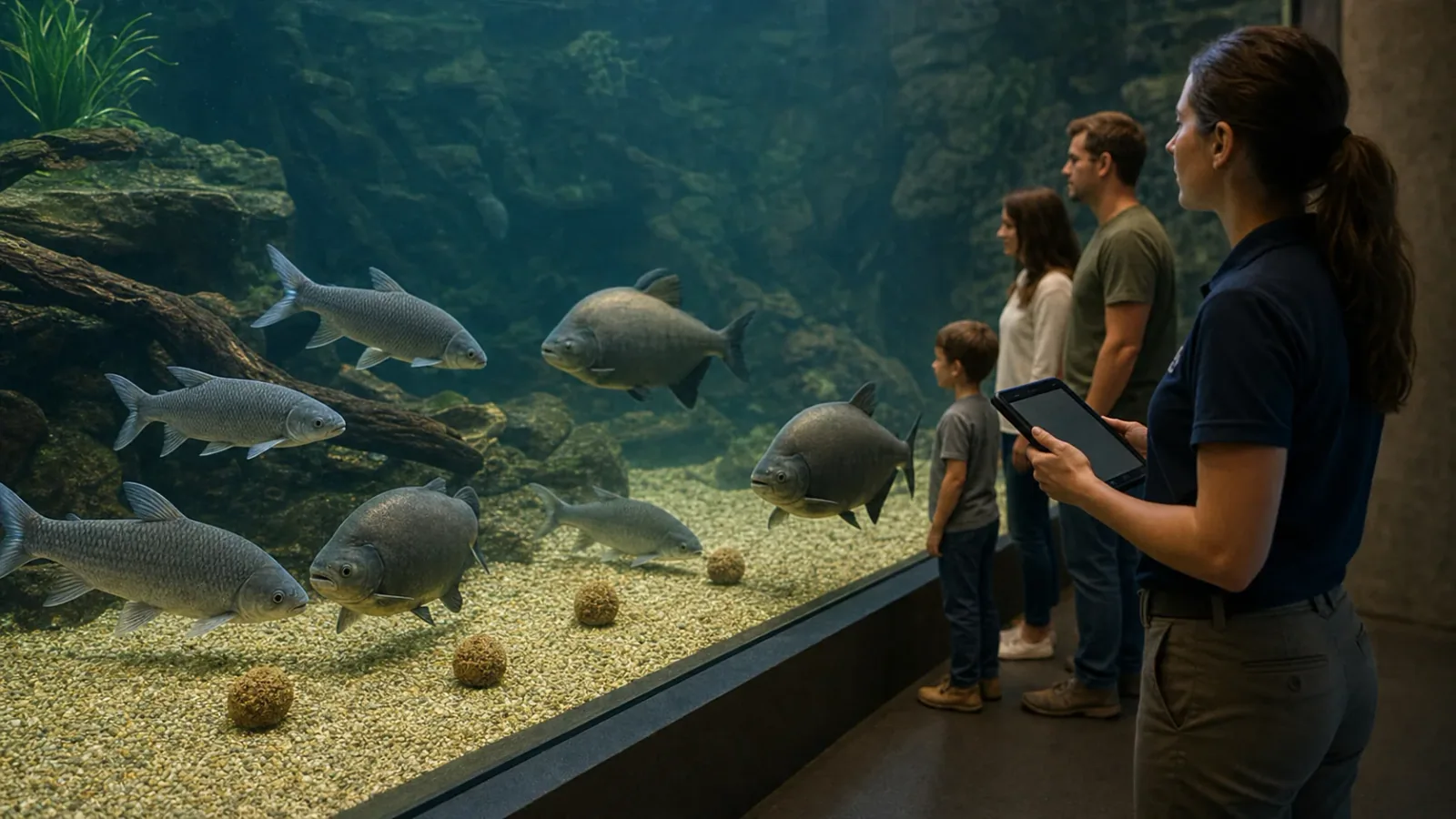
A public aquarium exhibit is not only a physical habitat. It also experiences daily changes in the number and activity of people outside the viewing panel. Movement, silhouettes, vibration and crowding may coincide with feeds or presentations. A 2025 study followed two freshwater fish species in a Brazilian public aquarium while recording both food enrichment and visitor attendance. Its most useful lesson is methodological: responses need to be measured by species, and greater activity should not automatically be labelled better welfare.
Two species sharing one exhibit
The study took place at the São Francisco River Basin Aquarium within Belo Horizonte Zoo. Five adult pacu, Myleus micans, and six adult curimba, Prochilodus argenteus, shared the exhibit. Both are native to the São Francisco basin, but their body forms and feeding strategies differ. Pacu are predominantly herbivorous, whereas curimba exploit resources on and within the substrate.
Researchers developed an ethogram after twelve hours of preliminary observation. They then compared three phases: baseline without enrichment, food enrichment, and a post-enrichment return to baseline conditions. Each phase included thirty hours of observation. Behaviour was recorded at one-minute intervals, and the number of visitors passing or remaining in front of the exhibit was counted during sessions.
The project generated 59,400 behavioural records. That large number should not obscure the biological sample: eleven fish, two species and one tank. The study provides detailed evidence for this particular system, but cannot establish that every species or aquarium will respond in the same way.
Making food acquisition last longer
The enrichment consisted of slow-dissolving baked blocks developed by the nutrition and aquarium teams. Feed and flour were incorporated into a hardened matrix. Six blocks were introduced on alternate days during the enrichment phase, gradually releasing particles and extending food-searching activity.
The purpose was not simply to offer a different ration. Predictable food delivered rapidly at one location can concentrate animals and shorten exploration. A feeding device may promote searching, manipulation or substrate use. It must nevertheless fit the diet, water-quality limits, exhibit safety and feeding abilities of each species.
Reduced inactivity is only one part of the picture
Both pacu and curimba were less inactive during enrichment. Curimba also showed more foraging and greater behavioural diversity. Pacu used their stronger jaws to break the blocks apart, dispersing fragments that curimba continued to seek on the substrate. One species’ feeding action therefore created opportunities for the other.
The pattern was not uniformly positive. Curimba displayed more agonistic interactions, more escape following those interactions and more observations out of view. The authors linked competition to the limited number of blocks and recommended that future trials provide at least as many items as fish to reduce monopolisation.
For pacu, enrichment reduced inactivity but did not significantly change the other main behaviours. Their behavioural diversity decreased during the enrichment phase. No single measure—activity, diversity or feeding frequency—can therefore carry a welfare conclusion. A useful assessment combines several responses and actively looks for unwanted effects.
Visitor numbers were entangled with time of day
As visitor numbers increased, fish were recorded as inactive less often and interacted less with the device, while foraging and some other behaviours were observed more frequently. Fast and slow swimming, aggression and escape following agonistic interactions were not correlated with visitor numbers.
These associations do not prove that visitors directly caused every change. Blocks were offered in the morning when attendance was low and were often consumed before the afternoon visitor peak. Reduced interaction with enrichment could therefore reflect its disappearance rather than avoidance of the public. Active fish may also attract more people to stop at a viewing panel, reversing the assumed direction of cause and effect.
This limitation is highly relevant to institutional monitoring. Time, feeding, keeper activity, cleaning, lighting, temperature and attendance often change together. A protocol should record them separately and, where practical, compare equivalent periods with and without visitors.
Designing useful behavioural monitoring
An operational ethogram describes observable actions without assigning an emotional state at the outset: slow swimming, immobility, substrate searching, device interaction, chasing, refuge use or being out of view. Definitions need enough precision for two observers to classify the same sequence consistently.
Observations should cover multiple days and times, including quiet periods. Location adds context: a fish active only away from the viewing window presents a different pattern from one using the entire exhibit. Attendance data can be complemented by noise, vibration or special events without filming or identifying visitors when that is unnecessary.
Before a feeding enrichment becomes routine, teams should assess actual consumption, distribution between individuals, aggression, residues and filtration effects. Nutrients supplied through the device belong in the total ration. Every matrix or object also needs review for composition, stability and accidental ingestion risk.
Treating enrichment as a testable hypothesis
Device design should reflect species ecology. A block that rewards strong jaws may indirectly benefit a substrate forager but also concentrate competition. Multiple feeding points, variable schedules or dispersed particles can produce different outcomes. Multi-species exhibits require particular attention because one species may facilitate or restrict access for another.
Stopping criteria should be agreed before a trial: injury, persistent exclusion, water-quality deterioration or a clear rise in aggression. The aim is not to retain an innovation because it engages visitors. It is to determine whether the intervention expands behavioural opportunities without an excessive cost.
The same logic applies to visitor effects. Responses may be neutral, stimulating or aversive depending on the species, exhibit and context. Quiet refuges and visual choice remain valuable even when average attendance is associated with greater activity. Individual differences can otherwise disappear inside a group average.
How Vetofish can support aquarium teams
Vetofish can help public aquariums build ethograms, select health and behavioural indicators, schedule observations and interpret results alongside feeding, attendance and water-quality data. Support can also include nutritional and veterinary review of a device before trials begin.
This turns enrichment and visitor interaction into a revisable management process. Visitors are neither inherently a stressor nor automatically a source of enrichment. Their effects depend on species, exhibit, timing and associated events. Structured observation helps teams move from impressions to documented decisions.
References
- Silva AA, de Azevedo CS, Cipreste CF, Pizzutto CS, Eskinazi Sant’Anna EM. “How Does Food Enrichment and the Presence of Visitors Affect the Behaviour of Two Species of Freshwater Fish in a Public Aquarium?” Journal of Zoological and Botanical Gardens. 2025;6(3):35. 10.3390/jzbg6030035.
- Barros IB, de Azevedo CS, Cipreste CF, Reisfeld LC, Suzana T, Capriolli RG, Pizzutto CS. “The Impact of Food Enrichment on the Behavior of Cownose Ray (Rhinoptera bonasus) Kept under Human Care.” Journal of Zoological and Botanical Gardens. 2024;5:325–337. 10.3390/jzbg5020022.
- Williams E, Hunton V, Hosey G, Ward SJ. “The Impact of Visitors on Non-Primate Species in Zoos: A Quantitative Review.” Animals. 2023;13(7):1178. 10.3390/ani13071178.