

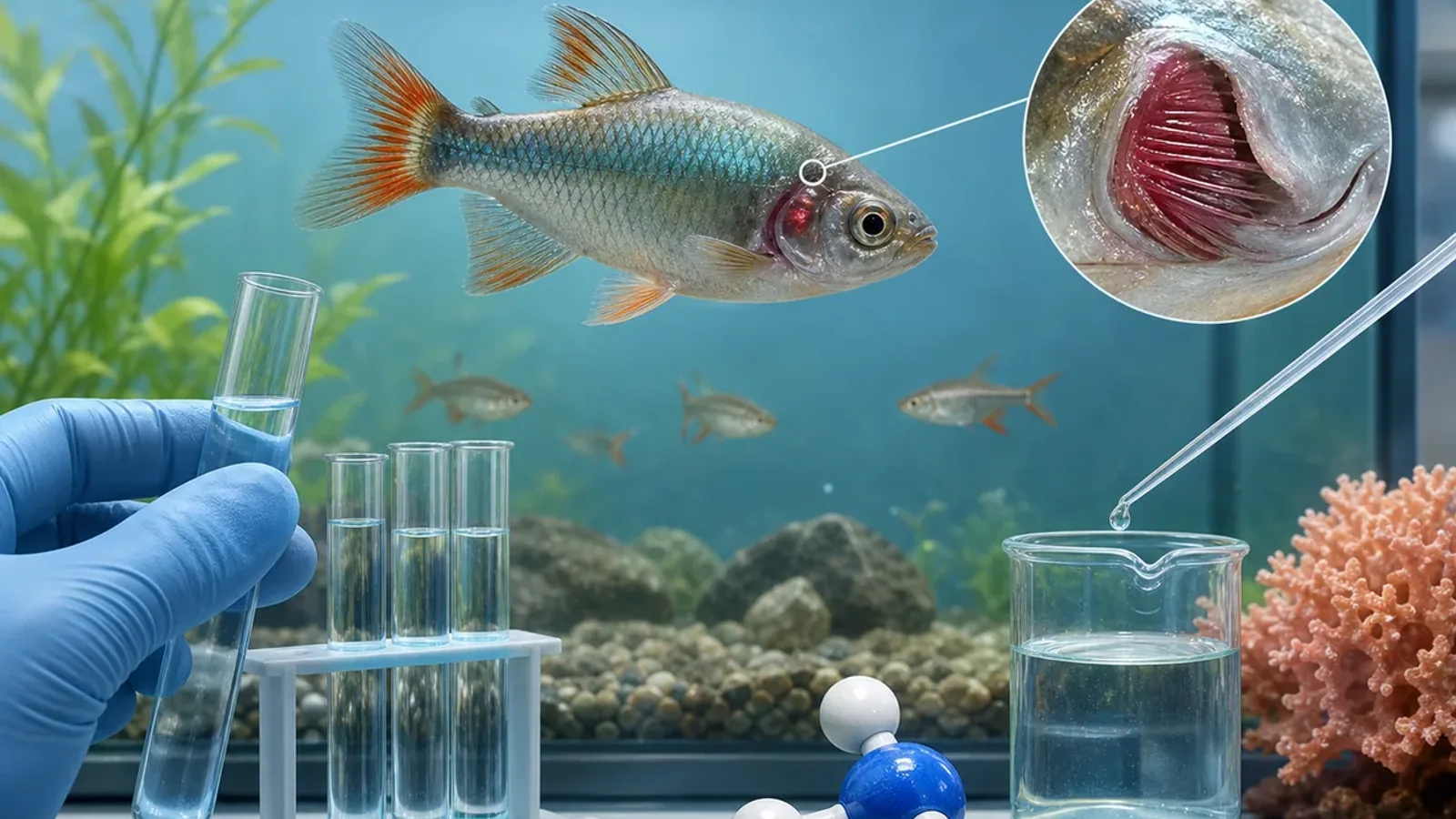
Why is NH3 ammonia toxic in fresh water?
Unionised NH3 is the form of ammonia most directly toxic to fish. It crosses the gills, interferes with excretion of ammonia produced by the animal and can damage the gills and nervous system. Severity depends on concentration, duration, species and fish condition.
What does the test actually measure?
Most kits measure total ammonia, meaning NH3 + NH4+. The proportion present as NH3 generally increases as pH or temperature rises. Record the test value, its unit, pH and temperature at the same time.
Also check whether the result is expressed as the compound or as nitrogen: “mg/L NH3-N” and “mg/L NH3” are not identical units. Do not use a threshold table if its unit or pH and temperature range is unclear.
What should be done when ammonia is detected?
In an established aquarium or pond, detection calls for action even before signs appear. Increase aeration, pause feeding briefly if fish condition permits, remove waste and dead animals, check biofilter flow and integrity, then replace part of the water with compatible, properly conditioned water.
Ecotoxicological criteria designed to protect a natural aquatic community are not “acceptable doses” to target in an aquarium. The practical objective is to restore system function and monitor the decline with the same test.