

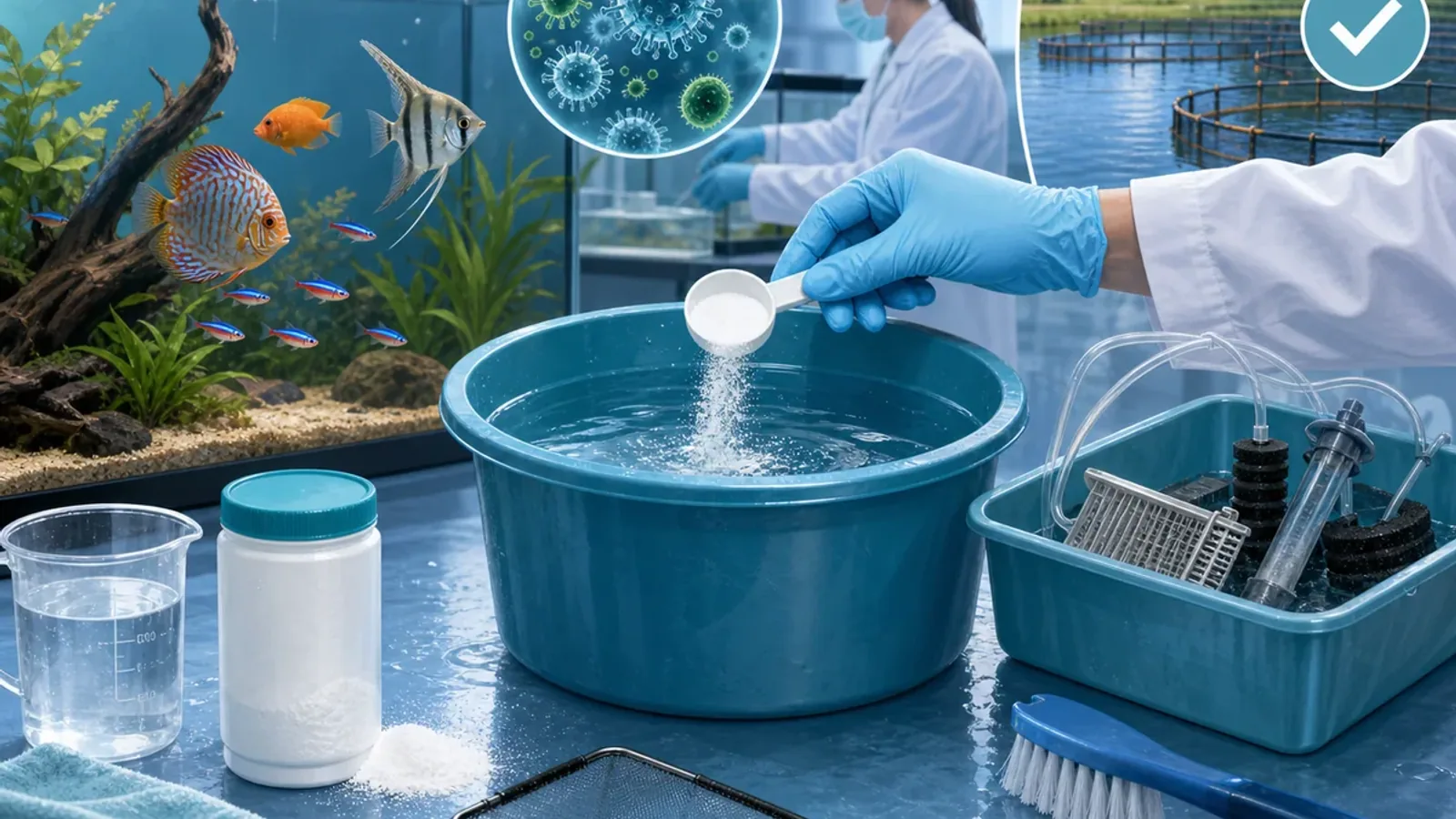
What is Virkon and how to use it?

Virkon is a multi-purpose disinfectant. It contains potassium hydrogen sulfate, sodium dodecyl-benzenesulfonate, sulfamic acid, and inorganic buffers.
It is intended for the disinfection of surfaces and equipment by soaking as well as for footbaths.
This product has a broad spectrum of activity against viruses, certain fungi and bacteria.
Mode of action
The reaction produced by the elements of the disinfectant is a cycle based on redox reactions. The KMPS complex (Oxone or Monopersulfate triple salt) is a powerful oxidizing agent which acts on the sodium chloride present in the formulation when the Virkon powder is diluted in water with the release of free oxidizing radicals (Cl°, OH° and 0°).
Advantages
This reaction allows the formation of the most deleterious radical forms for the membranes, enzymes and genome of organisms Prokaryotes. The production of these radicals is massive and homogeneous, like an oxidation battery. Their lifespan is short.
They degrade into H2O and O2 and do not cause tissue accumulation of residues and do not induce ecotoxicity. Bacterial resistance to the chemical species released by Virkon has not been demonstrated, unlike that observed with conventional disinfectants (quaternary ammoniums/aldehydes).
Biodegradability
Virkon is mainly made up of inorganic salts. Oxone (KMPS) degrades into common and natural inorganic ions such as sulfate, carbonate, potassium and hydrogen ions. The surfactant is rapidly biodegradable (EEC Directive 73/404) and gives 90% biodegradability under the conditions of the OECD test (CEE/73/405).
Once applied and diluted in drain water, Virkon does not hinder the activity of micro-organisms present in the sludge of sewage treatment plants and is not toxic to earthworms. Virkon is not classified R50 (Dangerous for the environment) in accordance with the European standard procedure for the classification and labeling of chemical substances.
Methods
The application of Virkon is always carried out in the absence of animals.
For the VIRKON product assessed in the Anses opinion of 9 October 2015, the favourably assessed uses concern non-porous surfaces and livestock equipment without food contact, after prior cleaning. The assessed concentration is 1%, with a 30-minute contact time at 10 °C. Check the label and authorisation for the specific product being used.
Spraying surfaces
Spray pre-cleaned, non-porous surfaces with a 1% Virkon solution, keeping them in contact with the product for 30 minutes at 10 °C. Spray uniformly without causing runoff.
Once disinfected, surfaces in contact with animals (tanks, windows) must be thoroughly rinsed under running water.
Soaking equipment
Pre-cleaned, non-porous livestock equipment without food contact must be fully immersed in a 1% Virkon solution for 30 minutes at 10 °C.
After soaking the equipment must be carefully rinsed under running water over its entire surface.
Footbaths
The Anses opinion is unfavourable to using the assessed product in footbaths or wheel baths: bactericidal efficacy was not demonstrated by an acceptable test, and no footbath virucidal test was submitted. Pink colour alone does not establish disinfectant efficacy.
Storage
Store the 1% Virkon solution in clean plastic containers at room temperature away from direct sunlight.
Do not expose the solution to cold.
The Anses opinion reports stability of the diluted solution for 2 days at 20 °C. Do not rely on the disappearance of the pink colour alone to decide when to replace it.
Dangers
In humans, the concentrated powder is irritating to the skin, eyes and inhalation of dust.
In a 1% solution, Virkon is not irritating to the skin or eyes.
The Anses opinion classifies the powdered VIRKON product as harmful if inhaled (H332), capable of causing serious eye damage (H318), and harmful to aquatic life with long-lasting effects (H412). Do not release the solution into the aquatic environment.
For more information on first aid, toxicity, ecotoxicity and handling, consult the current safety data sheet supplied with the product.
Composition differences in the range
| Substance | CAS No. | Virkon Aquatic (USA) | Virkon-S (FR) |
|---|---|---|---|
| Pentapotassium bis(peroxymonosulfate)bis(sulfate) (Oxone) | 70693-62-8 | 20-50% | 30-50% |
| Sodium dodecylbenzene sulfonate | 25155-30-0 | 10-25% | |
| Benzenesulfonic acid, C10-13 alkyl derivatives, sodium salts | 68411-30-3 | 10-20% | |
| Malic acid (butanedioic acid, 2-hydroxy-) | 6915-15-7 | <10% | 1-10% |
| Sulfamic acid | 5329-14-6 | <5% | 2.5-10% |
| Dipotassium peroxodisulfate | 7727-21-1 | <5% | 0.1-1% |
| Sodium toluenesulfonate | 12068-03-0 | 1-10% | |
| Sodium chloride | 7647-14-5 | <5% | |
| Potassium hydrogen sulphate | 7646-93-7 | <5% | 1-3% |
| Dipotassium disulphate | 7790-62-7 | <5% | 1-3% |
| Dipentene | 138-86-3 | 0.1-0.25% |