

Can aquarium filter zeolite be regenerated?

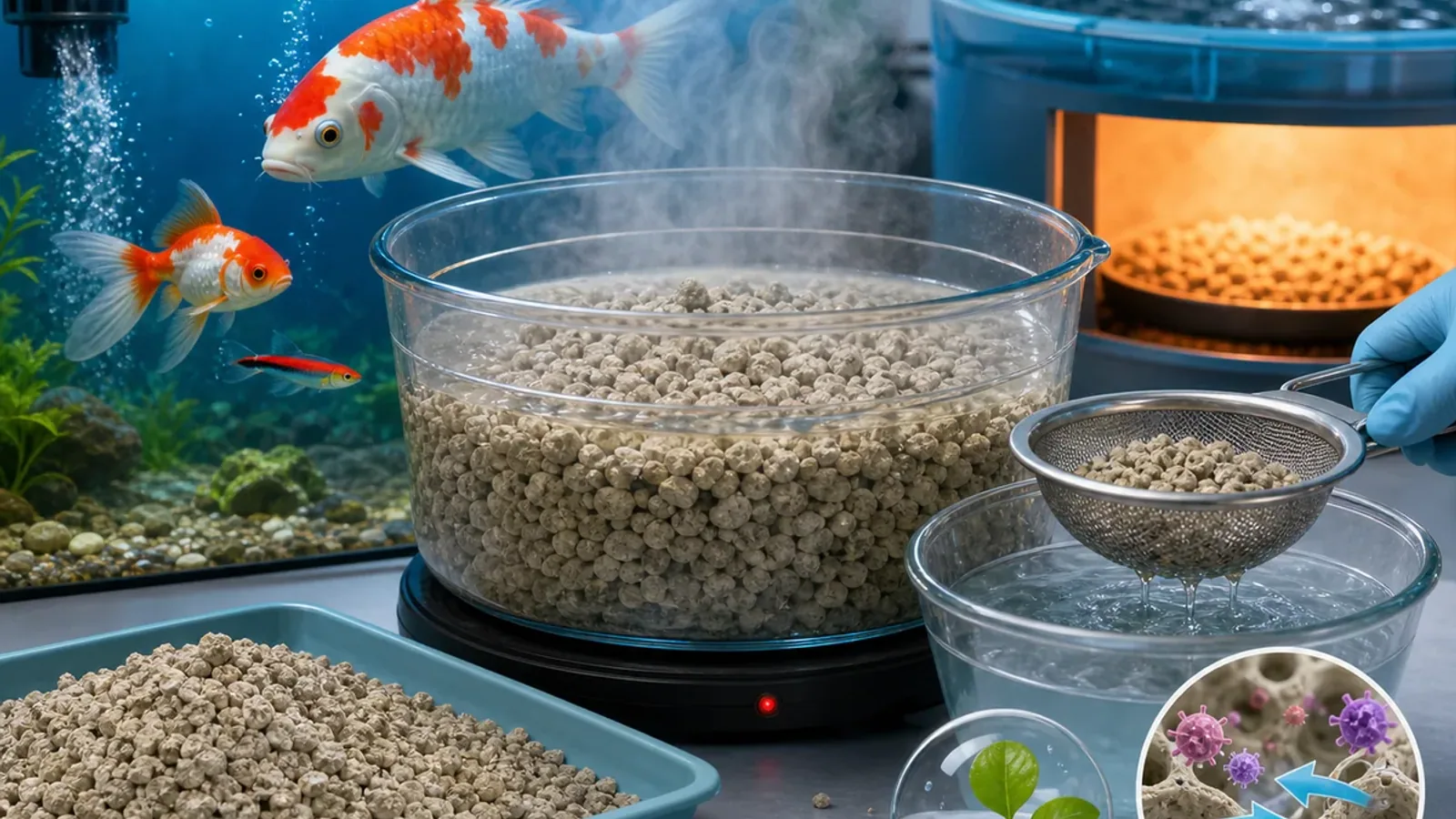
Some natural zeolites, particularly clinoptilolite-rich materials, retain ammonium ions by ion exchange. Capacity depends on the mineral, particle size, water composition and starting concentration, so one milligram-per-gram value or pond dose cannot apply to every product.
Check the product before regeneration
Read the instructions first. Some filter media are intended for replacement, while others may be regenerated with sodium chloride under a manufacturer protocol. If composition, capacity or procedure are unknown, replacement is safer than an improvised recipe.
Zeolite is not a substitute for a mature biofilter. It can buffer an ammonium increase in some freshwater systems, but it becomes saturated and competing ions reduce performance. In saltwater, exchange with abundant sodium greatly limits its usefulness for ammonium capture.
Regenerate only outside the aquarium
Remove the media, rinse away debris with suitable water and place it in a dedicated container. Use only the brine concentration, duration and solution-to-zeolite ratio specified by the manufacturer. Experiments confirm that sodium-rich solutions can displace retained ammonium, but their conditions are not a universal household recipe.
Vetofish regeneration protocol
For 1 kg of regenerable zeolite, prepare a clean vessel away from the aquarium with 10 litres of water, then add 300 g sodium chloride (NaCl) and 4 g pure sodium hydroxide (NaOH). Mix until fully dissolved, verify a pH of at least 12, and immerse zeolite that has first been cleaned of organic debris for at least 24 hours.
This procedure is for a trained operator: sodium hydroxide causes severe burns. Wear suitable gloves, goggles and protective clothing, work in a ventilated area, add sodium hydroxide to water without splashing and keep emergency rinse water accessible. Never perform the operation near animals, children or an acid.
The solution may be reused while its composition and regenerative capacity are controlled. The practical number of cycles depends on the product and fouling; replace the zeolite when capacity can no longer be demonstrated rather than relying on a fixed reuse count.
Rinse and verify before reuse
Spent brine contains the released ammonium. Collect and dispose of it under local instructions without returning it to the aquarium or the environment. Rinse the zeolite as directed until residual salt is compatible with the system.
Unchanged colour or appearance does not prove that capacity has been restored. Replace the media if performance cannot be tested. After it returns to service, measure total ammonia nitrogen and interpret it with pH and temperature; an increase shows that the media or biofilter capacity is insufficient.