

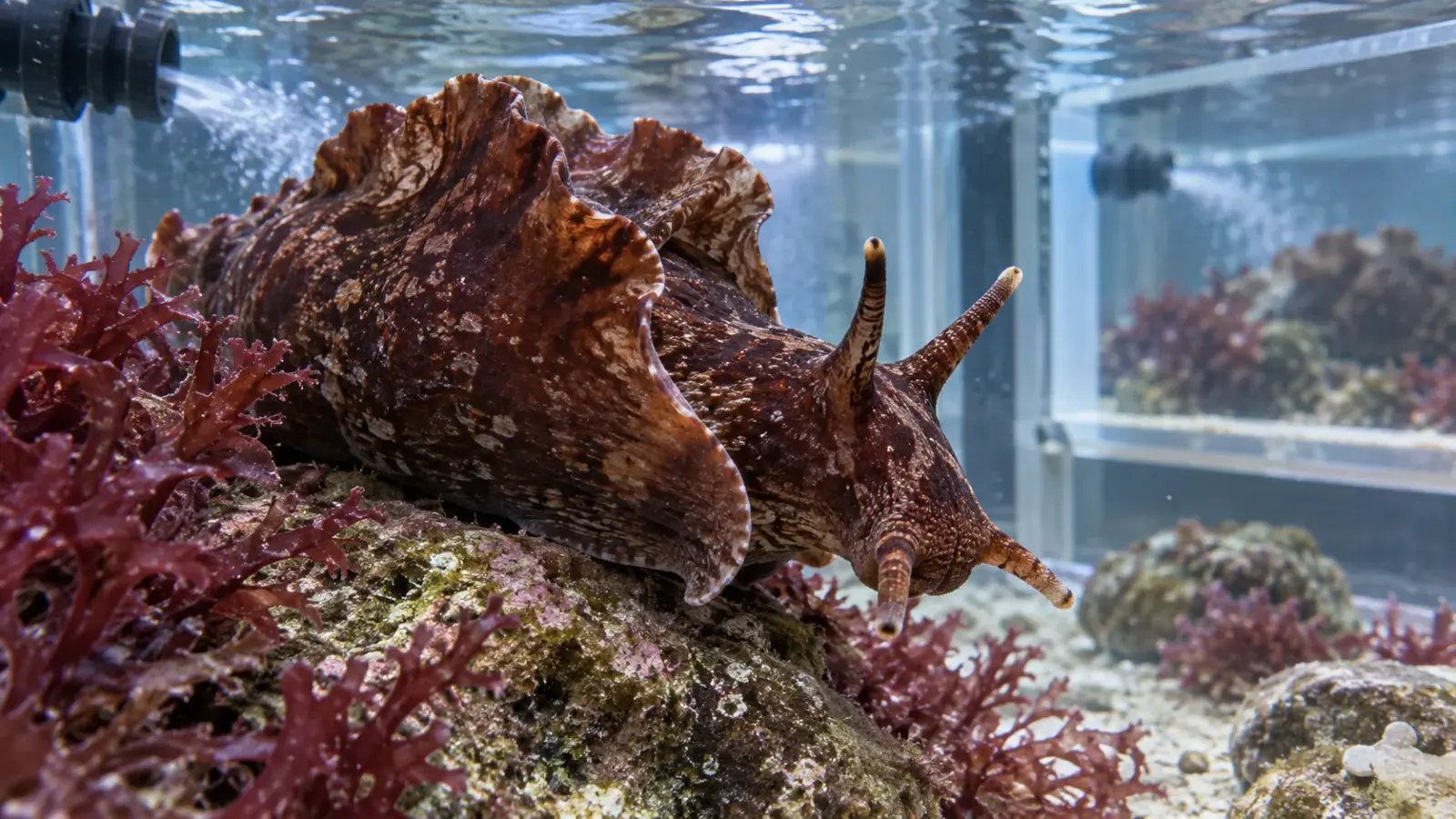
Aplysia californica: husbandry shapes the model
Large, identifiable neurons made Aplysia californica a landmark model. Origin, age, diet and water movement can also shape experimental results.
- Content type
- Species profile
- Sector
- Research
- Animal group
- Corals and invertebrates
With large neurons that can be recognised from one animal to another, Aplysia californica has helped reveal mechanisms of learning, memory and neuronal ageing. Yet this sea hare from the Pacific coast of North America remains a living organism whose physiology depends on age, diet and environment. A husbandry experiment published in 2018 makes that point clearly: making water movement more similar to a natural habitat did not uniformly make hatchery animals resemble wild ones. The model is most powerful when its living conditions are described, controlled and included in interpretation.
Why neuroscience uses Aplysia
The Aplysia nervous system has far fewer neurons than a vertebrate brain, and several cells can be recognised by position, size and physiological properties. This organisation allows researchers to connect a circuit, a reflex and cellular change. Homologous neurons can be followed through learning protocols or compared across age groups.
That advantage does not mean the animal represents the full complexity of a human brain. Aplysia is used to isolate conserved mechanisms or general principles, whose reach can then be tested in other systems. Conclusions should remain at the level supported by the experiment: altered gene expression in a sensory neuron is not, on its own, a clinical finding in a mammal.
A specialist breeding resource has strengthened reproducibility by providing cohorts of known age and origin. It reduces some variation associated with wild collection and enables longitudinal ageing studies. In return, husbandry must be treated as part of the experimental model rather than as invisible logistics.
Water movement does not automatically make animals “more natural”
Fieber and colleagues compared animals raised in relatively quiet water, siblings exposed to two intermittent turbulence regimes and wild animals. The hypothesis was that holding onto the substrate under moving water would exercise the foot as it might in a rocky intertidal habitat. The researchers measured oxygen consumption, flume performance and reflexes involving the foot.
Hatchery turbulence did not change resting oxygen consumption, righting reflex or tail-withdrawal reflex compared with quiet-water siblings. Wild animals righted themselves faster, but they did not perform better in the flume test. A biologically plausible intervention therefore did not produce a simple “wild phenotype” across all measurements.
The absence of differences in some endpoints is informative. It suggests that turbulence alone does not reproduce the sensory history or muscular activity experienced in nature. It also shows that findings depend on the chosen test. Locomotor performance, a defensive reflex and oxygen consumption sample different dimensions of phenotype.
Age and cohort should travel with every result
Ageing is another field in which Aplysia offers unusual resolution. Kron and colleagues analysed gene expression in two sensory-neuron populations from six to twelve months of age. They identified trajectories involving energy metabolism, neuronal signalling and proteostasis. The study links molecular profiles to ageing in the model; it does not make every differentially expressed gene a direct cause of functional decline.
For reproducibility, “adult” is not enough. Chronological age, cohort, reproductive stage, size and feeding history should be recorded. Animals of similar mass may have followed different growth trajectories. A change in ration or temperature can shift performance and confound comparisons between laboratories.
Experimental groups should be balanced within cohorts, and tank effects should be addressed. Several animals sharing one container are not always fully independent replicates. Depending on the hypothesis, the tank, water system or parental spawn may be the relevant experimental unit.
Turn husbandry into traceable data
A batch record should connect hatch date or estimated age, available parentage, origin, stocking density, temperature, salinity, photoperiod, flow, water-movement regime and feed. Amounts offered and refusals help interpret growth. Spawning, handling, treatments and mortality complete the history.
Water quality needs defined methods and sampling frequency. A weekly mean can conceal a short excursion. Sensor location, calibration and sampling time therefore matter for reproducibility. Monitoring intensity should match the hypothesis: metabolic work requires different environmental control from a one-time anatomical observation.
Behaviour can provide internal checks. Activity, substrate attachment, feeding, righting and withdrawal responses may flag a difference before it appears as mortality. Repeated reflex testing, however, can itself alter responses through habituation or sensitisation. Observation schedules should avoid turning routine monitoring into an unplanned intervention.
Standardise without erasing biology
Standardisation does not mean making every animal identical. It means identifying sources of variation, reducing some and retaining others when the question requires them. Comparisons between hatchery and wild animals can show what a laboratory model gains or loses. Comparisons among husbandry conditions can reveal that an apparently neutral practice changes physiology.
Publications should describe the animal and its environment well enough for readers to distinguish the tested effect from a cohort effect. Negative findings, such as the lack of improvement in several endpoints under turbulence, prevent plausible intuitions from becoming unsupported standards. They direct better experiments rather than weakening the model.
Vetofish can help aquatic research teams formalise husbandry parameters, batch records, health criteria and sampling plans. For Aplysia californica, reproducibility starts before the electrode or sequencing run: it starts with the documented history of each cohort.
To move from evidence to action, explore our advice and support service and our expertise for research facilities.


