

Helping visitors see fish beyond their appearance
Appearance shapes which fish receive attention, while well chosen information can shift some perceptions. Recent experiments offer ideas for interpretation, with no demonstrated increase in real donations or animal welfare.


- Content type
- Scientific news
- Sector
- Public aquariums
- Animal group
- Fish
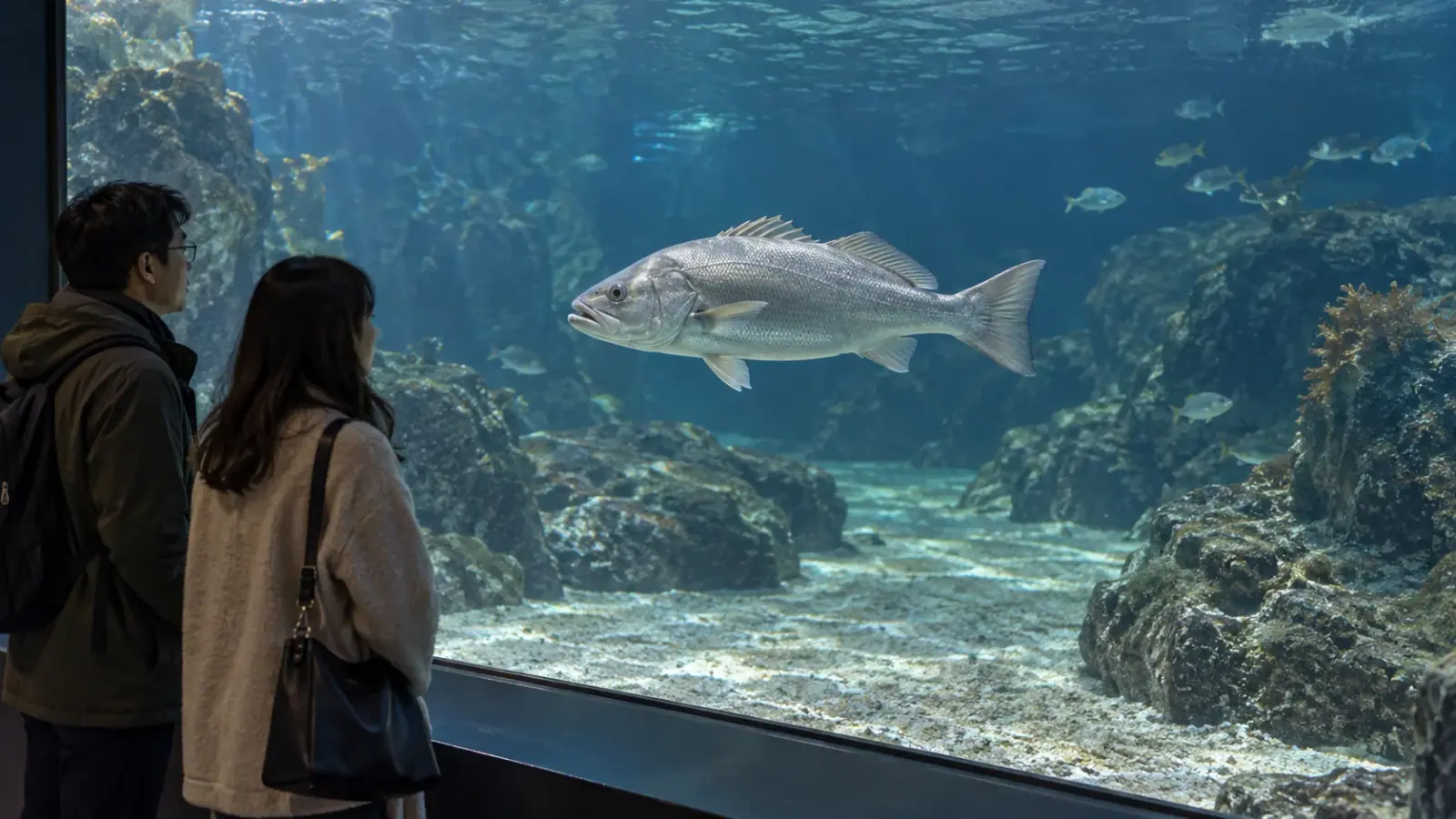
Visitors do not attend to every fish in the same way. A vivid pattern may draw a crowd while a less conspicuous species with a distinctive ecological role receives little attention. Two studies involving French researchers help public aquariums frame a practical question: can an exhibit explain the significance of an overlooked fish without confusing its appearance, visitors’ opinions, support for conservation and the animal’s actual welfare? The studies measure human judgments. Neither is a clinical assessment of fish in an exhibit.
A broad pattern in aesthetic preference
Langlois and colleagues combined people’s judgments of fish photographs with a visual prediction model to estimate aesthetic value for 2,417 species of reef ray-finned fish. They found a mismatch: some species rated less attractive were among the more ecologically or evolutionarily distinctive, or were recognised as threatened. This does not mean every visitor shares a fixed ranking. It identifies a possible bias when the species selected for attention are chosen chiefly for visual appeal.
The study drew on photographs and statistical predictions rather than tracking people moving through aquarium galleries. Lighting, swimming behaviour, tank size, social interaction and exhibit interpretation may all affect the experience. The researchers did not measure the fish’s health or stress. Their findings concern human perception and its possible implications for conservation communication.
An experiment separates impressions from support
Tribot and Mouquet examined perceptions of Argyrosomus japonicus, presented as a less charismatic fish, with 1,080 participants in France. Participants viewed its photograph in one of six conditions: image alone, information about conservation status, ecological traits, economic or cultural value, video, or sound. They rated dimensions including beauty, rarity, intelligence and sensitivity as they perceived them. A hypothetical allocation task was used as a separate measure of conservation attitude.
Several prompts shifted particular impressions, but none increased hypothetical funding allocated to the target species. Perceived beauty and cuteness did not improve. Sound had a notable effect on judgments of rarity, impressiveness, sensitivity and intelligence. Cognitive information reduced the budget advantage given to a more attractive comparison species; it did not demonstrate an increase for A. japonicus itself.
Those distinctions matter. A higher score for perceived intelligence is a statement about a respondent, not new evidence about the fish’s cognitive abilities. A fictional budget task does not predict an actual donation. Sound delivered to human participants is no licence to add speakers to a tank: fish exposure to noise requires its own welfare assessment.
What an aquarium could evaluate
An institution can start with the collection it already holds and identify species that attract little attention despite a documented ecological story. Concise interpretation might describe an observable behaviour, a role in the ecosystem or a well established conservation pressure. Video can show a feature that is difficult to see in the exhibit, provided it does not imply an individual history that has not been documented.
The effect of a new interpretation panel can be evaluated on a modest scale. Staff might compare understanding before and after exposure, observe attention in a defined area and ask visitors what they retained. These measures do not establish long term conservation engagement. If the intended outcome is behaviour, that outcome must be defined and tested separately. Visitor selection, prior interest and the surrounding exhibit can influence results.
An evaluation should also record which audience encountered the message and whether it was understood in the language and setting offered. A school group, a repeat visitor and a person who stops briefly at a viewing window may respond differently. Comparing like situations matters more than collecting a large number of unstructured comments. Where the aquarium changes several panels or tank features at once, it becomes difficult to attribute a shift in attention to any one interpretation choice.
The medium also has consequences for the animals. Playing a sound for people close to a viewing window may alter the acoustic environment of the exhibit. Neither cited study demonstrates that such a change is harmless for fish. Headphones, silent visual media or content accessed away from the tank may be preferable, depending on the species, the room and the facility’s assessment. Human psychology findings cannot replace a review of animal exposure.
Keep four questions separate
Aesthetic appeal concerns what a person enjoys looking at. Attributed sensitivity or intelligence records what that person believes. Conservation support describes an attitude or action that requires its own measurement. Animal welfare must be assessed through indicators suited to the species and its environment. A successful panel might improve a questionnaire answer while leaving husbandry unchanged; excellent husbandry could equally go unnoticed by visitors.
This separation gives teams honest goals. Interpretation staff can work to make overlooked species visible and explain their roles. Aquarists and veterinarians continue to monitor behaviour, feeding and water quality independently. The French experiment offers a hypothesis for local testing, not a universal formula for exhibit design or fundraising.
For public aquariums, our staff training can support accurate messages and an evaluation plan that keeps visitor learning distinct from animal welfare.


