

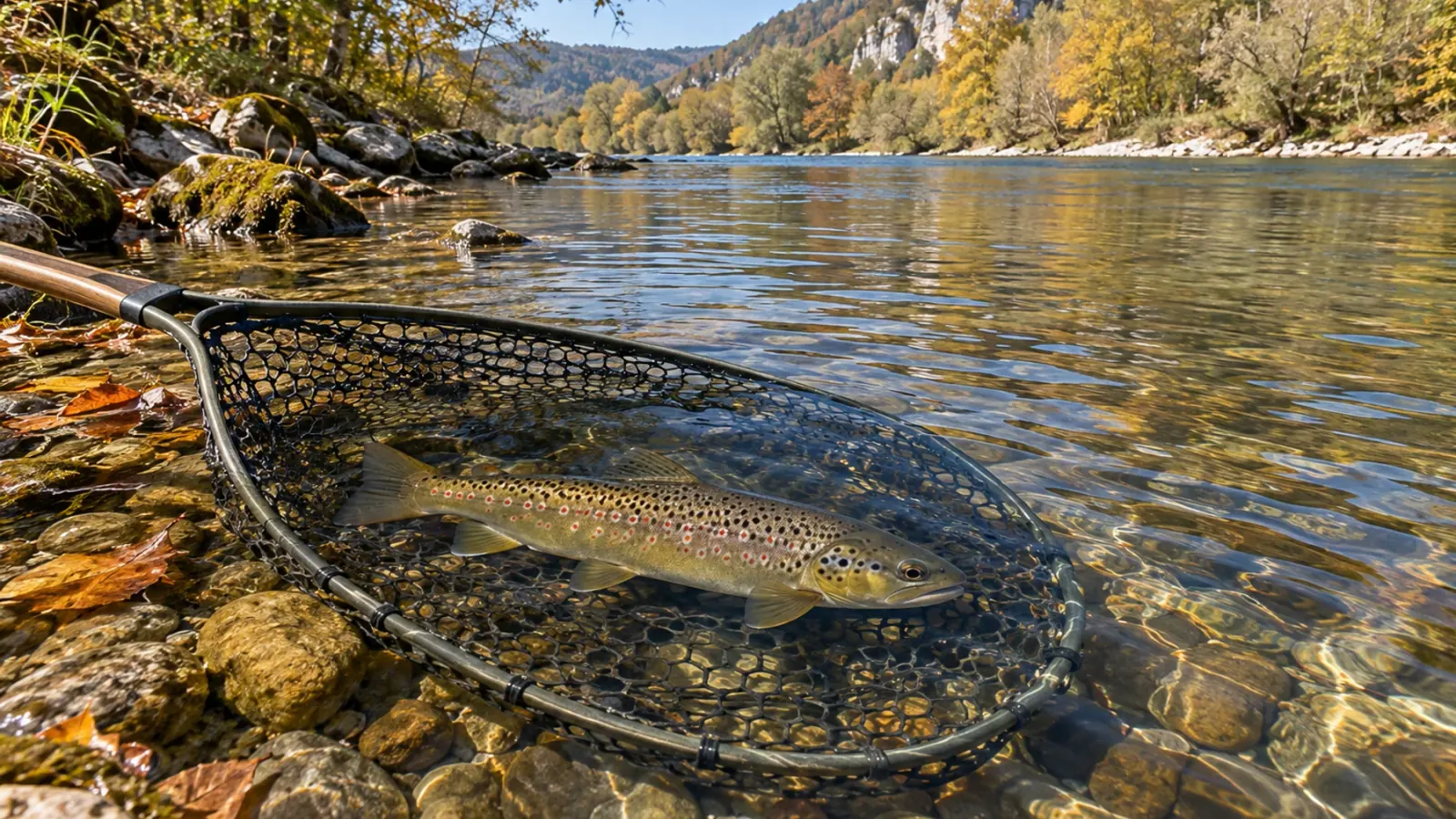
Catch and release: reduce unnecessary air exposure
Unhooking, measuring and photographing a fish can create repeated air exposures after capture. Planning the sequence helps reduce those burdens; neither a fixed time allowance nor swimming away can guarantee later survival.


- Content type
- Practical guide
- Sector
- Environment
- Animal group
- Fish
Plan the release before a fish is caught
A fish swimming away has not necessarily escaped the effects of capture. Exercise, hooking, handling and time out of water can have consequences after release. For recreational fishery managers and angling instructors, the useful task is to prepare an efficient, appropriate sequence. There is no universal number of seconds that guarantees survival.
Brownscombe and colleagues’ review, available online in 2016 and published in the 2017 volume of Fisheries Research, examines tools and tactics for catch-and-release angling. It connects injuries, stress and environmental conditions while recognising differences among species and settings. The review supports prevention; it is neither a universal mortality calculator nor a new investigation of French rivers.
Reduce unnecessary air exposure
Fish gills provide respiratory exchange in water. Removing a fish from that environment adds a challenge to those already imposed by capture, particularly after substantial exertion. The authors recommend reducing air exposure by keeping fish submerged wherever possible during the stages preceding release. This principle should influence how the entire landing and handling sequence is organised.
Separate brief lifts can accumulate. Removing a fish to unhook it, lifting it again for weighing and repeating the process for a photograph creates several handling events. Preparing tools and deciding which measurements are essential can remove unnecessary stages before an impaired fish is already being held. Efficiency comes from preparation rather than rushing an unplanned procedure.
Thermal conditions need consideration alongside the animal’s state. Water temperature, conditions in the air and species characteristics affect the constraints of handling. Cool weather does not make prolonged air exposure harmless. A duration used in a particular experiment cannot establish a safe allowance for every capture, and the practical objective remains to avoid unnecessary time out of water.
Use equipment that allows work while the fish is submerged
A sufficiently large landing net can keep a fish in water while unhooking equipment is prepared. It should allow a natural body position without bending the fish and remain suitable for the location. The review discusses rubberised and knotless materials for limiting contact damage. That advice does not make any net entirely free of effects on the animal.
Handling and equipment can disturb mucus and the skin surface. Minimise contact, avoid abrasive supports and plan safe access to the water. Site selection protects people as well as fish: an unstable bank or hazardous current is not justified by an intention to release quickly. An alternative landing point may be necessary before angling begins.
Retrieval equipment should suit the size and abilities of fish likely to be encountered. Undersized tackle can prolong the fight, including when a non-target species is hooked. Appropriate preparation cannot eliminate all risk, but it can prevent a foreseeable equipment problem from forcing additional recovery time or improvised handling later in the sequence.
Unhook and record without creating extra procedures
Hook position affects both removal difficulty and injury risk. An accessible superficial hook is different from one embedded deeply in sensitive tissue. The review shows that consequences of removal options depend on context. It does not justify a standard invasive manoeuvre by someone without the necessary skills.
Suitable pliers or other tools should be available before capture. Difficulty should not lead to progressively longer manipulation simply to obtain a hook-free photograph. Instructors need to teach an approach suited to the species and hooking situation, including the limits of what can be attempted without worsening injury. A prepared decision is more useful than an improvised response once the animal is already compromised.
Length can sometimes be measured with the fish submerged. Weighing and photography are not essential to every angling outing. Where a monitoring programme requires data, it should identify the indispensable observations, collection methods and circumstances in which measurement will be abandoned to allow a quicker release. The scientific purpose of recording should be clear enough to distinguish necessary information from optional documentation.
Observe condition without extending restraint
Swimming, balance, ventilation and visible injury provide information about the immediate state of the fish. They may reveal difficulty, but they cannot certify later survival. Brownscombe and colleagues discuss reflex assessment and recovery arrangements while noting limitations in the evidence for some practices. Their discussion should not become a requirement for anglers to perform a sequence of tests on every catch.
Extended restraint to check multiple responses can add the burden that the release process is intended to reduce. Observation and action need to remain proportionate, safe and consistent with local fishing rules. The aim is to recognise a problem and use an appropriate response, rather than repeatedly testing whether the fish is ready.
Delayed mortality limits what can be learned at the bank. A fish moving away does not reveal its later feeding performance, vulnerability to predators or condition several days afterwards. Public guidance should therefore describe risk reduction rather than promise that all released fish survive. Immediate departure is an observation, not a complete welfare outcome.
Translate the principles into site-specific instructions
A fishery manager can prepare a short field guide covering ready equipment, submerged handling wherever feasible, minimal contact, priority data and stopping criteria. It should identify the species and environmental setting for which it was written. In France, regulatory and temporary restrictions must be checked with the relevant authorities; international scientific guidance cannot replace those local requirements.
Training is easier to apply when the landing sequence can be demonstrated before fish are caught. Staff can check access to tools, the suitability of the net and how optional measurements will be omitted. That rehearsal makes the intended reduction in handling concrete without adding another procedure to the fish’s capture experience.
The practical conclusion is to remove stages that add exertion, contact or air exposure. Prepare before capture, then adapt to the animal and setting. A universal threshold cannot replace that organisation, and absence of immediate mortality cannot validate a practice on its own.
Develop practical guidance with Vetofish
Vetofish can help tailor instructions to the species involved and distinguish useful observation from avoidable handling. Our training service supports professionals working in the aquatic environment in explaining the limits of catch-and-release and preparing consistent field practices.


