

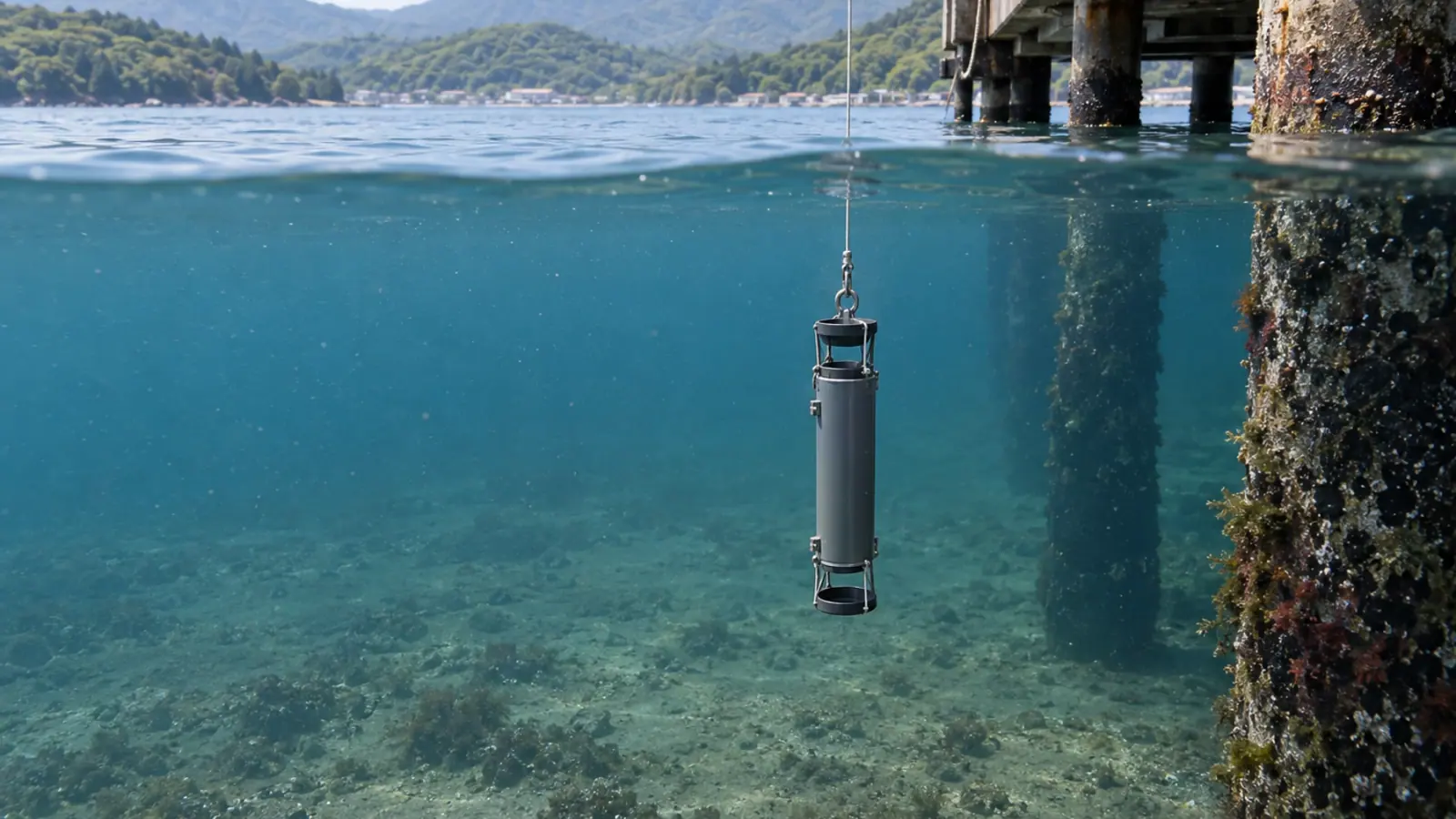
Coastal eDNA: deciding where replication matters
Repeating PCR and collecting another bottle address different uncertainties. A Japanese study published in 2026 shows why replication needs to reflect expected eDNA concentrations and differences across coastal sites and sampling times.


- Content type
- Scientific news
- Sector
- Environment
- Animal group
- Fish
- Keywords
- Environmental DNAPCRSalinity
Three laboratory reactions from one bottle do not replace three independent water samples. That distinction matters when a monitoring budget must cover field visits, bottles, filtration and environmental DNA analysis. Replication at each step addresses a different source of uncertainty.
A study by Jo and Murakami, published in July 2026, examines this allocation in a Japanese bay. Its findings show that the dominant source of variation can also depend on signal concentration. For coastal monitoring, additional analysis should target an identified uncertainty.
A nested design using 468 seawater samples
The authors reanalysed samples collected in June 2015 in Maizuru Bay, Japan, measuring DNA from Japanese jack mackerel, Trachurus japonicus. The species is common in the area. The 2026 publication is a new analysis of older field material, not a field campaign carried out that year.
The design included twelve sites and thirteen sampling times over 73 hours, with three water samples for each site–time combination. This produced 468 samples. Each extract was assessed in three quantitative PCR reactions, giving 1,404 reactions in total. The assay targeted a fragment of the mitochondrial cytochrome b gene.
This structure separated variation between sites and times from variation between bottles collected together and reactions derived from the same extract. Environmental measurements included temperature, salinity, turbidity and pH. The work concerned one target species in a relatively protected bay, rather than all fish or all coastal environments.
The largest source of variation is context-dependent
Across the full dataset, approximately 94% of concentration variance was associated with sites, sampling times and their crossed effects. Repeated water samples and laboratory reactions accounted for the remainder. Where the objective is to describe the distribution of an established signal, this finding highlights the importance of field coverage rather than laboratory repetition alone.
The pattern changed in the low-concentration subset, where the contribution attributed to the PCR level became dominant. When very little target DNA is present, one reaction may amplify it while another does not. Additional technical replication may then help characterise that variability rather than simply repeating the same certainty.
These percentages describe a model fitted to this dataset. They do not establish that 94% of uncertainty always comes from field sampling or that a fixed number of reactions is sufficient elsewhere. Formal limits of detection and quantification were not established for the dataset, so the results cannot supply a universal analytical threshold for monitoring programmes.
Water movement adds another dimension
Ely and colleagues’ 2021 California study illustrates why an environmental signal is not static. The team introduced homogenised grass carp tissue into a coastal site to create a recognisable DNA signal. No live grass carp were released; the introduced material was a tissue homogenate used to trace detection over time.
The signal was detected at neighbouring points nineteen metres on either side of the central point after one and a half hours. It was no longer detected from seven and a half hours onwards in that experiment. Transport, dilution and degradation could all contribute to its disappearance. The result was not a general DNA lifespan or a clock that could date any fish detection.
Repeated surveys of the resident communities also changed across sampling times and samples. Field sampling therefore had to represent moving water as well as laboratory measurement. The two studies are complementary without being interchangeable: one quantified a species-specific signal by PCR, while the other also used metabarcoding to describe communities.
Match replication to the management question
For a rare species or an early introduction, discuss the risk of missing a weak signal, controls and confirmation rules with the laboratory. Negative results need to be interpreted alongside filtered volume, extract quality and assay characteristics. A series of non-detections is not, by itself, proof that the species is absent throughout the study area.
For comparisons between sites where a signal is frequent, spatial coverage, visit times and consistent sampling also deserve attention. More reactions from one bottle do not represent other water masses. Nearby locations are not necessarily equivalent replicates if current, depth or the influence of a discharge differs.
A pilot programme can help estimate these components before the final design is fixed. Keep each bottle and extract identifiable so that field replication remains distinguishable from technical replication. Pooling samples may answer some questions, but it removes information about their individual variability. That trade-off should be explicit rather than hidden in sample handling.
Practical records should also connect the molecular result with its collection conditions. Location, depth, time, filtered volume, storage and departures from the planned method help explain whether two results are genuinely comparable. A more elaborate laboratory analysis cannot recover field information that was never recorded.
Keep uncertainty visible in the report
The studies concern Japanese and Californian coastal waters. They do not directly validate a design for a Mediterranean lagoon, a river or a different animal group. Temperature, hydrodynamics, season, fish behaviour and the analytical method may change how the signal represents the environment.
DNA concentration is not a direct count of fish. A change may reflect animal movement, release of biological material, water circulation or technical steps. Environmental data can help discuss those mechanisms, but an association with a water parameter does not demonstrate that it caused the observed variation. The distinction matters when molecular results will guide a management action.
Repeat the step that answers the uncertainty
The 2026 study supports selecting the level of replication according to the expected signal and monitoring objective. Field and laboratory design belong together, with controls that make both detection and non-detection interpretable. There is no single replication recipe for every coastal survey.
Vetofish’s consultancy and support service can help connect sampling strategy, fish information and analytical capacity for aquatic environmental projects. The aim is a defensible design appropriate to the site, without turning an isolated molecular result into certainty about a population.


