

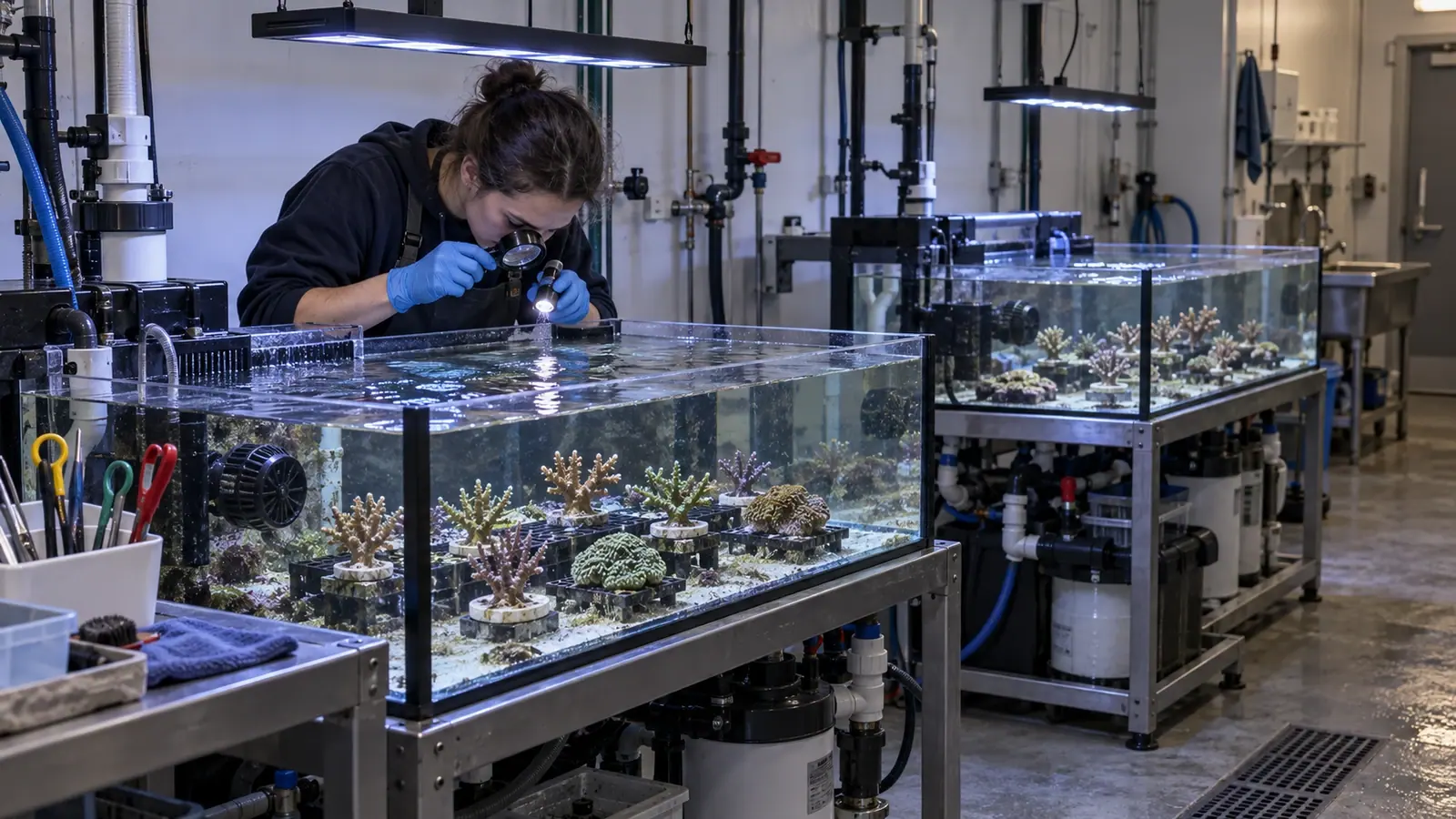
Coral quarantine is a barrier, not just a waiting period
Coral quarantine is more than a dip or a fixed number of days. It combines separated flows, repeated observation, stable water quality and a documented release decision.
- Content type
- Scientific news
- Sector
- Public aquariums
- Animal group
- Corals and invertebrates
A coral fragment can enter an aquarium without an obvious lesion while carrying eggs, flatworms, nudibranchs, copepods or other associated organisms. A single reception inspection is therefore insufficient. Quarantine is an organised period designed to reveal a problem before it reaches a shared system where control becomes substantially harder.
The open review by Cardoso and colleagues describes major pests and parasites of ornamental corals, their life cycles and the limitations of control methods. It recommends repeated inspection under suitable light, removal of visible egg masses, targeted dips and a four-to-six-week quarantine as a practical reference. That interval should not become a universal rule: biology of the suspected organism, stock origin and husbandry conditions remain decisive.
Separate quarantine from the collection in practice
A tank beside the main reef is not isolated when forceps, hoses, gloves or containers move freely between them. Flow organisation is the first barrier. Water must not return to the collection; equipment is dedicated, labelled and stored on the quarantine side; work moves from units with the best-known status towards higher-risk units.
Splashes and wet hands are also transfer routes. Tank spacing, lids, hand hygiene and glove changes should be built into the design rather than added after an incident. Wastewater and removed solids need a defined route compatible with biological and chemical risks.
Traceability starts at arrival: supplier, origin, declared species, date, transport conditions, stock appearance and any abnormalities. Fragments from different sources should not be pooled before their status is sufficiently understood. A mixed quarantine obscures attribution and exposes every item when one problem emerges.
Observe repeatedly and from different angles
Examine corals before and after acclimation and then at planned intervals. White light and, where useful, night observation can reveal organisms that remain hidden during the day. Inspect tissue, base, plug, folds, fragment undersides and structures resembling egg masses.
Standardised photographs help track retraction, tissue loss or colour change without relying on memory. They do not replace examination. Describe any abnormality by location and progression and record associated organisms; whitening or retraction alone does not identify a cause.
Water quality deserves the same attention as in the main collection. A coral stressed by unstable temperature, salinity, light or flow can develop non-specific changes that complicate diagnosis. Quarantine should not be a degraded environment simply because residence is temporary.
Dips do not replace observation time
Reported treatments have variable efficacy and often affect only exposed stages. Adherent eggs may survive a dip that removes adults. Repeating a product without identifying the target can harm coral tissues or microbiota without ensuring eradication.
A dip decision should define its objective, substance, concentration, duration, temperature, aeration and stop criteria. It should include a separate rinse when the protocol requires one. Concentrated products should never be poured directly into a quarantine tank while estimating the final dose.
Mechanical removal of a visible organism or egg mass can help, but follow-up observations must cover the relevant life cycle. A heavily affected fragment may need further separation or exclusion to protect the group. Conservation value, tissue condition, diagnostic confidence and collection risk all inform that decision.
Keep detection and diagnosis distinct
A magnifier or good photograph may support identification of a macroscopic pest. Tissue changes can require cytology, microbiology, molecular testing or histology. Sampling should preserve the transition between healthy and affected tissue and be planned before treatments reduce diagnostic value.
Finding an organism on a coral does not always prove causation. Likewise, several quiet days do not demonstrate freedom from pests. Confidence depends on repeated examinations, observation quality, test sensitivity and knowledge of the organism’s cycle.
A release record should summarise observations, interventions, results and deviations. It identifies who authorises transfer and which criteria were met. An uncertain group may require a longer period or continued separation; space pressure alone should not dictate release.
The record should also distinguish preventive action from treatment. A routine observation, a targeted diagnostic sample and a therapeutic dip do not carry the same meaning. Dates, products, concentrations, contact times and animal responses allow later teams to understand what was done and avoid repeating an unsuccessful or poorly tolerated intervention. If an organism is photographed or retained for identification, link that evidence to the same arrival record.
Match duration to risk
The four-to-six-week reference proposed in the 2026 review is useful for organising practice, but it cannot cover every coral or hazard. Adjust duration to origin, history, resistant life stages, temperature-dependent development, available tests and the coral’s tolerance of quarantine conditions.
Effective quarantine combines four coherent elements: physical separation, stable husbandry, repeated inspection and a documented release decision. Dips and diagnostics are added according to risk; they cannot compensate for shared water or equipment.
At facility level, this barrier complements the wider approach to animal health and biosecurity in public aquariums that protects both individual animals and the collection.
Teams should rehearse what happens after a suspected pest is found. The response may include stopping transfers, separating exposed fragments, preserving diagnostic material, reviewing equipment movements and increasing observation frequency. Predefined responsibilities prevent hurried actions that spread water between tanks or destroy the evidence needed for identification.
Vetofish can help public aquariums map flows, define observation schedules, plan diagnostic sampling and formalise collection-entry criteria. The objective is to reduce risk without turning every new coral arrival into a routine treatment or overinterpreting a visual change.
To move from evidence to action, explore our health expertise and biosecurity service .


