

Hydroelectric dams: assess fish injury and survival
A fish recovered alive just below a dam does not reveal its complete outcome. A systematic review shows why passage route, injury, delayed follow-up and procedural effects need separate assessment.

- Content type
- Practical guide
- Sector
- Environment
- Animal group
- Fish
Recovery after passage is only one observation
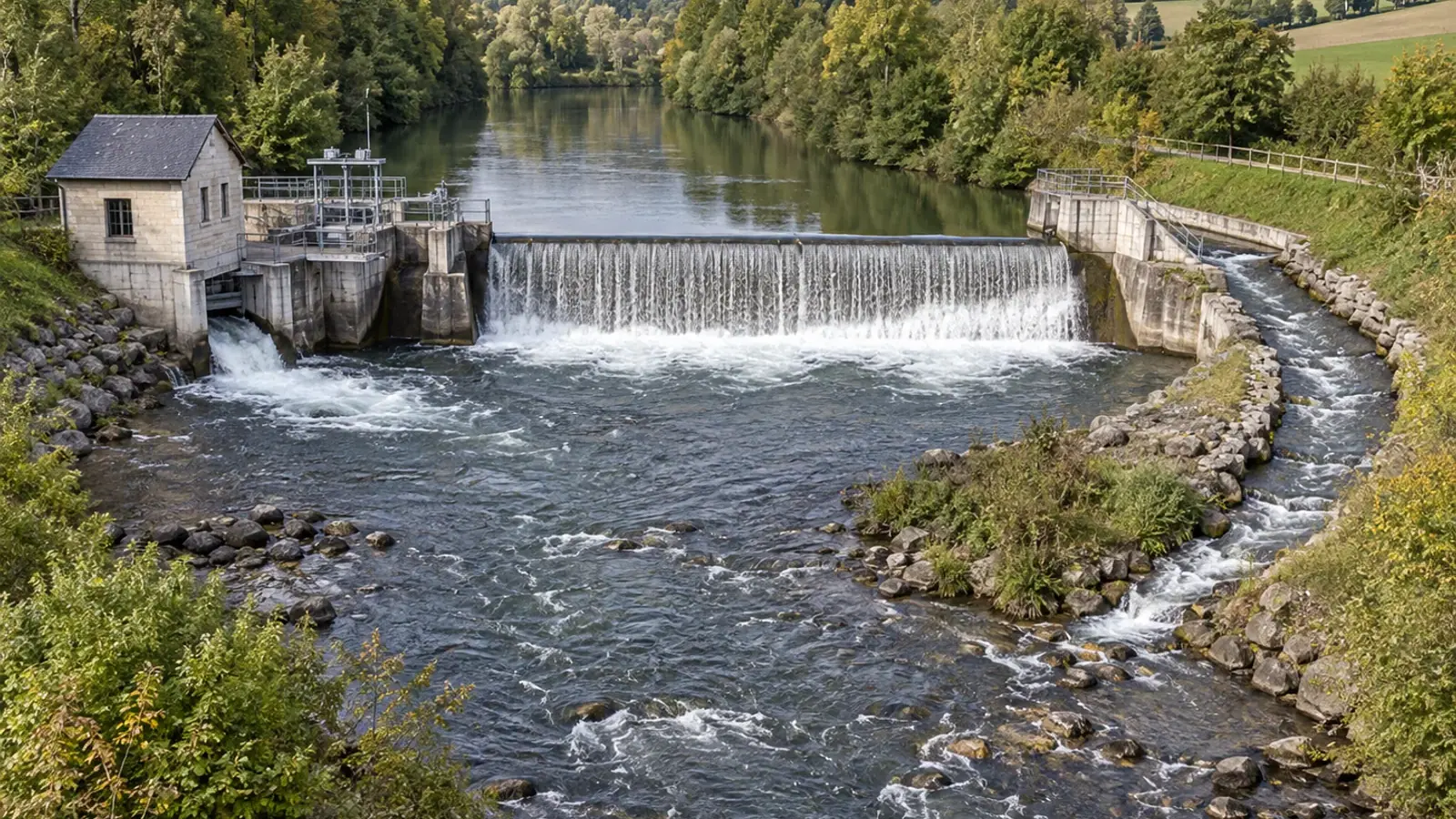
Downstream-moving fish may pass a hydroelectric structure through a turbine, spillway or bypass. Understanding the outcome requires a distinction between the route used, injury and survival after passage. Recovering a live fish immediately downstream does not answer every part of that assessment.
Algera and colleagues published a systematic review in 2020, drawing on 264 studies from 87 articles for the narrative synthesis. The review examines comparisons between passage-exposed fish and controls at hydroelectric dams in temperate regions. It does not provide a mortality percentage that can be assigned to any individual European structure.
The evidence base is strongly concentrated: 93% of studies were from the United States and 86% involved salmonids. Other species, life stages and hydraulic settings are less well represented. Those proportions matter when the review is used to design monitoring elsewhere. A local question should retain its own species and operating conditions rather than assume the literature describes them directly.
Define what the fish encountered
Discharge, operating conditions and the route actually taken define the exposure. Comparisons between monitoring campaigns become difficult if routes or operating regimes changed without being recorded. Turbine type alone does not capture every condition experienced by a fish during passage.
A monitoring record should identify species, stage, body size, release location, route under investigation and water conditions. Temperature information, where available, helps describe the context of capture and follow-up. These records do not ensure comparability, but they make differences visible before an apparent change in outcome is attributed to an engineering measure.
Across the review, turbine and spillway passage were associated with greater injury and immediate mortality than control conditions. Bypass routes had a more favourable injury profile in the comparisons examined. This is not evidence that every bypass is harmless. Nor does it create a universal ranking of equipment that can replace assessment of the structure, route and fish concerned.
Several mechanisms can leave different injuries
Collision, abrasion, shear, turbulence and changes in pressure are different exposures. External inspection may not distinguish them and may miss internal injury. Describe the findings before assigning a certain mechanism. A visible lesion can contribute to an investigation without proving exactly where or how it occurred.
Swim-bladder anatomy illustrates why species matters. In fish with this organ, a rapid pressure reduction can cause gas expansion and contribute to barotrauma. The response depends on species and exposure conditions. Fish cannot all be treated as if they possessed the same bladder structure or ability to adjust its gas content.
Information on the fish and its exposure history therefore belongs beside the description of the infrastructure. A salmonid study does not automatically quantify risk for eels or cyprinids. Selection of a study species and life stage needs a biological justification, even when availability and logistical constraints influence the final protocol.
State the observation period explicitly
Mortality needs a defined time period and population. In the review’s classification, immediate outcomes used recovery within an hour, while delayed outcomes included later or more distant observations. These categories organise the studies; they are not a universal clinical boundary between immediate and delayed effects.
Some injury assessments made after 24–48 hours identified more injury than early observations. This supports asking what a brief monitoring window leaves unobserved. It does not establish one holding period suitable for every species, protocol or management question. Follow-up conditions themselves also need to be documented.
Delayed-outcome evidence was heterogeneous. Capture, handling, holding, tagging and detection capability can affect what is observed. A fish that is not detected is not necessarily dead: tag loss and movement beyond the monitored area create different uncertainties. The report should explain how these outcomes are classified rather than silently count all missing individuals as mortalities.
Controls help assess the monitoring procedure
Fish in a passage study may be caught, transported, tagged or held before examination. Those steps introduce exposures beyond the dam. An appropriately comparable control group can help assess their contribution, provided its own treatment is described. A handled group and an unhandled wild population do not answer exactly the same causal question.
The sampling plan needs to define fish released, fish recovered, missing information and independent units. Repeated examinations of one fish do not create additional exposed animals. Repeated observations can reveal change, but their relationship to the individual and monitoring campaign must remain intact during analysis.
Telemetry can document movement or subsequent fate according to the technology and receiver layout. Detection limits and potential tagging effects need to be considered. Recapture, observation and telemetry have different strengths; choosing one should follow the local question. None eliminates procedural bias merely by providing a more detailed record.
Separate passage outcomes from population benefit
The review shows that passage route and assessment method influence reported outcomes. It also identifies insufficient evidence for directly connecting these findings with population productivity. A reduction in measured passage risk does not, on its own, establish a quantified demographic improvement across the catchment.
For a manager, the useful requirement is a protocol capable of distinguishing exposure, injury and survival, with controls and uncertainty described. The report can then identify demonstrated findings, plausible explanations and missing evidence needed to compare management options. A proportion without a denominator, observation period or operating context cannot provide that basis.
This approach also makes later comparison more defensible. If equipment or operating rules change, retain the variables needed to judge whether fish encountered a comparable situation. An apparent improvement may be valuable, but its interpretation depends on the populations, conditions and procedures that generated the observations.
Develop the assessment with Vetofish
Vetofish can contribute to injury examination, selection of observations and veterinary interpretation of monitoring findings. Our advice and support assists aquatic environmental projects in separating structure-related effects, procedural effects and limits of inference, with monitoring proportionate to the question.


