

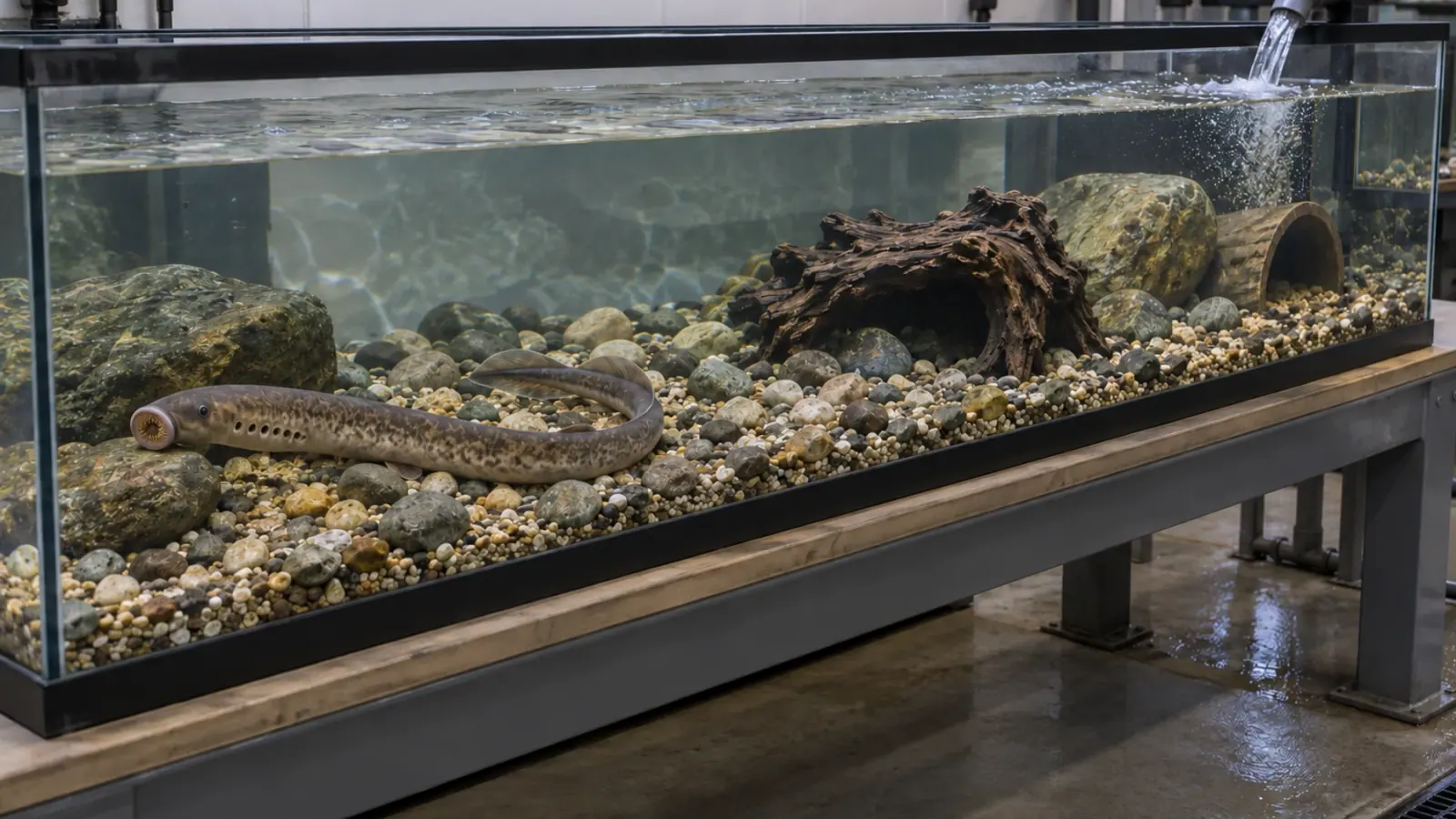
Lamprey: tissue identity changes genome interpretation
Sea lamprey retains germline sequences that somatic cells eliminate during development. Its 2018 germline assembly explains why genomic interpretation must retain tissue identity, developmental stage and reference version.


- Content type
- Practical guide
- Sector
- Research facilities
- Animal group
- Fish
- Keywords
- ReproductionPCRImmunity
In sea lamprey, the tissue used to obtain DNA changes part of the genetic information available for analysis. Germline cells retain sequences that somatic cells eliminate during development. This feature challenges the assumption that an arbitrary tissue sample always represents an animal’s complete inherited genetic complement.
The germline genome assembly published by Smith and colleagues in Nature Genetics in 2018 provides a reference for understanding this biology in Petromyzon marinus. Its relevance extends beyond describing an unusual fish. It requires genomic interpretation to retain the tissue, developmental stage and reference actually used. It does not supply a sampling procedure that a research facility can apply without assessment.
Different genetic complements within one animal
A genome comprises the genetic material under consideration. In animals, nuclear DNA is organised into chromosomes and should be distinguished from mitochondrial DNA. Here, the major difference concerns nuclear sequences retained in the germline but removed from the genetic complement of somatic cells during early development.
Physical DNA presence differs from gene expression. A gene may remain in a cell without being actively transcribed. Programmed genome rearrangement in lamprey goes beyond simply silencing a gene: particular sequences are physically eliminated from the somatic genome. The distinction matters whenever absence of a molecular signal is interpreted as evidence about the organism’s biology.
The study describes elimination of approximately 0.5 billion bases from an estimated 2.3-billion-base germline genome. These orders of magnitude characterise the biological phenomenon; they do not imply a random, different loss in every cell. The authors describe a reproducible distinction between sequences retained in germline and somatic lineages.
Why a germline reference was needed
Early sequencing efforts concentrated on readily available somatic tissues, including blood and liver. A reference derived from those tissues could not adequately represent sequences already eliminated from them. Their absence from an assembly therefore could not simply be treated as evidence that the species lacked them altogether.
Smith and colleagues combined several sequencing and mapping data types to construct a more continuous germline assembly. A chromosome is an organised DNA–protein structure; a computational assembly seeks to reconstruct a representation of that organisation from data. It is not a direct, complete photograph of the chromosomes or a definitive inventory of every individual’s variation.
The authors also compared sequence organisation across vertebrates and incorporated genetic linkage information. Agreement between complementary data sources supports the reconstruction. It does not remove every uncertainty. The lamprey genome contains extensive repetitive sequence, creating difficulties for both assembly and identification of some genes. Those technical limits remain relevant when a later analysis uses the resource.
Eliminated genes do not settle every functional question
The assembly enabled identification of several hundred genes eliminated from somatic cells. Comparative analyses linked some mouse homologues to regulatory features involving Polycomb repressive complexes in embryonic stem cells. This suggests overlap in aspects of regulatory logic, while leaving important mechanistic questions open.
It does not establish that mice physically eliminate the same sequences or that every implicated gene has an identical function in the two species. Homology supports evolutionary and functional questions, rather than automatic transfer of an entire mechanism. The study acknowledges incomplete understanding of the mechanisms and consequences of programmed genome rearrangement.
Interpretation should therefore distinguish a gene, its copies, expression and function. PCR on DNA may fail to detect a physically absent sequence, but methodological or reference-related limitations can also explain a negative result. An absent expression signal raises a different question: the sequence may be present but transcribed little or not at all. These alternatives require different evidence and should not be collapsed into a single biological conclusion.
Retain tissue identity and reference versions
Research teams should start with the documentation. Records should preserve species, tissue origin, developmental stage, preparation and the version of the assembly or annotation. A file labelled only “lamprey genome” does not establish whether its reference represents the germline or somatic compartment, or which changes were incorporated into it.
Assembly and annotation also serve different purposes. Assembly organises sequences; annotation assigns features, including gene models, to that representation. An annotation update can alter a gene’s name or predicted boundaries without any change in the sampled animal. Comparisons need this reference history if apparent differences are to be interpreted correctly.
This requirement does not imply collecting additional samples by default. Checking existing records may prevent an unnecessary procedure or correct the interpretation of data already generated. Any further sampling belongs to the scientific project and its assessment, with suitable expertise and animal-care arrangements. Better documentation can be useful before a decision to obtain more material is made.
A comparative model with its own evolutionary history
Sea lamprey offers a perspective on vertebrate evolution and distinctive biological mechanisms. It is not an unchanged representation of an ancestor or a universal replacement for zebrafish. Its lineage has its own evolutionary changes, and its biology determines the questions for which it provides an informative comparison. Its adaptive immune receptors are evolutionarily distinct from those of jawed vertebrates, providing another reason to preserve that comparative context.
The 2018 assembly is a foundational resource rather than a guarantee that every annotation is final. References and data continue to develop. New analyses should state their versions and relevant limits, rather than assume that a species name identifies one timeless reference. The model’s value lies in the comparative question being addressed, not simply in its ancient lineage or unusual appearance.
Conclusion and Vetofish support
For Petromyzon marinus, specifying tissue and genomic reference protects interpretation as much as the measurement itself. Our training programmes can help research-facility teams connect model biology, sample traceability and critical reading of results. This preparation complements specialist genomic expertise and project assessment; it does not replace either.


