

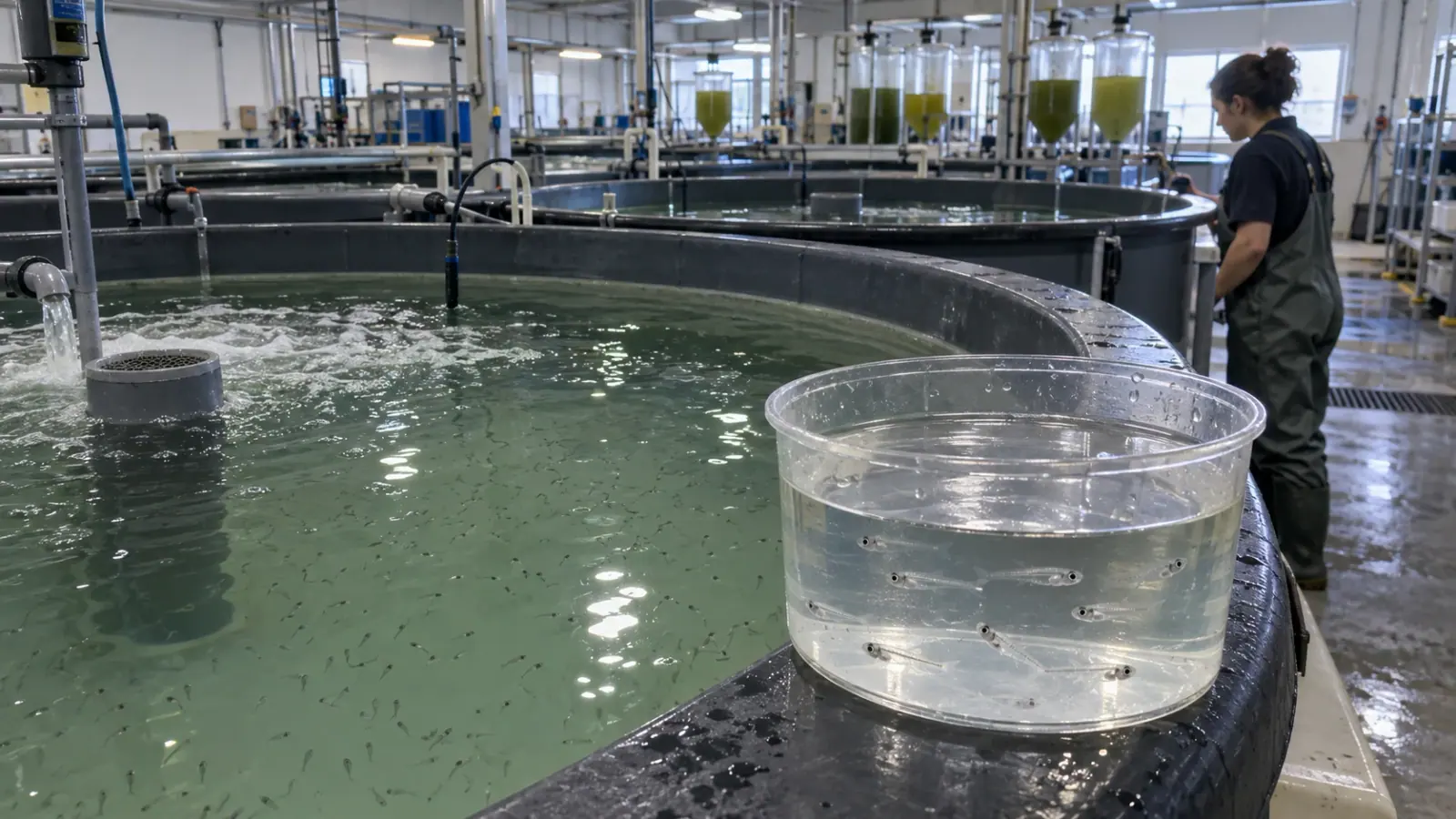
Larval mortality: investigate the whole hatchery
The speed of a larval mortality event should not force an early choice between water, nutrition and infection: the entire hatchery is the unit of investigation.
- Content type
- Practical guide
- Sector
- Aquaculture
- Animal group
- Fish
A sudden mortality event in fish larvae is rarely explained by a snapshot taken when losses become obvious. Larvae have limited reserves, their physiology changes rapidly, and they share water with eggs, microalgae, rotifers or Artemia. A drift beginning in a reservoir, live-feed culture or supply line may therefore reach several tanks before staff recognise the signal.
An open 2025 study of gilthead seabream larvae illustrates this systems approach. The investigators did not examine diseased larvae alone. They sampled source water, eggs, algae, rotifers, Artemia and several feeding conditions. Vibrio alginolyticus was recovered from multiple compartments. This finding does not make every Vibrio detection a diagnosis, but it shows why the hatchery, rather than the affected tank, should define the investigation.
Reconstruct the timeline first
The first question is not “which treatment should we use?” but “what changed before losses increased?” For each tank, align hatching time, developmental stage, broodstock and egg batch, stocking density, first feeding, diet transitions, water exchange, cleaning, temperature, salinity, oxygen, pH, nitrogen compounds and staff interventions.
A daily curve separating background losses from a break in trend is more useful than a final cumulative percentage. Spatial patterns matter too. Mortalities concentrated near an inlet, within one loop or after one live-feed batch lead to different hypotheses. Apparently unaffected tanks are valuable comparators; treating or mixing them immediately can destroy evidence.
Staff should also record the denominator used for mortality. Counts based on stocked eggs, hatched larvae or estimated live larvae answer different questions. When exact counting is impossible, the estimation method must remain consistent so that an apparent rise is not created by a change in sampling.
Record the biological stage precisely. Yolk absorption, swim-bladder inflation, a diet transition and metamorphosis do not create the same vulnerabilities. Calendar age alone is insufficient when temperature alters developmental speed.
Read water quality as a trajectory
A measurement taken after mortality may describe a consequence rather than a cause. Dead larvae and organic material consume oxygen, increase microbial load and affect nitrogen cycling. Preserve sensor histories, check calibration and compare source water, tank water and loop return.
Averages hide short events. A night-time aeration failure, abrupt temperature change or intermittent flow restriction may have disappeared before the morning round. Where equipment permits, retain minima, maxima and rates of change. Turbidity, suspended solids and filter condition add context to the usual parameters.
A value labelled acceptable in a general handbook is not proof that it suits this species, stage and installation. The strongest first comparator is a healthy historical batch run under the same protocol.
Trace live feeds and their culture systems
Microalgae, rotifers and Artemia deliver nutrients, but they also deliver culture water, microbial communities and the consequences of their own husbandry. The investigation should identify every strain, vessel, enrichment, rinse and distribution point. A new supplier, a restarted culture or extended storage may be more informative than a single result from the larval tank.
The seabream study combined clinical examination, bacteriology, molecular methods and histopathology across several hatchery components. That combination matters. Culture shows that a viable organism was isolated, PCR detects a target, and compatible lesions more directly connect an agent with damage. None replaces the others.
A New Caledonian study of blue-shrimp larvae also found that water microbial communities varied with larval stage and survival. Some taxa were associated with favourable or unfavourable outcomes, but antibiotic exposure and mortality effects could not be fully separated. Those limitations prevent direct transfer of its biomarkers to fish larvae and rule out using an association alone to justify antimicrobials.
Sample before the event becomes blurred
Write the incident plan before an outbreak. It should identify who samples, which containers are used, how many larvae are pooled, how water, live feeds and tissues are stored, and which laboratory is contacted. Freshly collected moribund larvae are usually more informative than autolysed animals retrieved from the tank bottom.
Collect representative material from tanks affected early, affected later and not yet affected. Depending on the case, include untreated and treated source water, biofilm, live feeds, eggs and broodstock samples. Handling must prevent cross-contamination while preserving options for histology, bacteriology and molecular testing.
Stabilise the system without erasing evidence
Immediate measures should first restore the environment: secure flow and aeration, remove mortalities carefully, segregate equipment and stop transfers between loops. Empirical treatment can alter cultures, select resistance and reduce diagnostic yield. It should be decided with the veterinarian in light of the hazard, species, life stage and available results.
After the event, connect each probable cause to a failed barrier: parameter monitoring, live-feed separation, rinsing, cleaning, batch traceability, emergency stocks or alert thresholds that trigger a health investigation. Success is not only a short-term fall in losses. It is the ability to reproduce a healthy cycle without merely suppressing the visible outcome.
Vetofish can help hatcheries design a differential-diagnosis tree, sampling plan and escalation thresholds, then interpret timeline, water quality, pathology and microbiology together. Preserving evidence early turns an unexplained mortality into a preventive action that can be tested.
To move from evidence to action, explore our testing and diagnostic service and our expertise in aquaculture.


